SaaS SEO Security Strategies for Protecting Your Application

What if the next SEO attack on your SaaS app comes not from a competitor, but from a cybercriminal exploiting your search visibility? SaaS SEO security is no longer just a technical nice-to-have-it’s now a business-critical defense. As SaaS platforms dominate the cloud landscape, attackers are evolving. They’re not just after your infrastructure or user data. Increasingly, they’re targeting the very SEO signals that drive your growth and reputation.
Let’s define the ground. SaaS SEO refers to the strategies and processes that boost a SaaS application’s visibility in search results-organic rankings, technical crawlability, schema, backlinks, and content optimization all count. But in the SaaS world, SEO security means protecting these assets from manipulation, abuse, and attack. This includes defending against tactics like malicious link injection, content scraping, automated spam, or even poisoning AI-generated content-threats that can quietly undermine both your search presence and user trust.
Why does this matter now? The stakes have never been higher. Security researchers predict a sharp rise in targeted SaaS SEO attacks through 2026 as AI-powered threats become mainstream. High-profile breaches are already making headlines: attackers hijack help centers for negative SEO, inject toxic links via public forms, or exploit misconfigured APIs to manipulate site structure at scale. According to the Cloud Security Alliance, threats from generative AI and automated bots are rapidly outpacing traditional manual attacks (source). Meanwhile, TrustCloud highlights new risks unique to SaaS-from permission creep to overlooked subdomain takeovers-that can quietly sabotage both security posture and search rankings (source).
This article breaks down the intersection of modern SEO and cybersecurity for SaaS operators and technical marketers. You’ll learn why old-school “set it and forget it” won’t cut it-and how to spot vulnerabilities before they wreck your brand or drain your organic traffic. We’ll explore real-world threats you can’t ignore and actionable strategies you can deploy today. Ready to see where your stack stands? Let’s dive into the new rules of SaaS SEO security-before an attacker does it for you.
Evaluation Criteria for SaaS SEO Security Solutions
Key comparison factors

Choosing the right SaaS SEO security solution means weighing several technical levers. Each factor answers a different risk. Access controls decide who gets into your system and what they see-think of it like keycards at an office. If access isn’t tight, one weak password could invite disaster.
Security compliance keeps your business aligned with regulations like SOC 2 or GDPR. For example, B2B SaaS platforms handling healthcare data need HIPAA-grade controls or risk major fines.
AI capabilities are now essential. With AI, you can spot threats faster and patch holes before attackers find them-AI-driven tools scan for unusual traffic patterns or risky admin behavior in real time.
Integration matters too. Your tool must play nicely with CI/CD pipelines, identity providers, and analytics stacks. For example, a platform that won’t sync with Okta will slow down onboarding and frustrate DevOps teams.
Cost is always part of the equation. Some solutions charge per user, others by crawl volume or feature tier-teams need to model these costs against their growth plans.
Lastly, scalability determines if your setup survives as traffic spikes or teams expand across regions. A solution fit for a startup might struggle when supporting thousands of users in new markets.
Why criteria selection matters
Picking criteria isn’t just box-ticking-it’s about matching defenses to real-world risks. For example: A fintech SaaS startup faces strict audits; so compliance tools are non-negotiable (see this guide to mitigating risks). A data-heavy marketing app processing millions of keywords needs robust AI detection and elastic scaling.
The right evaluation framework helps teams avoid mismatched investments-or worse, gaping vulnerabilities hidden behind “feature checklists.” In short: clear criteria turn comparisons into reliable decisions that protect both customers and company reputation.
Comparison of Leading SaaS SEO Security Approaches
Overview of Each Approach
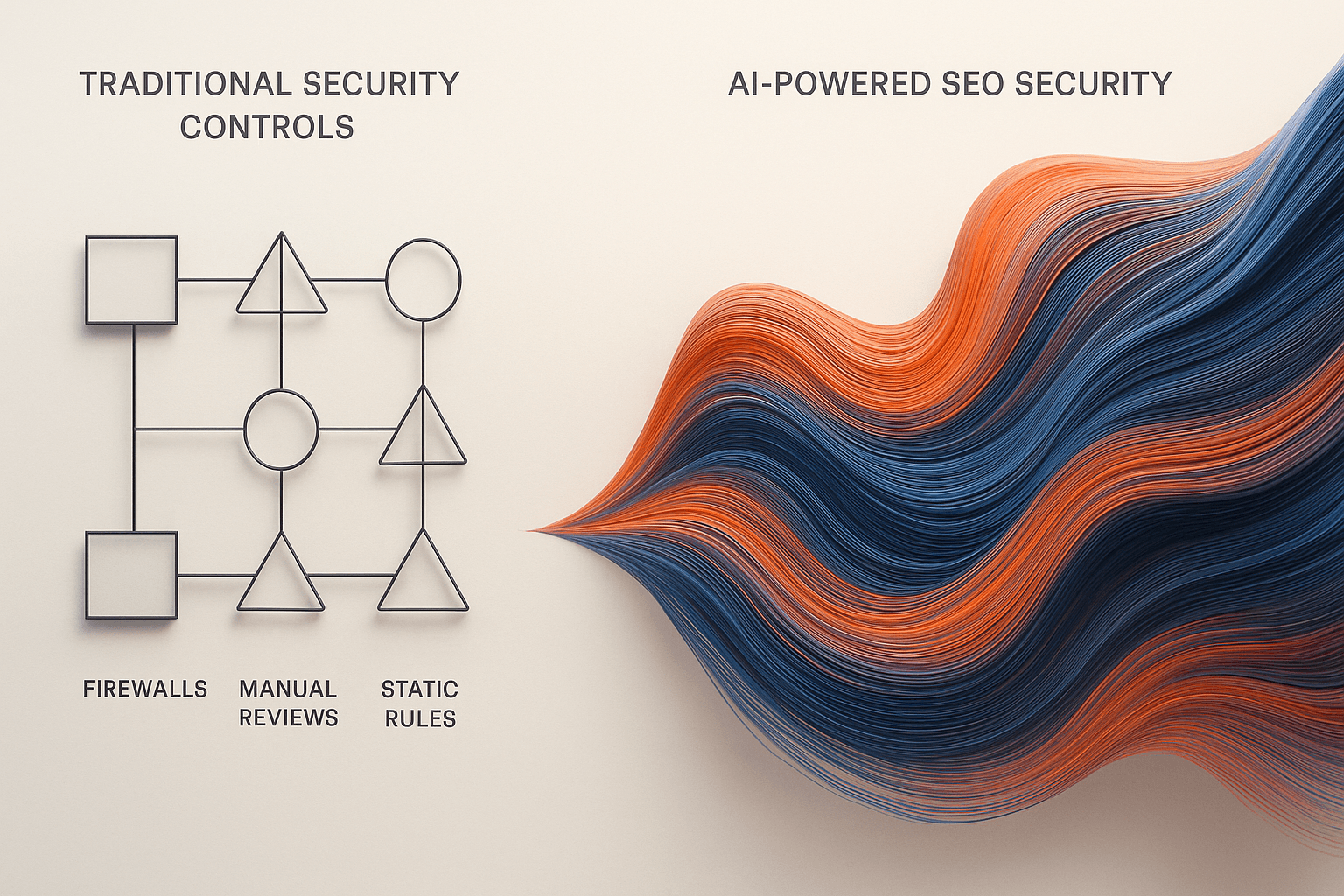
SaaS operators face a key decision: rely on traditional security controls or adopt AI-powered SEO security. Both approaches aim to protect SaaS applications from evolving threats. Their methods, however, differ sharply.
Traditional controls use established practices-think firewalls, manual reviews, and static rules-to secure SaaS infrastructure. For example, a technical marketer might set up IP restrictions and schedule regular code audits. These tactics follow a clear guide to designing compliant and secure SaaS environments.
AI-powered SEO security takes a different route. It leverages machine learning to spot patterns, flag anomalies in real time, and adapt quickly to new attack types. For instance, an AI tool might detect abnormal spikes in bot traffic targeting your sitemap within minutes-not hours or days.
Key Features and Specs

Traditional Security Controls
- Manual configuration of access policies
- Scheduled vulnerability scans
- Static monitoring dashboards
- Role-based permissions set by admins
- Customizable audit logs for compliance tracking
AI-Powered SEO Security
- Automated anomaly detection using ML models
- Real-time alerting for suspicious indexation changes
- Continuous risk scoring based on user behavior analytics
- Self-updating rulesets as new threats emerge (source)
- Integration with large data sources for pattern analysis
For example, where traditional tools require you to define every rule up front, AI solutions can learn from previous incidents. It’s like teaching a spam filter what “bad” looks like-except here the stakes are your entire search presence.
Strengths and Weaknesses
Traditional Security Controls
Strengths:
- Predictable operations; easy to audit for compliance.
- Low false positives; changes only occur when triggered by humans.
Weaknesses: - Slow response to novel attacks.
- Heavy reliance on manual oversight.
For example: If someone exploits an unknown API endpoint affecting robots.txt files, detection may lag until next scheduled review.
AI-Powered SEO Security
Strengths:
- Rapid identification of unusual activity (source).
- Scales easily across multiple domains or properties.
Weaknesses: - Initial setup requires high-quality training data.
- Possible increase in false positives if not tuned carefully.
A common misconception is that AI runs “hands-free.” In reality, ongoing tuning is needed-just as you’d calibrate network intrusion systems over time.
Best Fit Scenarios
Traditional Security Controls: Best suited for organizations with strict regulatory requirements needing predictable workflows. For example, financial SaaS platforms often favor these controls due to the need for detailed audit trails and change management protocols.
AI-Powered SEO Security: Fits companies managing many dynamic assets or facing fast-evolving attack surfaces-for instance, global SaaS providers rolling out weekly updates across dozens of regions. Here the ability to spot zero-day threats without human delay is crucial (see more).
In summary: Traditional controls offer stability but can miss emerging risks. AI-powered approaches adapt faster but need careful oversight at launch. The best choice depends on your team’s resources and your threat model-secure SaaS requires both structure and agility today.
Common Pain Points and Mitigation Strategies in SaaS SEO Security
Typical challenges for SaaS operators
SaaS teams often wrestle with three core SEO security pain points: misconfigured access controls, compliance gaps, and AI false positives.
Misconfigured access controls can punch holes in your SEO foundation. For example, a dev team might accidentally expose staging environments to search engines. This leaks sensitive data and lets Google index content you never meant to share.
Compliance gaps are another headache. As regulations tighten, SaaS operators need airtight proof of security compliance across all their digital assets. If even one subdomain slips through the cracks, it can mean costly audits or penalties.
AI false positives add a modern twist. Automated threat detection tools sometimes flag legitimate bots-think Googlebot-as hostile traffic. Suddenly, your site’s visibility tanks because AI-driven rules block crawlers that actually help your rankings.
Each of these issues creates real business risk. They’re not just technical annoyances-they impact revenue and reputation.
Actionable solutions and best practices
Start with access controls. Establish role-based permissions for every environment-production, staging, test. Use automated configuration management tools to catch mistakes before they go live. According to this TrustCloud guide, regular audits of cloud configurations cut exposure dramatically.
For compliance gaps, don’t rely on static checklists or manual reviews. Use continuous monitoring platforms that alert you when new assets appear or settings drift from secure baselines. This is like putting a “tripwire” on every door in your digital house-if something opens unexpectedly, you know about it instantly.
Dealing with AI false positives takes finesse rather than brute force. Train your systems using real-world examples of good bots versus bad actors. Review flagged events weekly instead of blindly trusting automation out-of-the-box-a principle echoed by the Cloud Security Alliance’s take on mitigating GenAI risks.
Finally, focus on cross-functional collaboration between developers and security leads so that fixes happen fast-and stick around after deployment.
In summary: automate what you can but keep humans in the loop for high-stakes calls. The best SaaS operators treat SEO security like a shared responsibility-not an afterthought or side project.
Conclusion

Choosing the right SaaS SEO security approach depends on your company’s context and risk profile. Startups benefit from AI-driven tools that offer fast deployment, automation, and cost control. Enterprises with complex stacks should pair advanced AI with robust policy engines to manage scale and granular access. Highly regulated industries require solutions that prioritize compliance frameworks and audit trails over pure automation.
It’s critical to distinguish between CASB-focused on data flow between users, cloud services, and endpoints-and dedicated SaaS SEO security platforms designed to protect search visibility, web assets, and API exposure. The former guards general cloud usage; the latter addresses threats unique to organic growth channels.
For technical leaders, the main decision pivots are: depth of integration required, tolerance for machine learning errors versus manual review overhead, regulatory mandates in your sector, total cost of ownership (including hidden operational complexity), and support for future growth. There is no universal best fit-each solution brings trade-offs shaped by your architecture and goals.
As threat landscapes evolve alongside rapid advances in AI tooling, staying proactive means reviewing controls regularly-not just at purchase but as part of ongoing engineering sprints. Security for SEO in SaaS isn’t a checkbox-it’s continuous engineering discipline that pays off every time you stay visible without being vulnerable.