YOUR CONTENTHAS BLINDSPOTS.
A page can read well and still rank nowhere. Keyword gaps, readability issues, AI-sounding patterns, brand voice drift — you can't catch them by reading. Your agent scores every page across five dimensions and tells you exactly what to fix.
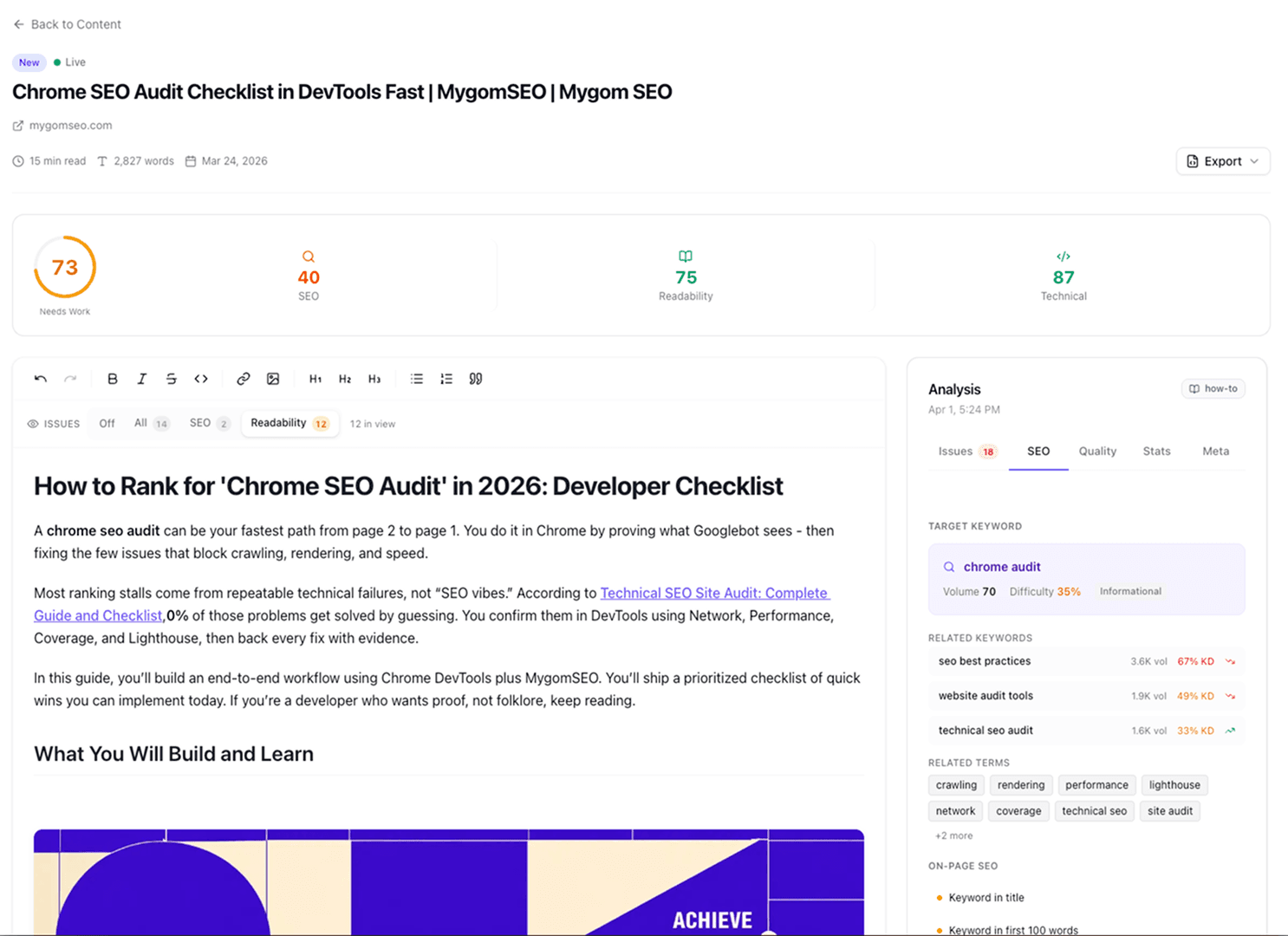
What every page gets scored on.
SEO Optimization
Keyword in title, first paragraph, headings. Keyword density, LSI coverage, internal and external links, image alt text — 10 checks weighted by impact on rankings.
Readability
Grade level, sentence length, passive voice, complex words. Scored against your content type — a tutorial has different standards than a case study.
AI Detection Risk
Sentence variety, specificity, vague language patterns. Know if your content sounds AI-generated before Google does. Scored as Low, Medium, or High risk.
Brand Voice Alignment
Tone match, preferred words, avoid words, audience fit. Your brand profile is checked against every page — so nothing gets published off-voice.
HTML Structure
Heading hierarchy, image alt text quality, link text clarity. Catches missing H1 tags, skipped heading levels, and generic "click here" links that hurt accessibility and SEO.
Prioritized Suggestions
Not just scores — actionable fixes ranked by severity. Blockers that prevent publishing at the top, minor tweaks at the bottom. Each with a specific fix recommendation.
Five scores, one verdict
Most content tools give you a single number. We show you five. SEO, readability, AI detection, brand voice, and HTML structure — each scored 0-100, weighted into an overall quality score. You see exactly which dimension is dragging your content down and where to focus your effort.
- ·Overall score: Excellent (90+), Good (75+), Needs Work (60+), Poor, or Critical
- ·SEO counts for 30%, readability 25%, the rest 15% each
- ·Quality gates block publishing when critical issues exist
- ·Blog type auto-detected: tutorial, how-to, listicle, case study, and more
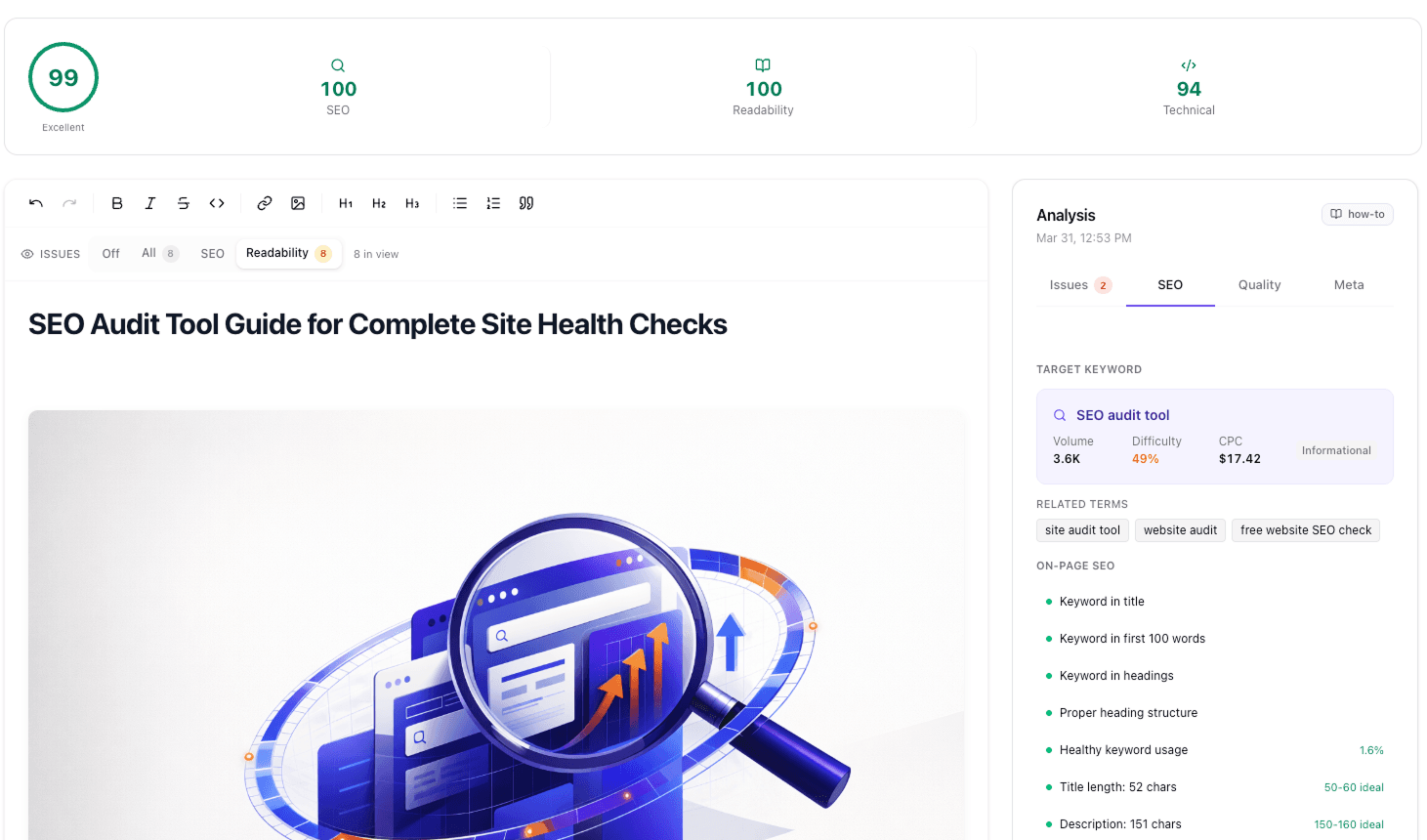
Every SEO signal in one panel
The SEO tab shows your primary keyword placement, density, and semantic coverage at a glance. Below that: title length, meta description, heading structure, internal links, external links, and image alt text — each with a pass/fail indicator and recommended targets.
- ·Primary keyword tracked across title, headings, and first 100 words
- ·LSI keyword coverage shows how well you cover the topic
- ·Link and image counts vs. recommended targets with progress bars
- ·Search volume, difficulty, and intent data for your target keyword
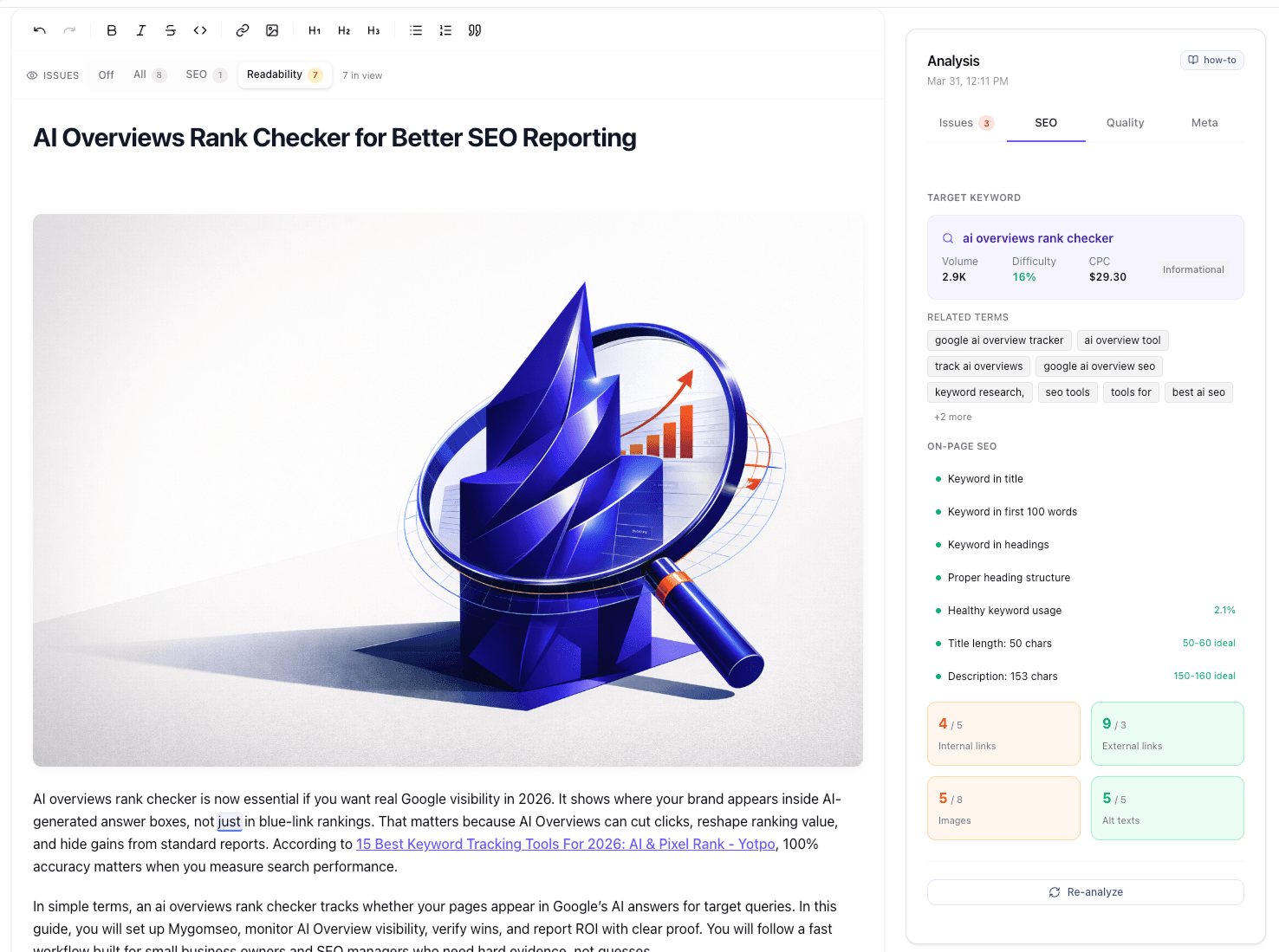
Catch AI patterns before Google does
The readability tab goes beyond grade level. It checks sentence variety, specificity, and vague language patterns that signal AI-generated content. A dedicated AI detection box shows your risk level — Low, Medium, or High — with three sub-scores so you know exactly what to fix.
- ·AI risk scored on sentence variety, specificity, and natural language
- ·52 vague language patterns flagged with specific replacements
- ·Reading grade level calibrated to your content type
- ·Passive voice and complex word percentages with clear targets
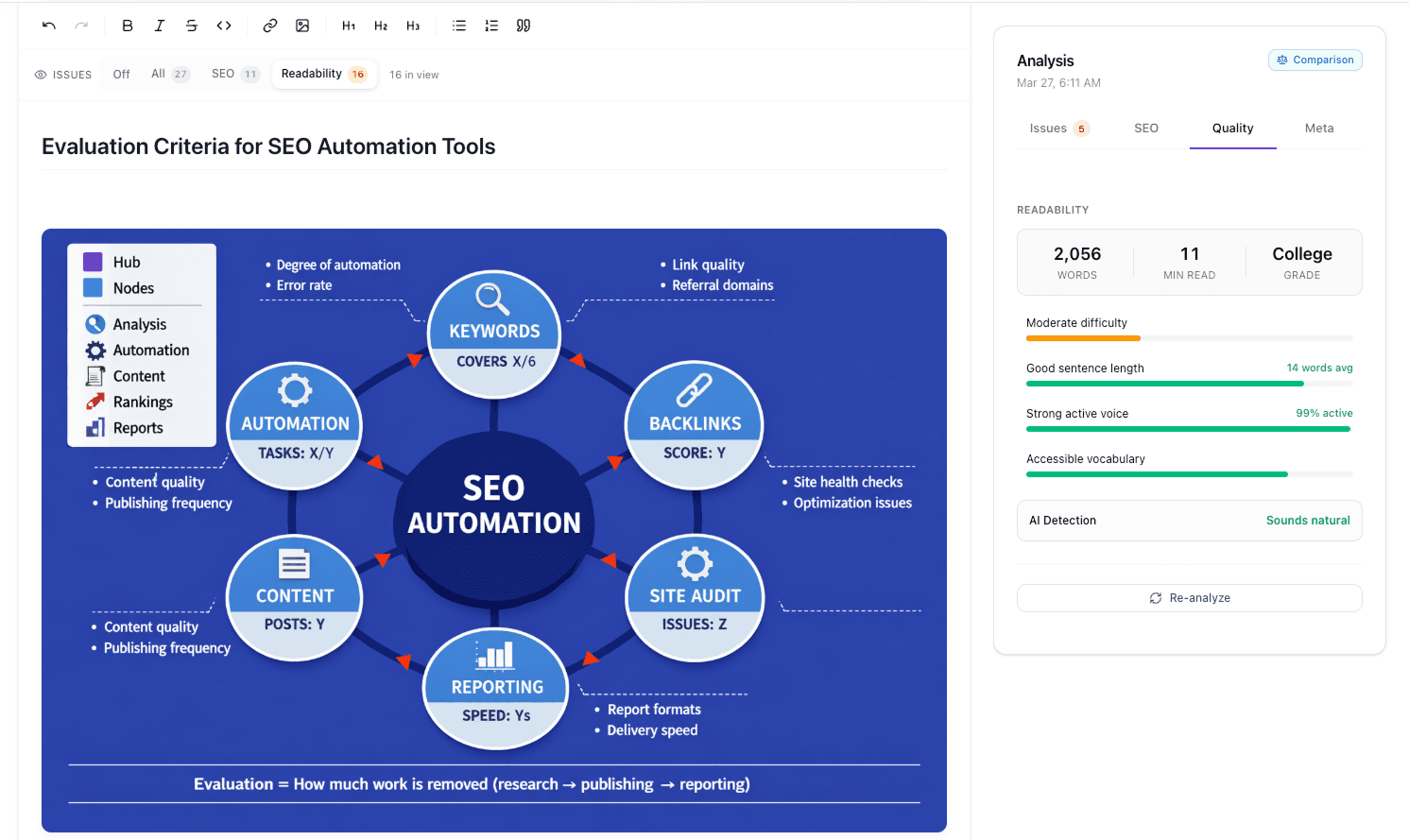
Issues found? Your agent writes the fix
Other content tools show you a score and wish you luck. Your agent reads the analysis, understands the blockers, and suggests specific fixes. Missing keyword in the title? It rewrites it. Too much passive voice? It restructures the sentences. Then it can publish the improved version directly to your CMS.
- ·Issues deduplicated and ranked: blockers first, then warnings, then tips
- ·Each issue includes a specific fix recommendation
- ·Agent can rewrite sections, restructure headings, and add missing elements
- ·Publish fixes directly to WordPress, Webflow, Shopify, and 10+ CMSs
How it works.
Pick any page
Select a page from your scanned site, or paste content directly. No setup required — analysis starts in seconds.
Get scored in five dimensions
SEO, readability, AI detection, brand voice, and HTML structure. Each scored 0-100 with an overall quality verdict.
Fix what matters first
Blockers at the top, minor tweaks at the bottom. Fix them yourself or let your AI agent handle it — then publish directly.
Frequently asked.
The content score is a weighted combination of five dimensions: SEO optimization (30%), readability (25%), AI detection risk (15%), brand voice alignment (15%), and HTML structure (15%). Each dimension is scored 0-100, and the overall score tells you if your content is ready to publish or needs work.
SEO checks 10 factors including keyword placement, density, LSI coverage, title optimization, and link counts. Readability uses multiple algorithms calibrated to your content type — a tutorial has different standards than a thought leadership piece. AI detection analyzes sentence patterns, specificity, and vague language. Brand voice checks tone, preferred words, and audience fit. HTML structure validates heading hierarchy, alt text, and link text quality.
AI detection measures how much your content resembles AI-generated text. It checks sentence variety, specificity (concrete numbers vs. vague claims), and patterns like overuse of formal transitions. A high risk score means your content may look AI-generated to readers and search engines — even if a human wrote it. The analyzer flags specific sentences and suggests how to make them sound more natural.
You set up a brand profile with your tone, preferred words, words to avoid, and writing samples. The analyzer checks every page against this profile — flagging tone mismatches, missing preferred terms, and forbidden words. For deeper analysis, it evaluates audience appropriateness and technical depth alignment, then suggests specific improvements.
The analyzer auto-detects eight content types: how-to guides, tutorials, listicles, news updates, problem-solution articles, comparisons, thought leadership pieces, and case studies. Each type has calibrated scoring thresholds — a tutorial needs code examples, a case study needs quantifiable results, a listicle needs to match its title promise.
Issues are classified as blockers, warnings, or tips. Blockers are critical problems that should prevent publishing — like a missing H1 tag or keyword absent from both the title and first paragraph. Warnings are important but not deal-breakers. Tips are minor improvements. Blockers appear at the top, always.
Yes. Your AI marketing agent reads the analysis results and can rewrite sections to fix identified issues — restructuring sentences for readability, adding keywords naturally, fixing heading hierarchy, and more. You review the changes before they go live, and the agent can publish directly to your CMS when you approve.
Yes. You can paste content directly into the analyzer without it being published anywhere. This is useful for reviewing drafts, guest posts, or AI-generated content before publishing. The analyzer runs all five dimensions on any text you provide.
Works great with.
Website Audit
Content quality is one piece. Fix the technical issues underneath — speed, security, meta tags, and 100+ more checks per page.
Learn more →Keyword Tracking
See how your content improvements affect rankings. Daily position updates across 35+ countries with trend analysis.
Learn more →AI Marketing Agent
Your autonomous CMO. It reads your content scores, spots the weakest pages, rewrites them, and publishes — without you lifting a finger.
Learn more →Start
Free.
Full access for 7 days.
Zero commitment.
Starter
Full Feature Comparison
Everything included in each plan at a glance
| Feature | Starter $49/mo | Growth $99/mo | Scale $179/mo |
|---|---|---|---|
| AI | |||
| AI Agent messages | 15/mo | 50/mo | 150/mo |
| AI image generation | Unlimited | Unlimited | Unlimited |
| Brand voice learning | |||
| Extra message credits | Purchasable | Purchasable | Purchasable |
| Social Media | |||
| Platform connections | 3 | 5 | Unlimited |
| Compose & schedule | |||
| Per-platform customization | |||
| Carousels, reels, stories, threads | |||
| First comment (LinkedIn/IG) | |||
| Social analytics | |||
| Best-time-to-post heatmap | |||
| Follower growth tracking | |||
| Posting frequency analysis | |||
| SEO | |||
| Website audit (all checks) | |||
| Scheduled auto-scans | Weekly only | Any frequency | Any frequency |
| Keyword tracking | 100 keywords | 300 keywords | 500 keywords |
| Keyword sync | Weekly | Daily | Daily |
| Keyword boost (purchasable) | |||
| Backlink monitoring | Current status | Full history + daily | Full history + daily |
| Content analyzer | |||
| Google Search Console | |||
| Content | |||
| Article generation | 30/mo | Unlimited | |
| Article credits (purchasable) | |||
| CMS auto-publishing | 13+ platforms | 13+ platforms | |
| Content calendar (articles) | |||
| Content calendar (social) | |||
| Support & Extras | |||
| Support level | Priority | Dedicated | |
| API access | Coming soon | ||