Agentic SEO vs Traditional SEO: Why the Old Playbook Is Costing You Rankings

What if lean teams could ship SEO content without building a bigger team? Agentic SEO is that shift. It uses AI-led workflows to plan, publish, and optimize content with less manual work. Speed and efficiency now shape modern digital marketing decisions. For instance, a SaaS startup with one content lead could use an AI-driven workflow to publish 40 optimized pages in one quarter. Under traditional models, that same output would have required a team of three. According to HubSpot's State of Marketing Report, 63% of marketers cite efficiency as their top priority when adopting new tools. This article compares agentic SEO with traditional SEO on cost, control, output, and team fit. It uses clear criteria and equal coverage, so readers can make a smarter call fast.
Evaluation Criteria for Traditional SEO and SEO Automation
Why this comparison matters
This comparison starts with operating model, not feature lists. The real choice is agentic SEO versus traditional SEO, not simply software versus people. One model relies on data-backed AI and connected workflows. The other depends on manual planning, specialist review, and service delivery.
That difference shapes daily execution. For example, a startup may need three pages live this week. A larger team may need tighter review, brand checks, and stakeholder approval. Many articles explain what agentic SEO is, but few show where it breaks under real publishing pressure, handoffs, and reporting.
How each option will be scored
Each model will be scored on seven factors: speed to publish, cost, strategic control, content quality, scalability, reporting, and learning curve. Those criteria reflect the work behind the output, not just the output itself. In other words, the article compares how each system runs. That matters more than a feature checklist.
A key distinction sits here. Agentic SEO is not the same as SEO automation. SEO automation usually handles repeated tasks inside a defined process. Agentic SEO goes further. It aims to make decisions, adapt workflows, and move work forward with less manual coordination.
Industry benchmarking data from Why Digital Marketing Outperforms Traditional Methods | Razesh Goptta posted on the topic | LinkedIn and The #1 Digital Marketing Agency for Home Service Businesses | Geek Powered Studios suggests cost and performance improvements in digital marketing contexts. These directional indicators reflect agency observations rather than controlled studies, so they serve as reference points rather than definitive benchmarks.
What lean teams usually care about most
Lean teams usually care about output per headcount. They compare time saved, budget fit, visibility into work, and how much expertise the system demands. Small in-house teams also weigh whether AI SEO tools replace agency labor or still need service support.
Before choosing a model, businesses should compare operating speed, ownership of strategy, review burden, and reporting clarity. For example, software may publish faster, while traditional SEO may offer stronger editorial judgment. The best fit depends on team size, workflow maturity, and how much control the business wants.
Agentic SEO Review
Overview
Agentic SEO describes an AI-led workflow, not a single feature. In this model, an autonomous SEO agent handles chained tasks with limited manual input. It can research keywords, build briefs, draft pages, optimize copy, suggest links, and trigger updates across a content system. For example, a team can set a goal, approve a topic cluster, and let the workflow move from research to revision without repeated handoffs.
This does not mean full independence. It means the software carries more of the production load between human decisions. In practice, the model works like a junior operator with extreme speed. It keeps moving until a person resets the goal, changes the rules, or blocks publication.
Key Features
Most AI SEO tools in this category focus on continuous optimization. They monitor rankings, page gaps, and content decay, then recommend or trigger updates. Some also use live data sources, which helps the system react faster when search demand shifts. That makes the workflow feel less like a static checklist and more like an operating loop.
Task chaining is another core feature. One action can trigger the next step automatically, such as keyword discovery, brief generation, draft creation, meta updates, and reporting. Many platforms also bundle workflow orchestration, internal linking suggestions, and performance dashboards in one place. For example, a marketer can review one queue instead of managing five separate tools.
Strengths
The biggest strength is execution speed. Once the workflow is configured, teams can move from idea to published asset far faster than manual production allows. That matters most when a site has dozens or hundreds of pages to improve. Lower marginal content cost also becomes easier to achieve because each added page needs less hands-on labor.
The model also scales well for lean teams. A startup with one content lead can use data-backed AI workflows to test more topics, update old pages faster, and keep momentum without hiring immediately. Consider this example: A SaaS startup with one content lead could use an AI-driven workflow to publish 40 optimized pages in one quarter. Under traditional models, that same output would typically require a team of three. In that context, automated execution helps small teams cover more ground.
Weaknesses
The trade-off is quality variance. Outputs can look solid on the surface while missing nuance, product truth, or clear differentiation. Prompt quality also shapes results more than many buyers expect. If the setup is weak, the system often scales weak content faster.
There is also real over-automation risk. Brand voice can drift, facts can slip, and teams can become too dependent on one vendor's workflow. In regulated industries like healthcare, finance, and legal services, even minor factual errors can damage trust and violate compliance requirements (Why Digital Marketing Outshines Conventional Marketing Techniques - A Paradigm Shift in the Advertising Landscape in Kenya). Human review remains essential for these high-stakes contexts and for strategy, judgment, and final publishing decisions.
Best For
This model fits startups, SMB marketing teams, and growth-focused companies that need more output from small groups. It also suits teams that want rapid testing across landing pages, blog clusters, and refresh campaigns. For example, a B2B SaaS company launching three product lines might need 30 landing pages, 45 blog posts, and 15 comparison pages within one quarter. An agentic SEO system can handle the research, drafting, and optimization workload that would otherwise require a team of 3-4 content specialists. That is where agentic SEO tends to outperform slower operating models.
It is less suited to teams that need deep editorial craftsmanship on every page. It also may not fit brands that already rely on traditional seo agencies for high-touch strategy and approvals.
Common Pain Points
The biggest friction points appear after the demo. Teams often hit setup issues, unclear workflows, and trust gaps around automation. Shallow differentiation is another recurring problem. Content may be clean, but it can still sound like everyone else.
Agentic SEO cannot fully replace human SEO work. It replaces repetitive production tasks more than strategic thinking. Teams with clear offers, repeatable workflows, and limited headcount usually gain the most from autonomous SEO agents.
Traditional SEO Review
Overview
Traditional SEO is a human-led operating model. Internal specialists, freelancers, seo agencies, and traditional seo agencies run the work through research, review, and editorial judgment. People decide what to target, what to publish, and what to fix first.
In practice, this model looks more like a newsroom than a software workflow. For example, a content lead builds the brief and a writer drafts the page. Then an SEO strategist revises headings, and a manager gives final approval. Unlike agentic SEO, the process depends on people moving each task forward by hand. This hands-on approach remains valuable in specific contexts.
Traditional SEO is still worth it in the right setting. It remains useful when search visibility affects revenue, compliance, or brand trust. It also gives leadership a clearer line of sight into who made each call.
Key Features
Traditional SEO usually includes several repeatable service layers.
- Strategy development based on business goals and search intent
- Keyword planning and topic mapping
- Technical audits for crawl, speed, indexing, and site structure
- Editorial review for accuracy, tone, and on-page quality
- Backlink work and outreach support
- Stakeholder approvals across marketing, product, and leadership
- Campaign reporting with rankings, traffic, and conversion updates
This structure gives teams checkpoints at every stage. For example, a healthcare company may require legal review before a single article goes live. That slows output, but it reduces risk.
Strengths
The biggest strength is strategic nuance. Human teams can weigh tradeoffs that tools often flatten. When search results are messy, mixed, or full of weak intent signals, experienced operators can still spot the better opportunity.
Traditional SEO also tends to align better with brand context. A strong strategist can connect search priorities with product positioning, sales objections, and leadership goals. That matters for companies selling complex services, where one wrong promise can hurt pipeline quality.
Accountability is often clearer too. A named specialist, consultant, or agency owns the recommendation. SEO agencies can deliver better results than AI systems when judgment matters more than speed. This advantage is most pronounced in complex, high-stakes scenarios.
Weaknesses
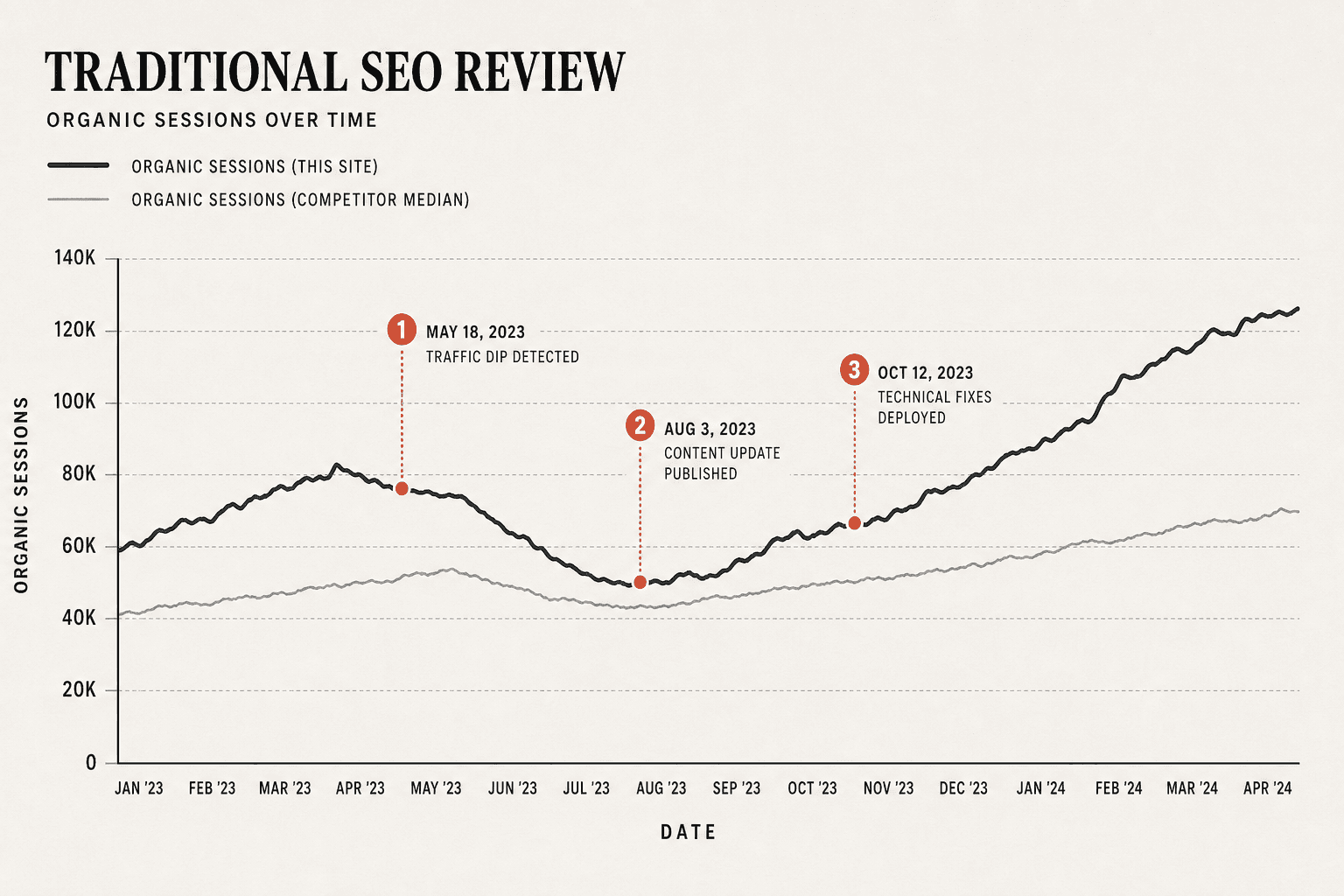
The limits are also clear. Traditional SEO usually moves slower. Every handoff adds delay, and every approval adds another pause. For example, one blog post can sit in review for days across content, legal, and brand teams.
Costs also rise fast. Internal hires cost salary and management time. Freelancers vary in reliability. Traditional seo agencies can bring depth, but monthly retainers often exceed the cost of software-led workflows.
Scaling is harder as volume grows. More pages usually mean more writers, editors, reviewers, and meetings. Quality can also swing sharply between seo agencies, since process discipline and talent depth differ from one provider to the next.
Best For
Traditional SEO fits brands with high stakes and low room for error. That includes regulated industries, companies with complex products, and teams that need close coordination across content, product, sales, and leadership. Consider an enterprise security software firm with 9-12 month sales cycles.
For example, an enterprise security software firm with 9-12 month sales cycles needs pages that explain complex compliance requirements, address C-level concerns about data governance, and align with legal review. Each page might go through five stakeholders before publish - a process where human judgment prevents costly mistakes. Even teams exploring agentic SEO often keep traditional review for these sensitive assets.
Common Pain Points
The recurring problems are familiar. Turnaround is often slow. Communication can fragment between specialists, account managers, writers, and leadership. Reporting may show activity without making ROI obvious.
Dependency is another issue. If one strategist leaves, momentum can stall. Execution can also become inconsistent across seo agencies, especially when discovery is strong but delivery is weak. Research from Why Digital Marketing Outshines Conventional Marketing Techniques - A Paradigm Shift in the Advertising Landscape in Kenya shows that operational consistency remains a challenge across the industry.
Agentic SEO Comparison Table and Best Fit
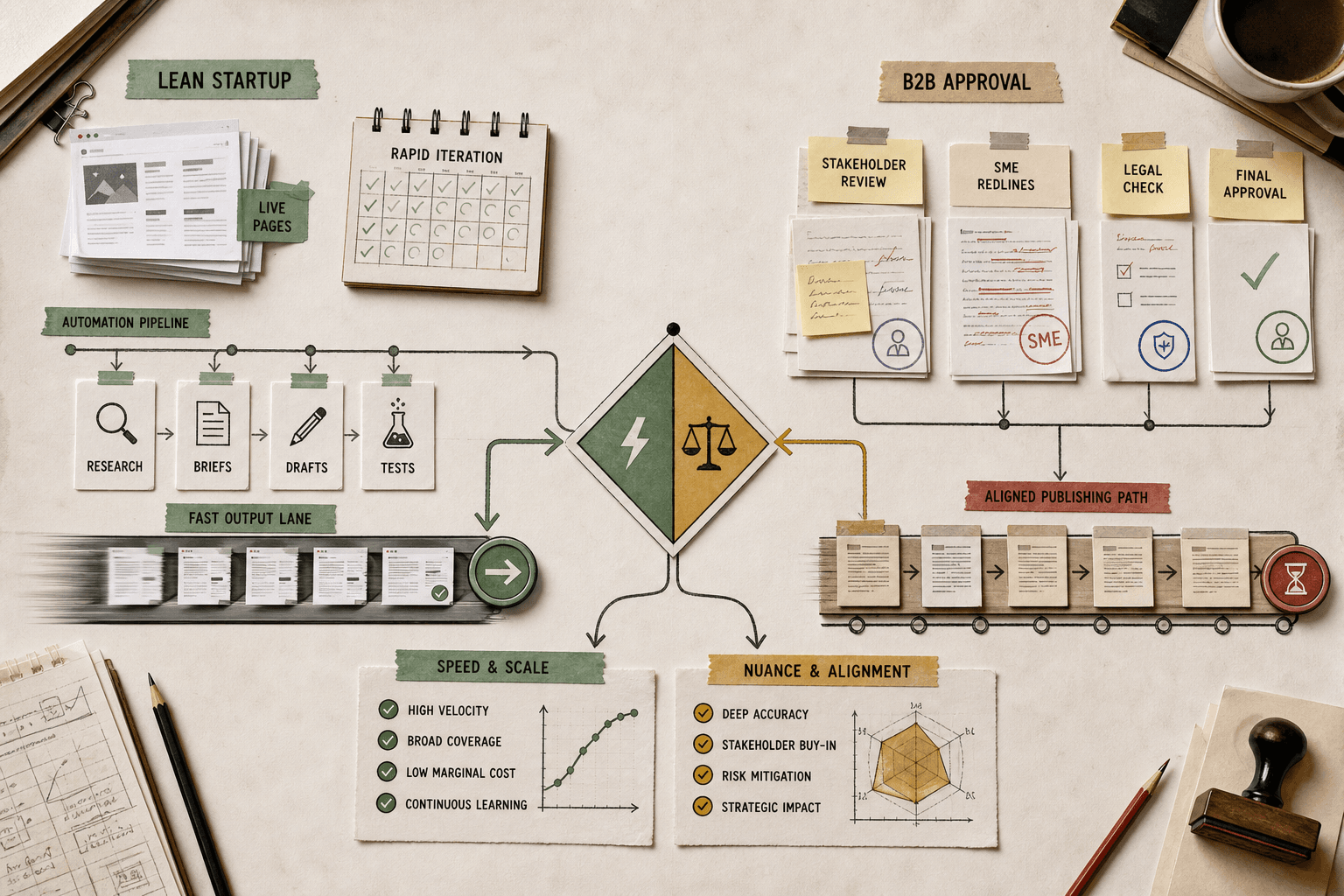
- Setup time — Agentic SEO: Higher upfront workflow setup · Traditional SEO: Lower tooling setup, higher process setup
- Monthly cost — Agentic SEO: Lower marginal cost after setup · Traditional SEO: Higher ongoing labor or agency cost
- Speed — Agentic SEO: Fast draft, update, and test cycles · Traditional SEO: Slower due to manual review and approvals
- Scalability — Agentic SEO: Strong across large page sets · Traditional SEO: Harder to scale without more headcount
- Human oversight — Agentic SEO: Needed at key review points · Traditional SEO: Built into the model from the start
- Strategic depth — Agentic SEO: Strong on pattern execution · Traditional SEO: Strong on nuance and prioritization
- Quality consistency — Agentic SEO: Can vary by prompts and systems · Traditional SEO: Can vary by team skill and process
- Ideal use case — Agentic SEO: High-output teams with tight resources · Traditional SEO: High-stakes brands needing deeper alignment
The tradeoff is straightforward. Agentic SEO usually wins on speed and scale. It helps lean teams publish more, test faster, and keep momentum without adding immediate headcount. Traditional SEO usually wins on nuance and stakeholder alignment. It handles messy decisions better, especially when brand risk, cross-functional approvals, or complex positioning matter.
The best fit changes by scenario.
- For a lean startup team, agentic SEO often makes the most sense. It supports fast output, faster learning, and lower operating drag. That matters when the goal is coverage and iteration.
- For an in-house growth team, the answer depends on bandwidth. If the team already has clear positioning and editorial rules, agentic workflows can extend output without breaking process. If those rules are still loose, human-led SEO may prevent expensive confusion.
- For a complex B2B brand, traditional SEO usually holds an edge. These companies often need tighter messaging, sales alignment, subject-matter review, and sharper judgment on which pages deserve attention.
- For companies considering a hybrid model, the strongest option may be both. Agentic systems can handle research, briefs, drafts, internal linking, and reporting. Human reviewers can then shape strategy, protect voice, and catch weak assumptions before publish.
That is the practical takeaway. The smartest teams do not ask which model sounds more advanced. They ask which model fits current constraints, internal skills, approval friction, and growth targets. In many cases, the winning setup is agentic SEO with human review layered on top, not agentic SEO alone.
The next wave of digital marketing will reward teams that mix automation with judgment instead of treating them as opposites.
For teams exploring that balance, Try It Free offers a starting point to test simple workflows and share projects.