How to Build an EEAT Signal Stack Without a PR Budget

Eeat seo 2026 is no longer a nice extra. It is how you make your brand easy to trust and easy to verify. Search results and AI answers now favor brands with clear expertise, strong entity signals, and consistent citations. According to How to Build Authority That Gets Cited by AI Engines, AI Overviews now appear on up to 55% of searches, and 96% of those AI citations pull from organic search results. That shifts the game fast. This guide shows you exactly what to build, and in what order: author pages, schema markup, citation coverage, and AI monitoring. You will not need a big PR budget. You need a clean system your team can run each week. If you want eeat seo 2026 that drives visibility, this is where you start.
Prerequisites for EEAT SEO 2026
Tools and accounts to gather before you start
Gather access to five core systems first. Open your CMS, Google Search Console, Google Business Profile, analytics, and any schema or citation tools you already use. For example, if your site runs on WordPress, confirm editor access, plugin access, and user profile access before touching author pages.
Create one shared sheet for links, logins, owners, and notes. Add tabs for authors, schema, citations, and branded search results. If your team uses marketing automation platforms, list those too. They often publish bios, local pages, or profile data across channels that need consistent EEAT signals. You should now have one operating sheet, not scattered docs.
What baseline data to record
List every current author page, team bio, business profile, and top branded search result in that sheet. Record the exact URL, owner, status, and last update date for each item. For example, include your LinkedIn company page, Google Business Profile, About page, and any speaker or founder bios.
At this point, your scorecard should track five baseline metrics: branded impressions, non-brand impressions, indexed author pages, valid schema items, and live citations. EEAT in SEO for 2026 means making expertise, experience, and trust easy to verify across those assets. Small businesses do need it, because clear proof beats vague claims.
How to define success for a small team
Define success with simple targets and one owner per metric. Set a 90-day goal for each number. Verify that one shared document exists with owners, URLs, and current numbers before any changes are made.
If you want execution without extra admin, Mygomseo works as the EEAT engine for lean teams. It helps you track updates across pages, profiles, and marketing automation systems.
Step 1 Audit EEAT Signals and Set Your Strategy
Map your trust assets
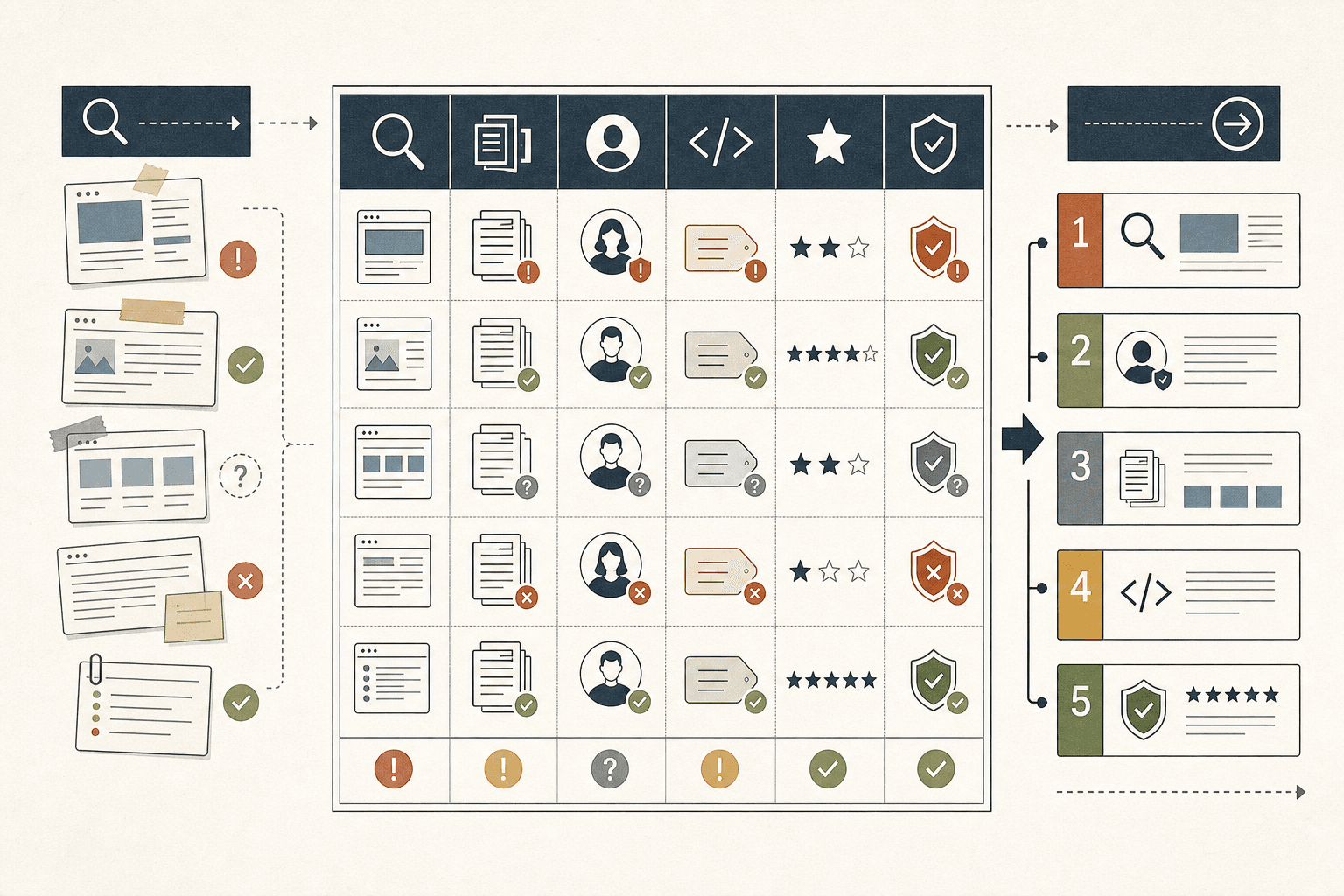
Start with your public trust pages. Review your homepage, About page, author pages, contact page, editorial policy, review process, customer proof, and outside mentions. Think of this like packing for a trip. You are not buying new gear yet. You are checking what is already in the bag.
- Open a spreadsheet with five columns: asset, URL, owner, evidence type, and status.
- Enter every page that proves expertise, experience, authority, or trust.
- Label each item clearly. Use tags like bio, review policy, testimonial, case study, or press mention.
- Score each asset from 0 to 2 for clarity, freshness, and verification.
You should now see whicheeat signalsalready support your brand. Verify that every important trust page has a live URL before proceeding.
Find gaps in authorship and brand consistency
Search your brand name, founder name, and product name. Review the first two result pages. Check for missing author bios, weak third-party references, inconsistent business details, and unclaimed profiles. According to How to Build Authority That Gets Cited by AI Engines, AI Overviews now appear on up to 55% of searches, and 96% of those AI citations pull from organic search results. Search visibility still shapes what AI systems cite and summarize, so gaps in your public trust signals directly impact AI answer accuracy.
For example, your homepage may look strong, but your founder name may return an old podcast bio and two empty profile pages. That is a gap. Your contact page may show one address, while a directory shows another. That is another gap.
- Search branded terms in an incognito window.
- Record whether you see a knowledge panel, review sites, directories, and media mentions.
- Flag missing author pages, missing Organization schema, inconsistent NAP data, and unclaimed profiles.
- Mark any citation source that uses the wrong company description.
You should now see where trust breaks across the web. Verify that each gap links to a specific URL or search result before moving on.
Set 30 day and 90 day targets
Now rank fixes by impact and effort. Start with the fastest wins for a small team. Usually that means author pages, Organization schema, NAP cleanup, and profile claims. If you use Mygomseo, this becomes your execution queue, not a loose ideas list.
- Label each task as Now, Next, or Later.
- Assign one owner, one due date, and one expected outcome.
- Set 30 day targets for fixes you can ship fast.
- Set 90 day targets for citation growth, review process updates, andautomation formonitoring mentions.
At this point, youreeat seo 2026plan should look measurable. You should see a ranked backlog with deadlines and owners. Verify that every task has a label, an owner, and a target date.
Step 2 Build EEAT Signals with Author Pages, Schema, and Citations
1. Create author pages that prove expertise
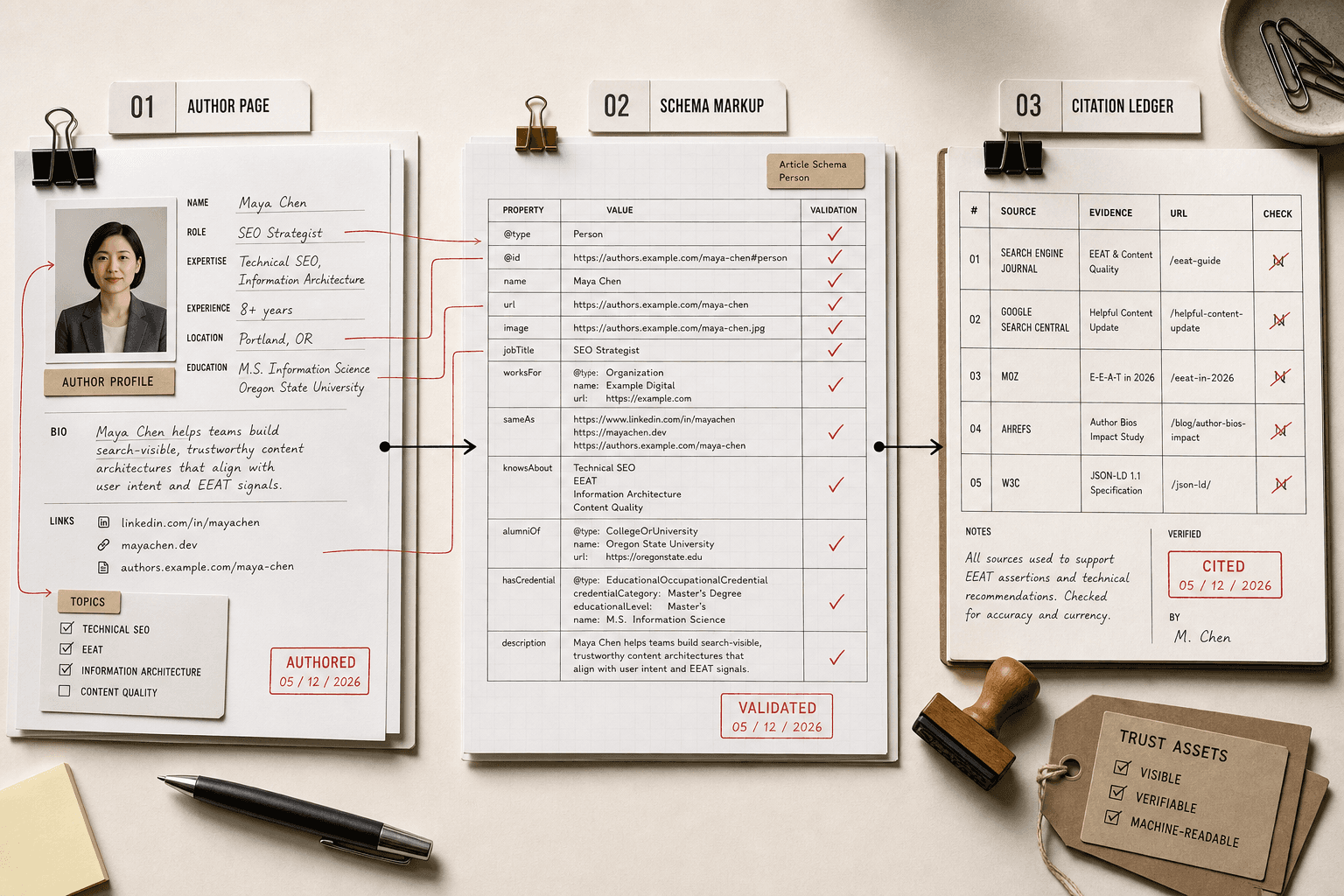
Start with one page for every real content owner.
- Create a dedicated URL for each author.
- Add the author’s real name and current role.
- Add credentials, certifications, or relevant training.
- Upload a clear headshot.
- List topic expertise in plain language.
- Show recent articles with links.
- Add social profile links.
- Write a short proof section with experience or results.
Use a simple layout. For example, a SaaS content lead might show “8 years in B2B SEO,” “led content for three product launches,” and “grew organic demos from branded comparison pages.” That proof matters because AI systems need evidence, not adjectives. How to Build Authority That Gets Cited by AI Engines
You should now see a complete public profile for each author. At this point, your site should no longer publish expert content under vague bylines like “Team” or “Admin.” Verify that each author page links back to their articles before proceeding.
2. Add schema markup that machines can read
Next, connect your people, content, and company with structured data.
- Add
Organizationschema to your main site. - Add
Personschema to every author page. - Add
Articleschema to blog posts. - Add
WebSiteschema to your homepage. - Add
sameAslinks for trusted external profiles.
Use JSON-LD on your main templates. Keep names, URLs, and profile links exact. For example, your founder’s Person schema should match the author page title, LinkedIn profile, and article byline word for word.
<script type="application/ld+json">
{
  "@context": "https://schema.org",
  "@type": "Person",
  "name": "Jane Doe",
  "jobTitle": "Head of Growth",
  "url": "https://example.com/authors/jane-doe",
  "image": "https://example.com/images/jane-doe.jpg",
  "sameAs": [
    "https://www.linkedin.com/in/janedoe",
    "https://x.com/janedoe"
  ],
  "worksFor": {
    "@type": "Organization",
    "name": "Mygomseo"
  }
}
</script>
You should now see clear entity connections across your site. Verify that your schema validates in Google’s testing tools before proceeding. If you use ai tools or marketing automation: platforms, map schema into templates once, then deploy sitewide through your CMS.
3. Build citation consistency without a PR budget
Now standardize your off-site brand references.
- List every active profile and directory.
- Update your business name, URL, and location.
- Match your team description across profiles.
- Add missing listings on LinkedIn, Crunchbase, and niche directories.
- Track each live citation in one sheet.
Citations help even if you are not local. They create repeated, machine-readable confirmation that your brand exists, your team is real, and your expertise is tied to the same entity everywhere. That matters for AI discovery, brand disambiguation, and automation for outbound visibility. How to Build Authority That Gets Cited by AI Engines
Use one citation template and copy it everywhere:
Brand name: Mygomseo
Website: https://example.com
Location: Austin, Texas, United States
Description: Mygomseo helps small teams run SEO, content, and gtm automation from one system.
As more teams invest in AI workflows, clean entity data becomes critical for brand trust verification. When AI systems interpret your brand signals, consistent citations and schema help them surface accurate information. If your positioning touches AI workflows, keep the same language on your site and profiles. For example, if you mention content ops on your site and demand gen on LinkedIn, fix that mismatch.
You should now have live author pages for every content owner, valid schema on key templates, and a tracked list of active citations. Verify that author pages are indexed, schema passes Google tests, and citation fields match exactly across every listing. If you need a live example of event-style entity clarity, review APAC Reseller Meeting 2026 and note how one page can anchor people, brand, and topic in one place.
At this point, youreeat seo 2026foundation is machine-readable, cross-checked, and ready to scale.
Conclusion: Turn EEAT Into a Living System
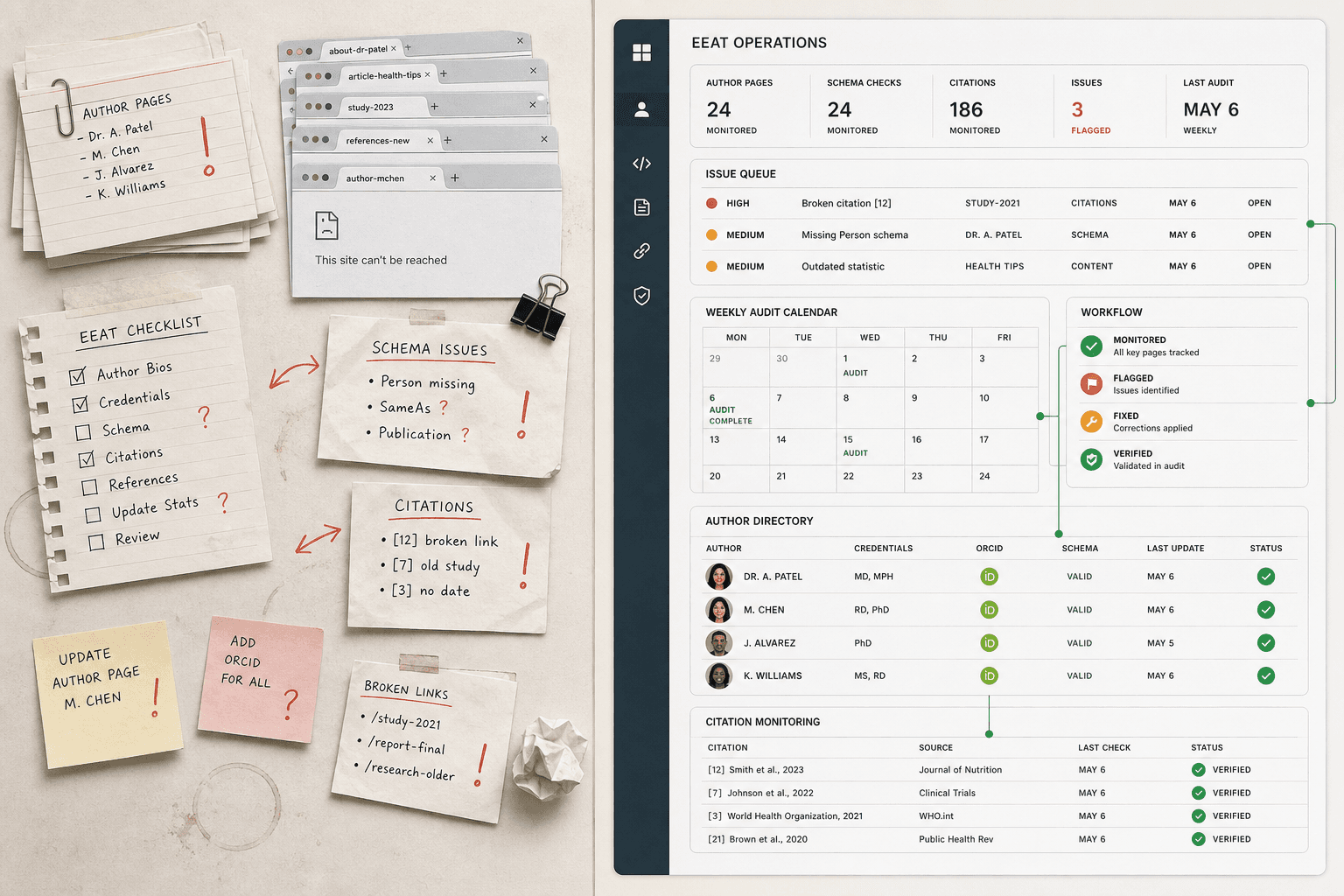
In this final step, you move from setup to operations. Prompt the major AI systems with your brand, founder, and product terms. Record how they describe your expertise, category, use cases, and proof points. Then review the signals every week. Check for citation drift, broken schema, missing bylines, and pages that lose index coverage after updates. Fix the weak spots before they spread across more content.
This is where small teams usually stall. Not because the work is hard. Because the work gets fragmented. One tool tracks schema. Another tracks citations. Another sheet tracks authors. That is why Mygomseo fits here. You can use it as your EEAT execution engine to manage author page updates, schema checks, citation workflows, and recurring audits in one place. Instead of chasing tasks across tabs, you keep one operating layer for your eeat strategy.
You should also connect AI monitoring with your go-to-market automation where it makes sense. Set alerts when brand summaries change. Trigger reporting when citation fields break. Flag content refreshes when AI tools describe your product inaccurately. This is practical ai marketing, not hype. You are building marketing automation that protects trust before rankings or conversions slip.
If results look messy, do not scale faster. Troubleshoot first. Fix inconsistent business details. Merge duplicate profiles. Rewrite vague bios. Remove claims you cannot support. Tighten the facts until your brand says the same thing everywhere. That is how eeat signals get stronger over time.
At this point, your work should look different. You should see owners, automations, and a monthly checklist. Not random SEO tasks. Not last-minute cleanup. Verify one thing before you call this done: your team can quickly show who created the content, what proves your expertise, and where your brand is referenced consistently online. If you can answer those three questions fast, your foundation is real.
Your next move is simple. Review your scorecard in 30 days. Expand citations based on relevance, not volume. Keep your author pages, schema, and external references current as new content goes live. That is how eeat seo 2026 becomes sustainable for a lean team. And that is how Mygomseo helps you keep trust signals current without turning your workflow into more manual overhead.
The brands that win here will not be the loudest. They will be the clearest, most consistent, and easiest to verify.
Want a simple way to keep execution moving? Try Mygomseo free to track author pages, schema, and citations from one dashboard.