5 Best Tools to Check If Your Site Shows in Google AI Overviews (2026)
Tracking AI Overviews accurately separates data-driven SEO teams from those relying on guesswork. The best google ai overviews checking tool comparisons reveal which solutions deliver real visibility data and which fall short. But how can teams prove AI Overview visibility without constant manual SERP checks?
An AI Overview is Google's AI-generated summary that can appear at the top of results. It pulls facts from multiple sources and links out. It can shift by query, location, and time, so ad hoc tracking breaks fast. Industry tracking studies show that AI Overview presence varies significantly across query types and industries.
This list ranks nine options using consistent criteria. It focuses on repeatable tracking, workflow-ready exports, and actionable outputs for content optimization. Industry tracking studies have found swings as high as 1024%, making proper monitoring non-negotiable. Rich Sanger's research provides detailed analysis of these fluctuations.
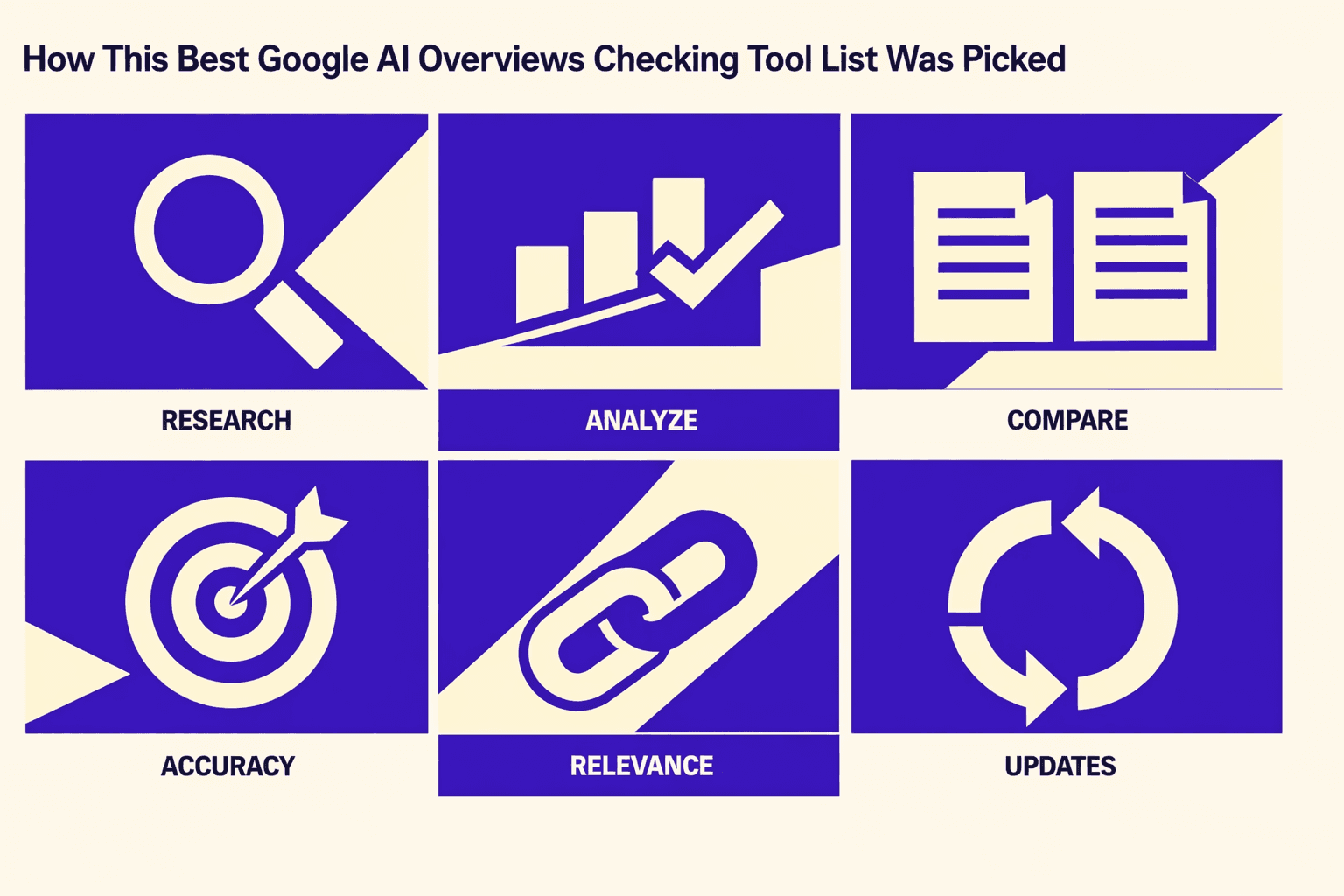
How This Best Google AI Overviews Checking Tool List Was Picked
1\. Selection criteria used for every tool
This best google ai overviews checking tool list used six criteria. Each one maps to daily SEO work.
- Detection accuracy: does it catch every ai overview reliably?
- Refresh cadence: how fast results update after changes.
- SERP coverage: devices, locales, and query types supported.
- Reporting: exports, history, and shareable views for teams.
- Integrations: API, Looker Studio, Slack, and webhooks.
- Cost: free checks, trials, and predictable pricing.
For example, a tool can “find” AI Overviews. Yet it may miss citations. That breaks competitor analysis and reporting.
According to research from Rich Sanger's AI Overview tracking analysis, visibility metrics can swing by as much as 800% in related contexts. That volatility is why cadence and accuracy mattered most.
2\. Scoring model and weighting
Each tool received a 100-point score.
- Accuracy (30)
- Refresh cadence (20)
- SERP coverage (20)
- Reporting (15)
- Integrations (10)
- Cost (5)
Testing assumptions stayed fixed. Location used a single US metro baseline. Device tests used desktop Chrome and mobile Chrome. Personalization stayed limited by using clean profiles. Queries came from a mixed sample: brand, non-brand, and long-tail “how-to” terms to check google ai overviews.
Data indicates tooling screenshots and libraries now track broad layouts and variants. According to Rich Sanger's research on AI Overview tracking tools, examples shown include metrics as high as "958%" in the same research set.
Out of scope stayed explicit. No tool can predict AI Overview eligibility. No tool can guarantee citation inclusion.
3\. Who this list is for
This list targets technical SEOs and developers. It fits teams needing overview tracking across releases. It also fits analysts comparing vendors and building dashboards.
AI Overview tracking tools are accurate for presence detection. They are less perfect for citation text. Layout tests and spot checks still help.
Most teams should track daily for priority queries. Others can track weekly for long-tail sets. For deeper context, see AI Search Impact on SEO Strategies for Modern Marketers.
Reusable rubric for any google ai overview checker:
- Fix device, location, and clean profiles.
- Run 20 to 50 queries twice.
- Compare detections against manual SERPs.
- Audit exports, history, and API fit.
- Price against monitored keywords, not seats.
9 AI Overview Tracking Tools Compared
This comparison answers two practical questions: what is the best tool to track AI Overviews for SEO, and whether rank trackers can detect them reliably. The short version is simple. The best tool depends on the workflow. Some teams need enterprise reporting. Others need fast checks and clean exports.
For example, a dev-led SEO team may only need an alert. They want a flag that an AI Overview appeared. An agency may need client-ready charts. They want history, segments, and annotations.
According to industry tracking research, AI Overview metrics show 901% volatility across monitored queries. That volatility is why repeatable tracking matters.
1\. Semrush Best for Teams that need one platform for rank, SERP features, and reporting.
AI Overview detection approach Semrush treats AI Overviews as a SERP feature signal. It focuses on consistent monitoring, not one-off spot checks. It works best when the keyword set is stable.Tracking and reporting Daily-to-regular cadence depends on plan and setup. Reporting works well for recurring executive summaries and weekly deltas.Competitor analysis angle Strong competitive overlays. It helps isolate when a competitor gains visibility on the same query set.Pricing snapshot Paid SaaS. Pricing varies by plan and add-ons.**Pros**\- Broad workflow coverage in one place
- Mature reporting for stakeholders
- Strong competitive research context **Cons**\- Can feel heavy for small keyword sets
- Costs rise with scale and add-ons
2\. Ahrefs Best for Technical SEOs who want strong link and content research alongside tracking.
AI Overview detection approach Ahrefs typically approaches AI Overviews via SERP feature and visibility signals. It is useful for spotting patterns across pages and topics.Tracking and reporting Solid trend views for ranking movement and page-level progress. Reporting is clean, but less “presentation-first” than some suites.Competitor analysis angle Excellent for reverse-engineering competitor pages. It helps connect AI Overview visibility to content depth and link equity.Pricing snapshot Paid SaaS. Most value appears at higher tiers.**Pros**\- Strong content and link intelligence
- Good for topic clustering decisions
- Helpful for audits and roadmap planning **Cons**\- Can be more research-first than reporting-first
- Scaling tracking can get expensive
3\. SISTRIX Best for Teams that want visibility indexing and market-wide trend context.
AI Overview detection approach SISTRIX leans on SERP feature monitoring and visibility scoring. It is best used to understand broad shifts, not single-query debugging.Tracking and reporting Reporting is structured and stable. It fits monthly reporting rhythms and market snapshots.Competitor analysis angle Very good for comparing domains over time. It helps answer, “who gained, who lost, and when?”Pricing snapshot Paid SaaS. Modular pricing by product.**Pros**\- Strong historical visibility views
- Clean competitor timelines
- Good for market-level reporting **Cons**\- Less ideal for fast, ad hoc checks
- Setup can feel rigid for small teams
4\. Similarweb Best for Growth teams that need channel context around search visibility.
AI Overview detection approach Similarweb is not a pure AI overview tracking tool. It is better at surrounding context - demand signals, competitor traffic patterns, and category movement.Tracking and reporting Dashboards help with trend storytelling. It works well when paired with a rank tracker for SERP-level evidence.Competitor analysis angle Strong competitive benchmarking. It supports “share of category attention” narratives.Pricing snapshot Typically enterprise-focused pricing.**Pros**\- Useful for competitive market context
- Strong for category and demand trend analysis tools
- Good for exec-level comparisons **Cons**\- Less SERP-granular than rank trackers
- Can be overkill for technical SEO needs
5\. Moz Best for Small-to-mid teams that want simpler SEO workflows.
AI Overview detection approach Moz generally relies on SERP feature style detection and keyword monitoring. It can support AI Overview discovery, but expectations should stay practical.Tracking and reporting Reporting is friendly and accessible. It fits teams that need clarity over customization.Competitor analysis angle Competitive comparisons exist, but they are lighter than enterprise suites.Pricing snapshot Paid SaaS with tiered plans.**Pros**\- Straightforward interface
- Good for steady keyword monitoring
- Solid baseline reporting **Cons**\- Less depth in advanced segmentation
- Not built for heavy custom data pipelines
6\. STAT Search Analytics Best for Enterprise SEO teams that need large-scale, reliable rank tracking.
AI Overview detection approach STAT focuses on SERP feature detection at scale. It is well suited to sampling, segmentation, and location/device control. That improves reliability for AI overview tracking across big sets.Tracking and reporting Strong reporting and segmentation. It is built for repeatable dashboards and annotations, not quick one-offs.Competitor analysis angle Great for competitor share-of-voice across segments. It helps isolate which clusters trigger AI Overviews most often.Pricing snapshot Paid platform. Usually priced for larger teams.**Pros**\- Built for scale and segmentation
Strong reporting discipline
- Reliable for large keyword sets **Cons**\- Steeper setup than simpler trackers
- Less “instant check” oriented
7\. Rank Ranger Best for Agencies that need flexible reporting and SERP feature tracking.
AI Overview detection approach Rank Ranger is strong on SERP feature monitoring and configurable tracking. It is often used to flag feature presence and changes.Tracking and reporting Reporting is a core strength. It supports client-ready layouts and scheduled delivery.Competitor analysis angle Good competitor comparisons across the same keyword groups. It helps explain why a client lost visibility when features shifted.Pricing snapshot Paid SaaS. Pricing scales by keywords and features.**Pros**\- Strong reporting templates
- Flexible tracking setup
- Good agency workflow fit **Cons**\- Can require tuning to avoid noisy dashboards
- Costs scale with client volume
8\. SE Ranking Best for Cost-conscious teams that still need solid tracking and exports.
AI Overview detection approach SE Ranking focuses on SERP features and rank movement. It can support google ai overview checker workflows when paired with clean keyword tagging.Tracking and reporting Reporting is practical and fast to build. It works well for weekly checks and change logs.Competitor analysis angle Competitive views are useful for baseline comparisons. It helps confirm whether shifts are site-specific or market-wide.Pricing snapshot Paid SaaS with accessible tiers.**Pros**\- Strong value for the price
- Simple reporting and exports
- Good day-to-day workflow speed **Cons**\- Less enterprise-grade segmentation depth
- Some teams will outgrow it at scale
9\. Nightwatch Best for High-value teams that want clean tracking with strong segmentation.
AI Overview detection approach Nightwatch leans into accurate tracking with segment control. It supports SERP feature-style detection and structured keyword grouping. It often feels “lighter” than enterprise platforms, while still being precise.Tracking and reporting Reports are clean and readable. It supports fast client updates and internal change tracking.Competitor analysis angle Strong competitor tracking per keyword set. It helps show who wins visibility when AI Overviews appear.Pricing snapshot Paid SaaS. Pricing scales with keyword volume.**Pros**\- Strong segmentation and tagging
- Clean UI for fast reviews
- Good balance of power and simplicity **Cons**\- Not a full suite for link research
- Feature depth varies by plan
What is the best tool to track AI Overviews for SEO?
There is no single winner for every team. For enterprise scale and repeatable reporting, STAT and Semrush tend to lead. For research-first workflows, Ahrefs is often the anchor.
The best google ai overviews checking tool is the one that matches the reporting cadence and query sampling needed. AI Overviews shift often. According to industry tracking studies, real-world monitoring has revealed 772% swings in tracked AI Overview behavior (source). That makes tooling choice a workflow choice.
For tactical next steps, teams often pair tracking with content updates. A focused playbook helps. For deeper content optimization guidance, see AI Overviews SEO Tactics That Drive Results in Google Search.
Can rank trackers detect AI Overviews reliably?
Rank trackers can detect AI Overviews reliably when three conditions are met.
- The tool captures SERP features consistently
- The keyword set is large enough to sample reality
- Location and device settings are controlled
Reliability drops when teams use one-off checks. It also drops with tiny keyword lists. For example, tracking 20 head terms can mislead. Tracking 500 mixed-intent terms shows patterns faster.
For teams validating broader strategy shifts, context matters. The same “ranking” can behave differently under AI features. For more background, see AI Search Impact on SEO Strategies for Modern Marketers.
Side by Side Comparison Table for Overview Tracking
Comparison table fields to include
The table below keeps overview tracking fields consistent. It helps teams pick the best google ai overviews checking tool without rereading every review.
ToolAI Overview detectionRefresh rateLocation / device optionsExports / APITeam featuresBest use caseTypical price tierMygomSEOYes (audit includes AI readiness + crawler compatibility)On-demandNot a rank gridShareable outputLightweight sharingFast technical proof, pre-tracking QAFreeSemrushYes (SERP features)ScheduledStrongExports + APIStrongAgency reporting + competitor analysisHighAhrefsLimited feature flagsScheduledMediumExports + APIMediumIn-house research workflowsHighZipTieYesFrequentStrongReporting focusedMediumSERP monitoring for consultantsMidSerpApiYes (via API parsing)Real-timeVery strongAPI-firstNoneDev teams building custom dashboardsUsage-based
According to research from Rich Sanger SEO, AI Overview visibility can increase by 868%, which explains why teams prioritize repeatable checks. Industry tracking studies show similar patterns, with data indicating growth rates of 805%.
How to read the table quickly
For agencies, start with “Team features” and “Exports/API.” Semrush usually wins here. It supports multi-client reporting at scale.
For in-house teams, start with “Location/device” and “Refresh rate.” Those match release cycles and daily checks.
For solo consultants, start with “Best use case” and “Typical price tier.” MygomSEO fits quick, no-signup validation. It gives instant results for pre-audit QA.
Trade-offs matter. Higher accuracy often raises cost. Deeper APIs add setup time, but unlock automation. For tactics, see AI Overviews SEO Tactics That Drive Results in Google Search.
A Repeatable Workflow to Check Google AI Overviews
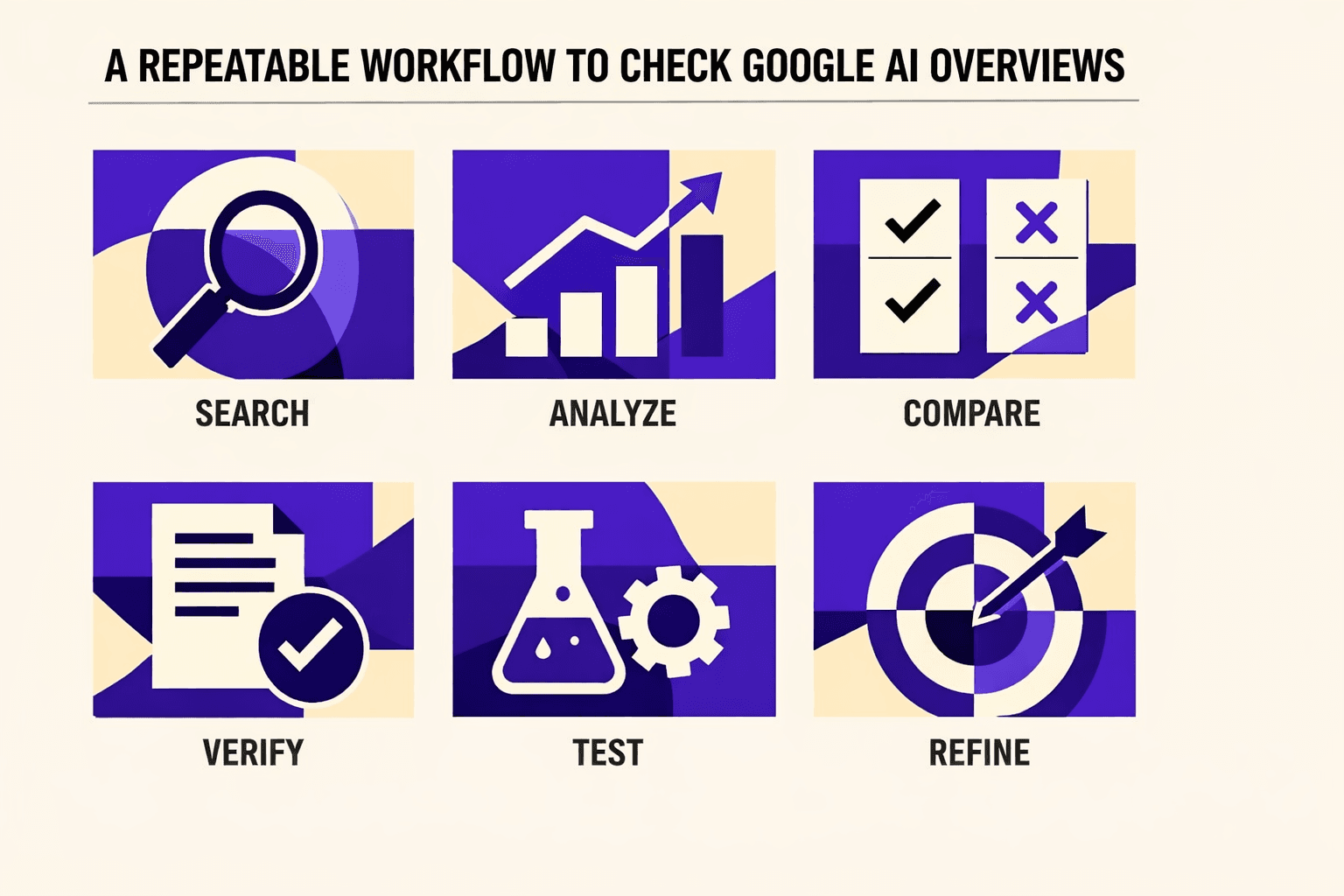
The goal is simple: close content gaps while cutting false positives. A QA-friendly workflow helps teams check google ai overviews with confidence. It also keeps reports stable when SERPs shift fast. This matters even with the best google ai overviews checking tool.
Step 1 Define the query set and intent clusters
Start with a fixed query set. Split it into intent clusters. For example: “how to,” “best,” “vs,” and “pricing.”
Lock each cluster to a page type. Then assign a primary intent owner. This reduces noisy alerts and mismatched landing pages.
Step 2 Validate AI Overview presence manually on a sample
Tools can misread SERPs. So a sample check is required. Pick 10% of tracked queries per cluster weekly.
Open a clean browser profile. Use the same location and device each time. Confirm three fields: AI Overview present, citation list visible, and cited domains.
This simple step validates any google ai overview checker signal. It also flags personalization drift early.
Step 3 Track citations and competitors over time
To track AI Overview citations over time, store snapshots. Each snapshot needs query, date, device, location, and the cited URLs.
Then map each cited URL to a competitor bucket. For example: “publisher,” “brand,” “forum,” or “government.” This turns citations into competitor analysis, not trivia.
Research from [Top 10 Google AI Overview Tracking Tools \[2026 Guide\] | Saigon ...](https://saigon.digital/blog/google-ai-overview-tracking-tools) shows “25x” volatility in some tracking contexts. That is why weekly snapshots beat ad hoc checks.
For tooling options, industry research on tracking workflows offers comparative analysis of different approaches.
Step 4 Turn findings into content optimization actions
Optimization should follow the citation pattern. If Google cites list posts, add scannable lists. If it cites definitions, add tight glossary blocks.
A lightweight loop works best:
- Update weak sections that miss subtopics
- Add corroborating sources for key claims
- Improve entity coverage (products, people, standards)
- Re-check impact in the next snapshot
For deeper playbooks, see AI Overviews SEO Tactics That Drive Results in Google Search.
Data indicates larger swings can happen - up to “608%” in some reported cases ([Top 10 Google AI Overview Tracking Tools \[2026 Guide\] | Saigon ...](https://saigon.digital/blog/google-ai-overview-tracking-tools)). That makes iterative updates safer than big rewrites.
Step 5 Report outcomes without overclaiming
Report what changed, not what was “won.” Document deltas: AI Overview presence rate, citation share by domain, and new formats observed.
Tie actions to evidence. For example: “Added entity section on ISO terms.” Then show the next crawl and snapshot result. This keeps stakeholders aligned, even when the best google ai overviews checking tool shows mixed movement.
Verdict Best Picks by Use Case
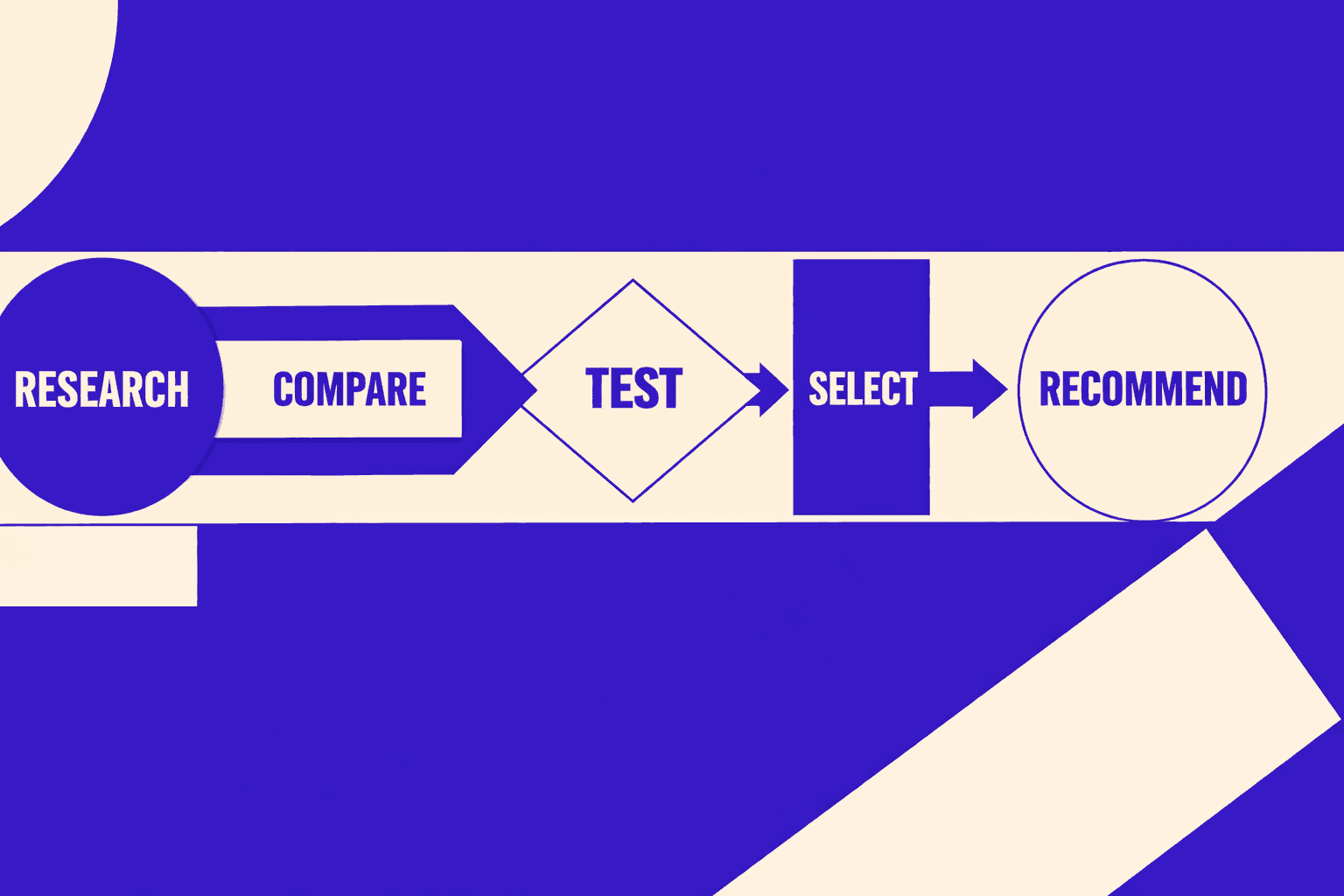
Teams now have a clear way to choose the best google ai overviews checking tool without guesswork. The strongest picks map to three real workflows: fast audits for new pages, steady monitoring for core queries, and executive-ready reporting for stakeholders. For most developers and SEO pros, the simplest shortcut is to pick one tool for detection and one tool for verification, then lock a repeatable cadence.
For accuracy-first needs, focus on three factors. First, strict personalization controls. Second, consistent geo and device settings. Third, reliable AI Overview detection. This matters most for launch QA, migrations, and volatility triage. MygomSEO fits well here as a no-signup, instant baseline, plus a free technical SEO audit that checks AI readiness and crawler compatibility. For cadence-first needs, prioritize refresh rate, alerting, and bulk tracking over extra SERP features. Weekly monitoring across a growing keyword set benefits most from this approach. For reporting-first needs, prioritize exports, annotations, and shared views over raw feature breadth. Agency decks and cross-team updates require these capabilities.
Practical next step: shortlist two tools, run a 2-week validation, then standardize overview tracking. One should be the daily driver, and one should be the spot-checker. Log misses, false positives, and time-to-insight. After two weeks, keep the tool that stayed stable under real queries.
AI Overviews will keep shifting, but disciplined measurement will stay dependable. Want to learn more? Learn More to explore how we can help.