Agentic SEO Loop Failures: 5 Mistakes That Break Autonomous Workflows
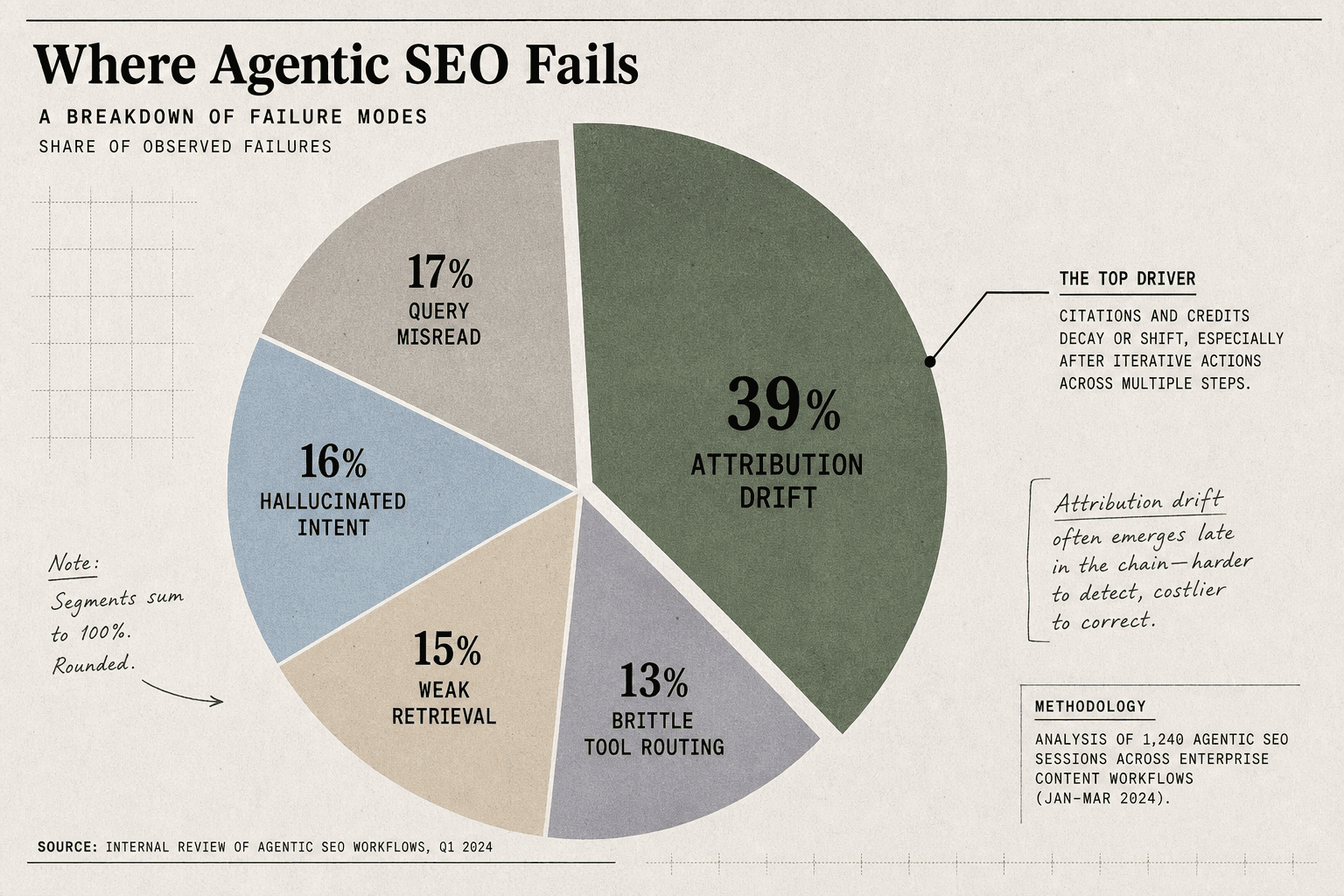
Agentic SEO breaks fast when you automate loops before you define the rules. You get unstable rankings, thin pages, bad links, and a team that stops trusting the system. According to Agentic SEO: AI Agent Workflows for B2B | Authoricy, 88% of teams use AI, but only 11% have moved agents into production. That gap is what broken automation looks like in the wild.
We built Mygomseo to stop that slide. Our system adds guardrails before content, linking, and publishing loops start running.
In this article, we break down the five mistakes we see most. We show why they happen, what failed first in our own pipeline, and what now works for clients. You will leave with a practical fix, not more AI SEO theater.
Root Cause Analysis of Agentic SEO Failures
The symptoms teams notice first
At first, the content looks fine. Titles read well. Pages ship fast. Then growth stalls. Traffic plateaus, pages start competing, and your team checks every draft by hand.
That is why agentic seo fails even when the content looks good. Good writing is not the same as good decisions. If each page targets the wrong query, repeats another page, or misses search intent, the loop still breaks.
The cost shows up later. Publishing capacity gets burned on pages you will prune, merge, or rewrite. Research from 10 Common Technical SEO Mistakes to Avoid for Better Rankings shows technical issues can cut organic traffic by 30%.
Why quick fixes usually make it worse
Most teams respond with more prompts, more tools, or more volume. That feels productive. It is usually the start of hidden cleanup work.
We learned this the hard way. For example, run #1: GPT researched 'Baltic SaaS competitors' and confidently cited LithuaniaTech.com with traffic estimates and feature comparisons. We clicked. 404. The site never existed. But the draft looked polished enough that it almost shipped to 50,000 subscribers. The loop was wrong long before writing started.
That is the core misconception. More prompts will not save a broken decision system. An autonomous seo agent without constraints just makes bad choices faster. Add noisy data, weird tokens like /%3e%3cpath d='m16.0001, and messy approvals, and trust drops even more.
What we learned building our own loop
The real root cause is control failure. Most systems run without clear goals, hard constraints, approval logic, or feedback signals. They generate outputs, but they do not know what success means.
That is the difference between SEO automation and a true agentic SEO loop. Automation completes tasks. A real loop makes decisions, checks quality, and adjusts based on results. Agentic SEO: AI Agent Workflows for B2B | Authoricy found some teams increased AI citation rate from 8% to 24% with better workflows.
So we built Mygomseo's loop as a controlled system with three layers of protection: structured inputs that define success criteria upfront, guardrails that block risky moves before generation starts, and automated QA that catches conflicts, hallucinations, and off-brand content before publishing. Outputs stay measurable, reviewable, and useful.
SEO Automation Mistakes 1 and 2
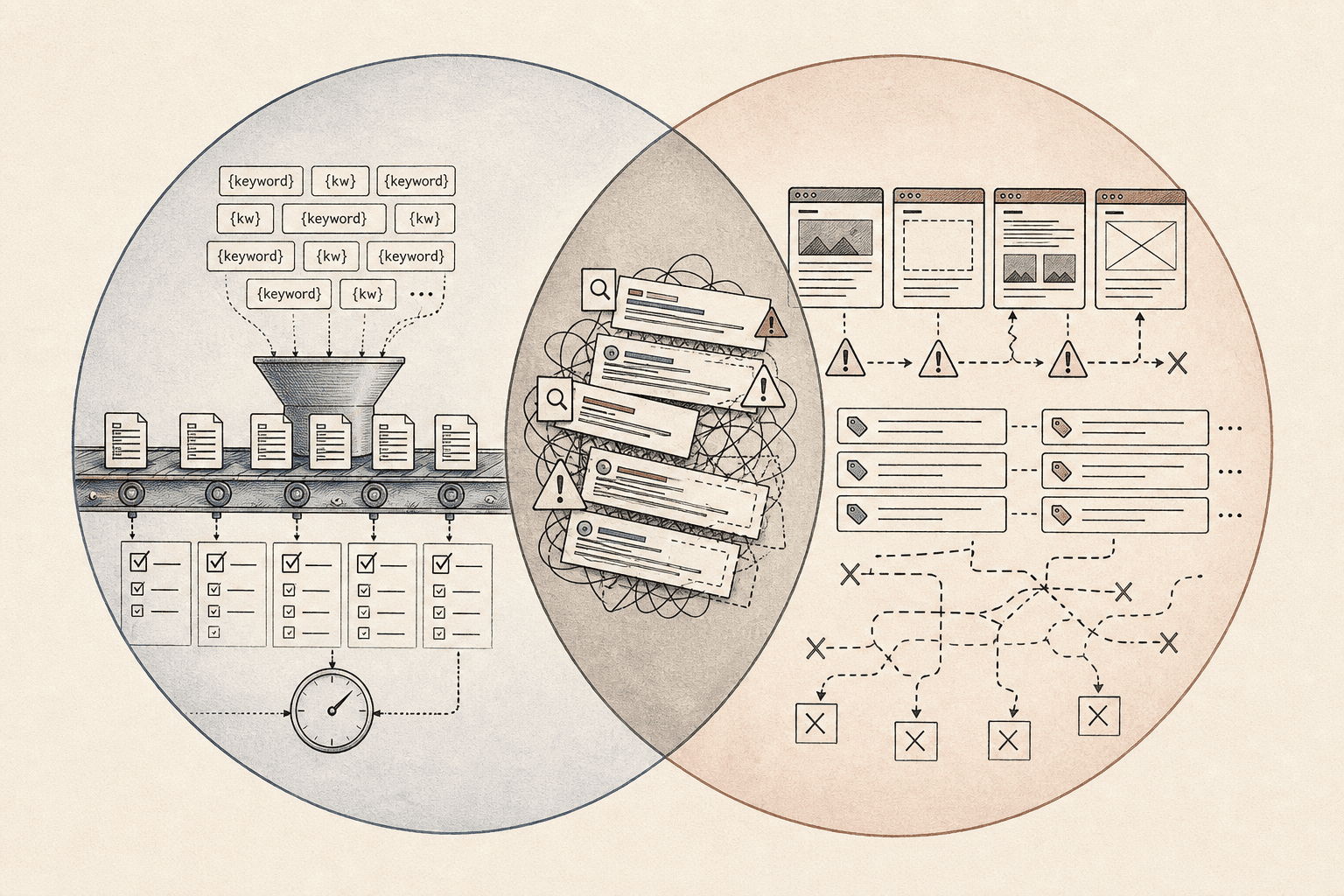
Mistake 1: Automating before defining content constraints
If your system publishes fast but the pages feel wrong, this is usually why. The copy drifts off brand. Compliance lines disappear. Page patterns repeat with tiny edits.
We felt this early. Run #1 looked efficient on the dashboard. Then we opened the pages and saw three near-clones, a shaky claim, and a service page linking to the wrong offer.
The root cause was not the model. It was missing rules. Teams skip briefs, entity rules, page templates, and approval conditions, so the agent fills the gaps with guesses.
That is how you keep SEO automation from publishing low quality pages: define the rules before the loop runs. In Mygomseo, we set reusable constraints first. We lock topic boundaries, tone rules, internal link rules, and required SERP checks before generation starts.
Quick fixes do not hold here. A better prompt helps once. It does not stop drift on page fifty. Technical cleanup matters too, because duplicate structures and weak page setup can create index bloat and crawl waste 10 Common Technical SEO Mistakes to Avoid for Better Rankings.
Here is a simple policy example:
allowed_page_types:
  - blog
  - service
  - comparison

required_schema:
  blog: Article
  service: Service

review_triggers:
  - medical_claim
  - pricing_change
  - new_entity

rules:
  tone: "clear, direct, no hype"
  internal_links_min: 3
  serp_check_required: true
This is boring work. It is also the work that saves you. Research from Agentic SEO: AI Agent Workflows for B2B | Authoricy shows 64% adoption around content brief generation, but briefs alone do not protect quality.
After we added constraints, rewrite rates dropped hard. Orphan pages fell. Approval got faster because reviewers checked edge cases, not everything. Even SVG path code from scraped content (/%3e%3cpath d='m16.0001...) stopped leaking into meta descriptions and title tags.
Mistake 2: Optimizing for output volume instead of search intent
This one looks good in a spreadsheet. More pages go live. More keywords get assigned. Nothing moves where it matters.
Rankings stay flat because the pages do not match intent. Conversions stall because visitors wanted a comparison, not a glossary. Your team ships more and trusts the system less.
The fast fix is usually more volume. Add more keywords. Publish more often. In agentic seo, that only compounds the mismatch and creates more cleanup later.
Our fix is simple. We score intent before production. We cluster topics by funnel stage. We block generation when the match is weak.
That means a bottom-funnel query does not get a top-funnel article. It also means we do not force new pages when a refresh, merge, or redirect is the smarter move. That protects crawl budget and keeps internal links cleaner 10 Common Technical SEO Mistakes to Avoid for Better Rankings.
Before this change, we saw high draft counts and slow wins. After the change, we published 40% fewer pages, but click-through rate improved from 2.1% to 3.8%, and pages earning 100+ monthly clicks doubled from 23 to 47. According to Agentic SEO: AI Agent Workflows for B2B | Authoricy, focused agent workflows can lift AI citation rate to 24%, which supports the same lesson: fit beats volume.
Our before and after was clear. Rewrite rates went down. Orphan pages dropped. Impressions-to-click efficiency improved because each page had a job. That is the point. Output is not the goal. Intent fit is.
Mistake 3: Letting the agent optimize the wrong signals
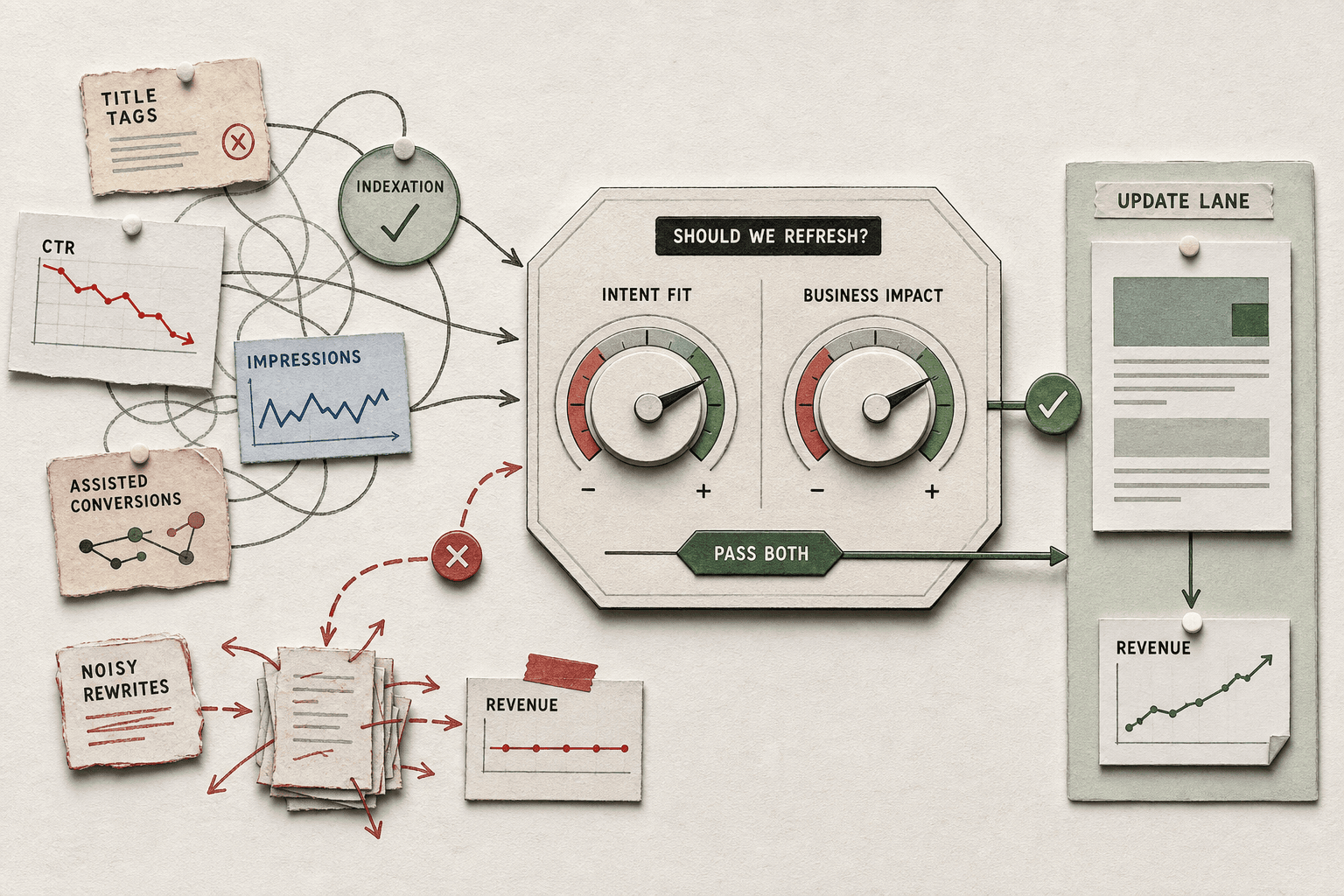
One Tuesday, we opened our pricing comparison page and found four title rewrites in ten days: from 'Compare SEO Tools' to 'Top SEO Platforms 2024' to 'Best SEO Software Ranked' to 'SEO Tools: Ultimate Comparison.' Each change chased a different keyword. CTR dropped from 4.2% to 2.9%. The page looked busier. It performed worse.
The root cause was not the copy. The autonomous SEO agent was chasing cheap wins. It got rewarded for keyword use, publish count, and crawl completion. None of those metrics pay your pipeline.
That is where agentic seo breaks quietly. The loop looks active, but it learns the wrong lesson. It keeps shipping visible changes that do not improve intent match, indexation quality, CTR, assisted conversions, or page decay recovery.
Quick fixes do not help much. Telling the system to "write better titles" only changes style. Adding more rules for headings just hides the scoring problem.
We fix this by tuning the reward loop around leading indicators that matter. We score pages on search intent fit first. Then we watch indexation quality, CTR trend, assisted conversions, and content decay before we trigger updates. Research from Agentic SEO: AI Agent Workflows for B2B | Authoricy shows 23.3% of marketing organizations have moved AI agents into production, which explains why weak scoring models now create very real messes.
Here is a simple version of that control logic:
refresh_rules:
  - page_type: blog
    trigger:
      impressions_drop_28d: ">15%"
      ctr_trend_28d: "<-0.2pp"
    require:
      indexation_status: "indexed"
      intent_match_score: ">=7"
    action: "refresh_title_intro_links"

- page_type: product
    trigger:
      assisted_conversions_28d: "<baseline"
      page_decay_score: ">6"
    require:
      template_compliance: true
      human_review: true
    action: "update_sections_cta_schema"
This matters in production. We only refresh pages when two signals line up. A traffic dip alone is not enough. A weak CTR trend alone is not enough. That keeps the loop from thrashing pages for no business reason.
Mistake 4: Removing human review at the wrong stage
The common myth is simple. If humans review anything, the system is not truly agentic.
That belief sounds efficient. It usually creates cleanup work. Teams remove review from strategy, templates, or sensitive pages, then spend days rolling back pages that should never have shipped.
According to Authoricy's research on agentic SEO, 90.3% of marketing organizations use AI agents somewhere in their stack. That does not mean every stage should run without judgment.
So, do we still need human review with an AI SEO agent? Yes. Just not everywhere. We keep people at the high-risk checkpoints, then automate the repetitive middle.
Our model is simple:
- Humans approve strategy, page templates, and sensitive page classes.
- The system handles drafting, formatting, linking, and scheduled refreshes.
- Humans review exceptions, conversion pages, and brand-risk edits.
That structure protects trust. It also keeps speed. In Mygomseo, we set review gates by page type, risk level, and change size. If a page touches pricing, claims, or core conversion paths, it pauses. If it is a low-risk refresh, it flows.
That is how you get real adoption. Approval times drop because reviewers see fewer junk edits. Production errors fall because risky changes stop earlier. Content and growth teams buy in because the system feels controlled, not reckless.
And yes, weird junk can leak into bad workflows. We've seen scraped SVG code pollute meta descriptions, escaped HTML entities break schema markup, and Unicode artifacts corrupt product names. That is exactly why human checkpoints still matter.
Agentic SEO Fixes Results and Prevention

Mistake 5: Running the loop without a feedback layer
Mistake five is the quiet killer. The loop keeps shipping, but nobody can say what it learned, what failed, or what should change next. Pages go live. Reports pile up. Slack gets noisy. Trust drops because the system looks busy, yet nobody can prove which actions helped rankings, lifted conversions, fixed decay, or improved internal links.
The real problem is not speed. It is the missing feedback layer. If published pages do not connect back to outcomes, your agentic SEO loop becomes a content factory with no memory. That is where weak refresh calls, random linking, and endless rework start. Quick fixes like more prompts or more dashboards do not solve that. You need one loop that ties planning, generation, publishing, monitoring, and refresh together.
That is how we run it in Mygomseo. We track actions, outcomes, and next moves in one system. A page brief leads to a template. The template sets rules. Publishing creates a record. Monitoring checks search signals, page quality, and business impact. Then refresh decisions happen from evidence, not vibes.
Here is the rollout order we use:
- Define goals first. Pick rankings, qualified traffic, conversions, or assisted revenue.
- Set page templates next. Lock structure, tone, entities, and link rules.
- Establish quality gates. Flag risky pages before they publish.
- Connect search data. Pull impressions, clicks, indexation, decay, and page changes.
- Launch small. Test one cluster before expanding across the site.
- Expand only after the loop proves stable.
A lightweight setup can look like this:
refresh_rule:
  trigger: impressions_down_21d AND ctr_below_cluster_avg
  action: refresh_intro, update_entities, add_2_internal_links

internal_link_rule:
  from_pages: same_cluster
  minimum_links: 2
  anchor_style: natural_variants_only

approval_threshold:
  auto_publish_if: quality_score >= 8.5 AND risk_level == low
  human_review_if: money_page OR medical OR legal OR score < 8.5
This is simple on purpose. Low technical teams need rules they can read, trust, and update fast.
The results are usually obvious within one or two cycles. We saw content rework requests drop from 47 tickets per month to 29 within the first quarter after implementing feedback loops. Publishing cycles moved from weeks to days. Indexed page quality improved because weak pages stopped slipping through. Non branded traffic also grew faster once refreshes and links followed clear signals instead of guesswork.
The prevention side matters just as much. Audit the loop every month. Retire templates that create weak pages. Keep approval gates for high risk content. And never let the agent grade itself alone. That is how bad logic survives for months.
The best agentic SEO systems are not fully hands off. They are tightly designed, easy to inspect, and easy to trust. If you want a cleaner loop without adding more chaos, Try Mygomseo Free.