How to Build a Self-Healing SEO System Using Agentic Feedback Loops

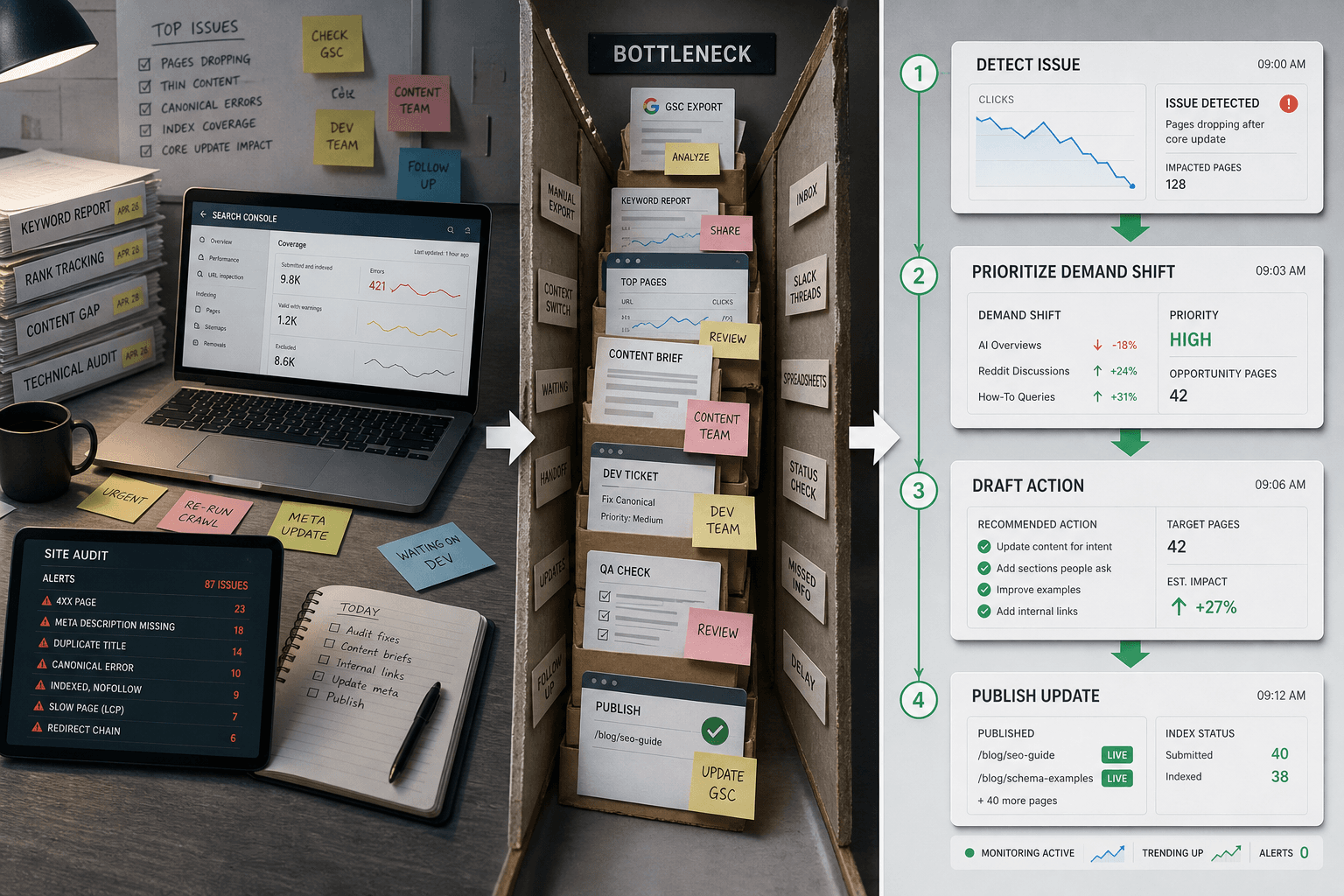
Agentic seo is how you stop babysitting broken workflows. It gives you a system that spots issues, picks the next action, and improves results with less manual work.
That matters because most teams still run SEO through scattered audits, spreadsheets, and one-off fixes. Then rankings shift, templates change, and the whole process snaps. According to Technical SEO Self-Healing Systems: Fix Site Errors in 2026, 40% of SEO issues can be caught and corrected faster with self-healing automation.
In this tutorial, you will build a self-healing SEO system in Mygomseo. You will use feedback loops, guardrails, and approval rules you can actually run. The focus is practical implementation, clear decision logic, and production-minded testing - not vague AI hype.
Part 1: Agentic SEO Foundations and Prerequisites
What You’ll Build
In this part, you’ll define the smallest system worth building. Your scope should stay tight. You will monitor rankings, page health, internal links, content freshness, and remediation actions inside one workflow.
Think of it like a thermostat for search performance. It does not guess. It checks conditions, spots drift, and triggers the next best move. In plain English,agentic seomeans a system that can observe, diagnose, decide, act, verify, and learn with limited human intervention.
For example, you might watch revenue pages for sudden traffic drops. If one page slips, Mygomseo can flag the issue, suggest a likely fix, and route it for approval before anything changes.
What You’ll Learn
By the end of this section, you’ll understand the project boundary first. That matters because vague scope creates noisy alerts and weak decisions. You are not building a robot to “do all SEO.”
You are building one autonomous SEO agent for one business problem. You will also learn how that differs from basic seo automation. Automation runs preset tasks. An agent weighs signals, selects an action, and then checks whether the result helped.
Why agentic SEO Beats One-Time Audits
A one-time technical seo audit gives you a snapshot. It tells you what broke today. It does not keep watching tomorrow.
Agentic seo works more like a smoke detector with a checklist. It keeps listening for change. When traffic drops, links break, or content gets stale, the loop starts again. That is why it is self-healing in practice. The system does not just report problems. It supports the next response.
For example, if an internal link points through a redirect chain, fixing it can preserve cleaner flow. According to Technical SEO Self-Healing Systems: Fix Site Errors in 2026, a direct URL path preserves 100% of link equity.
Prerequisites, Tools, Accounts, and Access
By the end of this section, you’ll know what access to gather before setup. Keep this list simple and complete.
- Mygomseo account
- Google Search Console access
- GA4 property access
- CMS editing access
- A page inventory with key revenue pages
- A simple approval workflow for changes
If your team is small, one approver is enough. If your process is messy, review Save time with bulk workflows for similar connections.
Your Minimum Viable Feedback Loop
Start with one use case only. Detect traffic drops on revenue pages. Then trigger a fix recommendation with optional approval.
This is your minimum viable feedback loop: observe the drop, diagnose likely causes, decide the safest fix, act after approval, verify results, and learn from the outcome. That core pattern borrows from self-healing test systems, where the goal is not magic, but fast recovery with fewer manual checks.
Part 2 Build Your Agentic SEO Workflow in Mygomseo
1. Sign up and connect your data sources
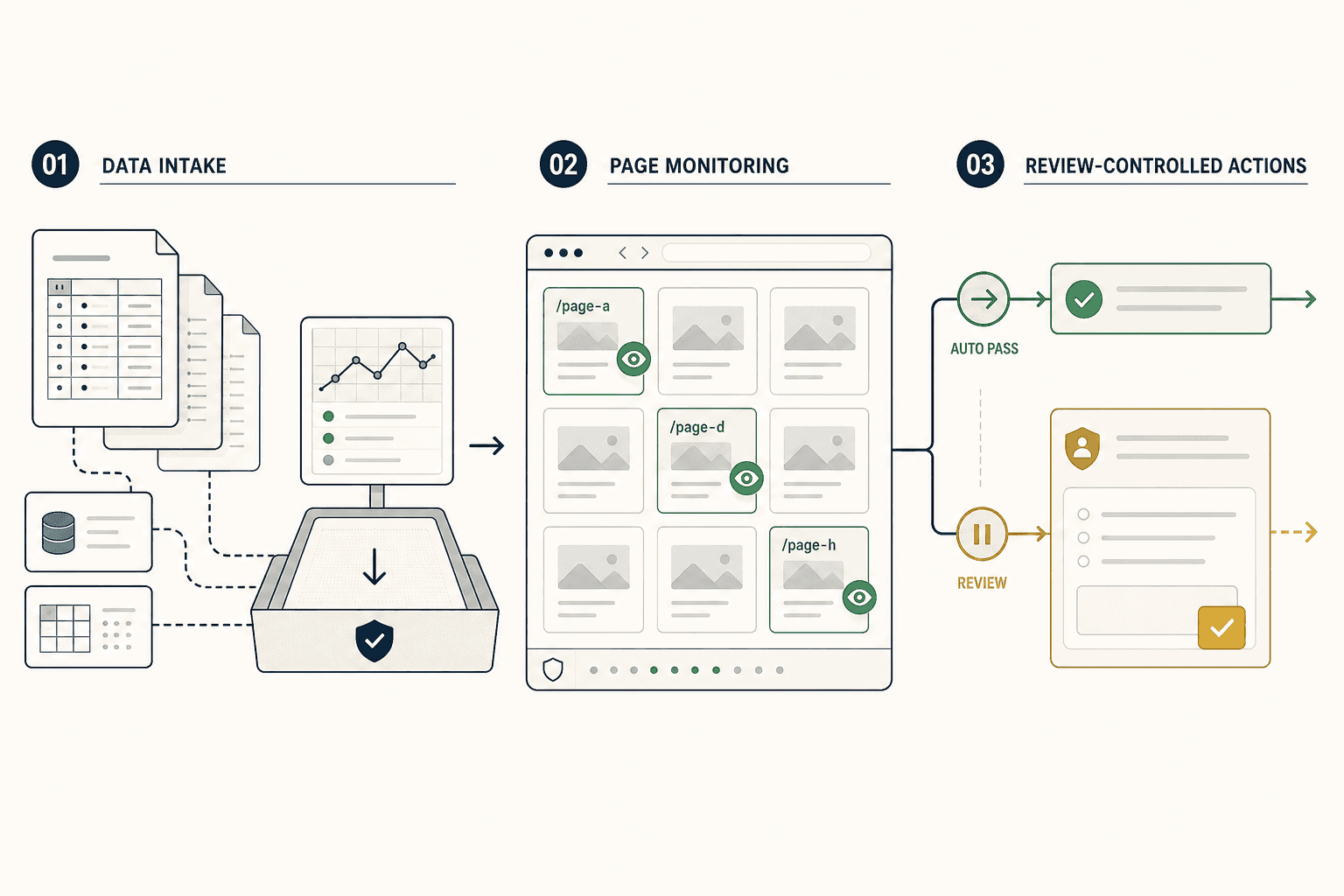
Start by you sign up for Mygomseo and create a new workspace. Then connect Google Search Console and your analytics property. This gives your workflow search data, landing page behavior, and trend context in one place.
Next, import your priority URLs. Keep this list tight at first. Use revenue pages, core service pages, and high-intent blog posts. Then define business goals for each group, such as leads, demos, or assisted conversions. That step matters because your agent should protect business value, not chase random ranking noise.
If your page sets share patterns, group them by template. For example, put location pages in one bucket and product pages in another. That makes later fixes faster, much like Save time with bulk workflows for similar connections.
2. Create your first monitoring agent
Now build your first autonomous seo agent. In Mygomseo, create one agent for a narrow scope, such as priority landing pages. Tell it to watch ranking drops, indexing changes, content decay, and template-level issues.
For example, your services template may lose clicks across twelve pages at once. A human may spot one page late. An agent spots the shared pattern early and flags the template, not just the symptom.
For a visual walkthrough of workflow thinking, check out this tutorial from Nate Herk | AI Automation:
3. Set triggers conditions and confidence thresholds
Keep your first rules boring. That is a good thing. If impressions drop and crawl health changes, trigger diagnosis first. Do not jump straight to edits. You want evidence before action.
Set confidence thresholds inside Mygomseo for each signal. A mild ranking wobble might only create an alert. A confirmed indexing loss plus crawl errors can open a technical seo audit task. This is how agentic seo stays useful instead of noisy.
Research from Technical SEO Self-Healing Systems: Fix Site Errors in 2026 shows 80% for front-end fixes in self-healing systems, but SEO still needs careful thresholds before wide changes.
4. Map actions to issue types
Next, map each diagnosis to an allowed action. If the issue is content decay, suggest a content refresh brief. If the problem is canonical drift, open a technical fix ticket. If several pages break after one deploy, route the issue to the shared template owner.
Think of this like a decision tree, not a magic box. Self-healing tools work best when each issue type has a clear next step.
5. Add human intervention where risk is high
Can AI do SEO automatically? Yes, for monitoring, triage, and low-risk recommendations. It can even prepare fixes. But high-impact actions still need human intervention.
Add approval steps for changing titles at scale, deindexing pages, or editing templates directly. Those actions can hurt traffic fast. Use predictive self-healing where risk is low, and require review where brand, compliance, or revenue risk is high.
Part 3 Add Self Healing SEO Automation
1. What counts as self healing in SEO
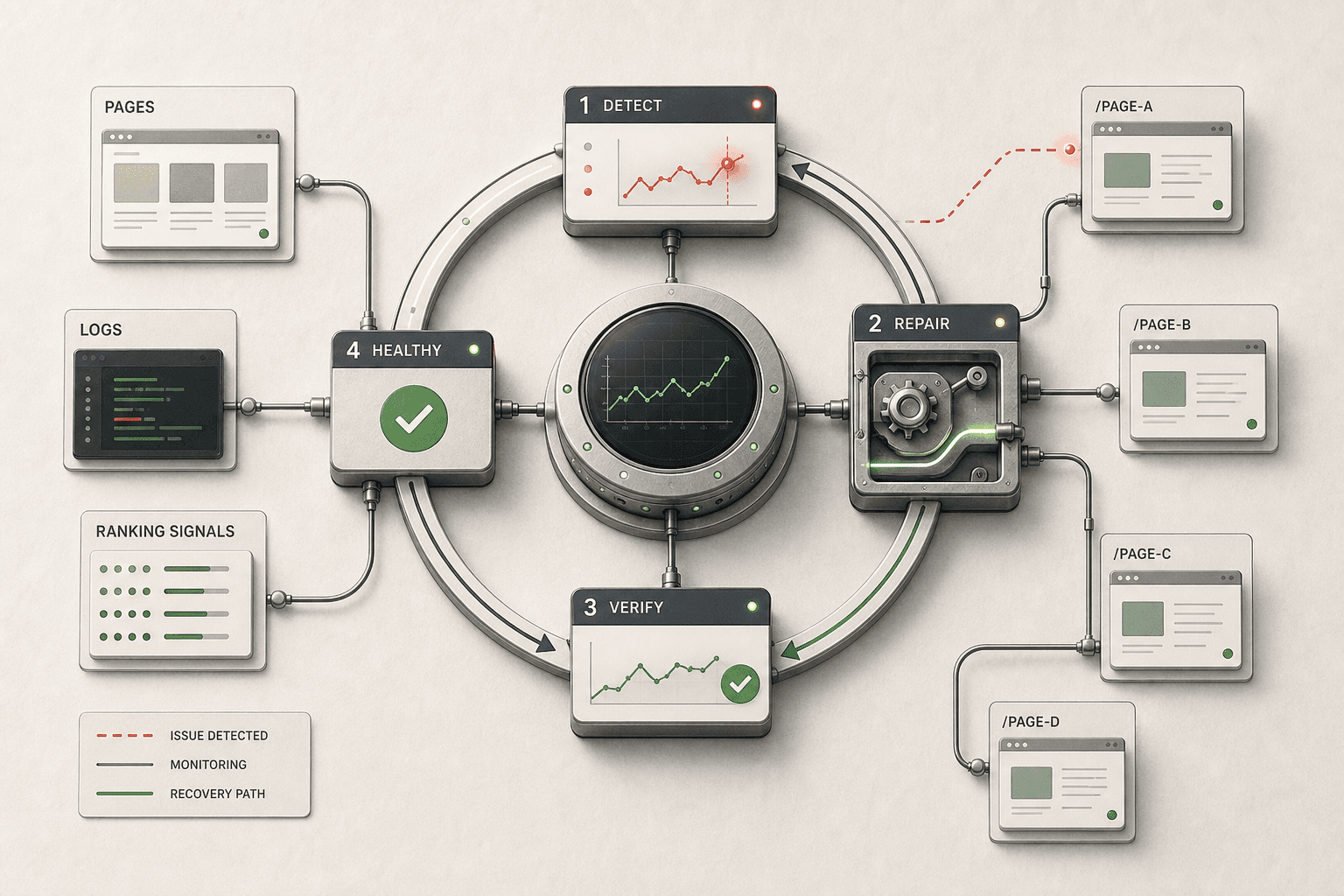
A self-healing workflow acts like a smart site operator. It sees a failure, picks the right response, and verifies the outcome. If the result fails, it rolls back or asks for review. That is why self-healing tools matter. They reduce repetitive cleanup work without removing human control. For a broader view of operational workflow design, see Digital Marketing & Operations Executive (UK).
For example, a crawler finds twenty broken internal links on product pages. A basic system sends you an alert. A self-healing system maps each dead URL to the best live target, updates links, and re-crawls those pages. That recovery pattern mirrors how self-healing systems work in testing and automation Self-Healing Test Automation: What It Is & Why It Matters.
2. Build remediation playbooks for common failures
Start with playbooks, not prompts. Each playbook should define the trigger, diagnosis, action, verification step, and fallback path. In Mygomseo, you can build one playbook for broken internal links, one for stale content, one for metadata conflicts, one for indexing anomalies, and one for sudden non-brand click drops.
For example, if a page title duplicates another template, your system can suggest a replacement based on page intent, publish the change, then check crawl output and click data. If stale content slips past your refresh schedule, it can queue an update brief first. This is also why Save time with bulk workflows for similar connections fits large page sets.
3. Use predictive self healing for early warnings
Predictive self-healing starts before rankings crash. Watch for crawl pattern shifts, falling CTR, or template regressions across similar pages. If three category pages lose rich results after a code release, your system should treat that as an early warning, not a future postmortem. Technical SEO Self-Healing Systems: Fix Site Errors in 2026 describes this preventive model well.
Research from Self-Healing Test Automation: What It Is & Why It Matters shows a visual asset at 1024x, which is a useful reminder here: the interface matters, but the real value is verified recovery logic.
4. Set guardrails to avoid bad automated changes
Not every fix should auto-run. Use rollback logic, rate limits, page priority rules, and a confidence score before execution. For example, let high-confidence internal link fixes publish automatically, but require approval for title rewrites on revenue pages. If a fix lowers clicks or creates new conflicts, the system should reverse it fast. That is how agentic seo stays safe while is self-healing.
Part 4 Testing Your Agentic SEO System
Testing checklist before production
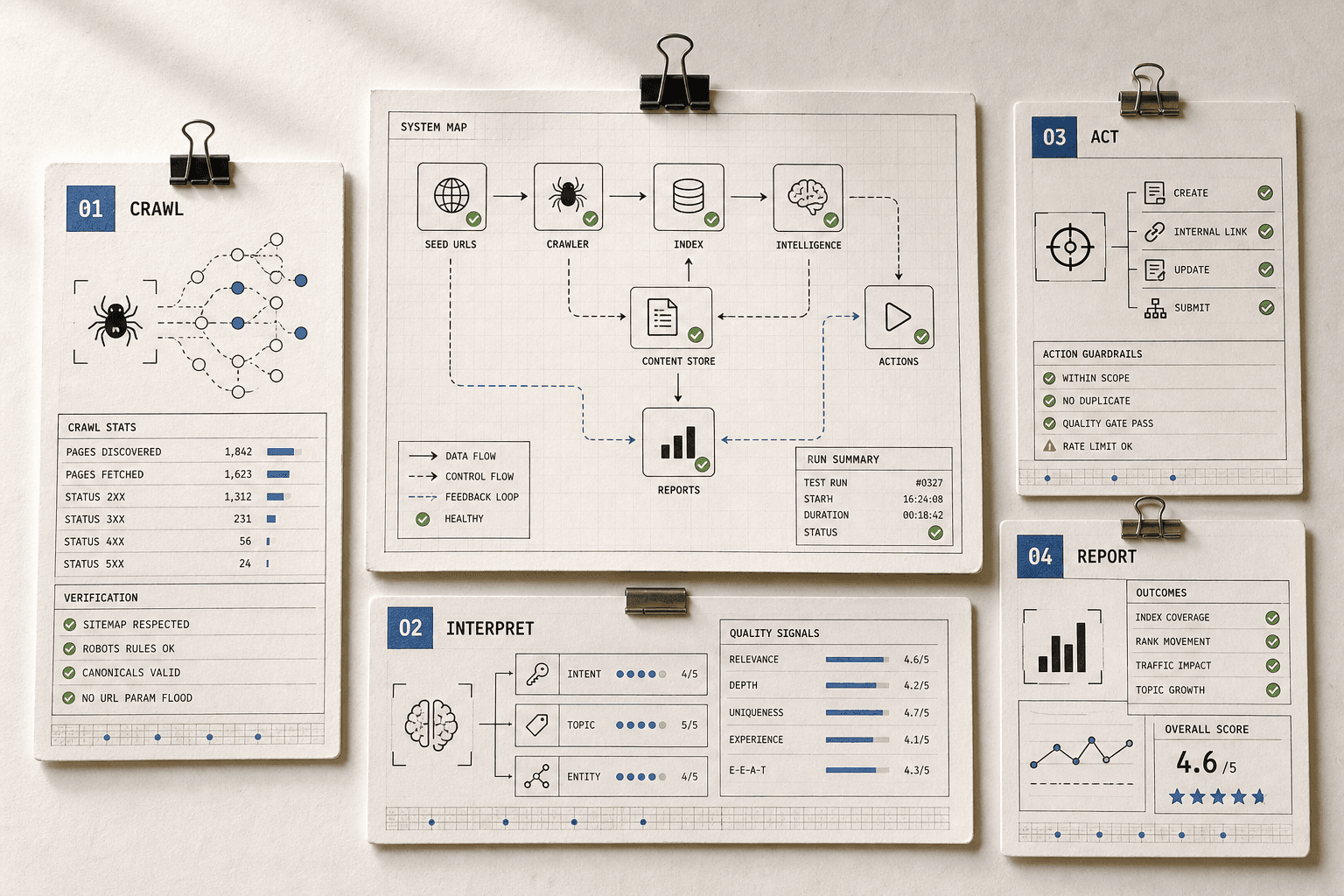
In this part, you will learn how to test your workflow before real damage happens. Testing is not optional. Your first agentic seo rollout should stay inside a narrow sandbox.
Start with one template, one category, or a fixed set of revenue pages. That gives you a clean baseline. It also makes human intervention fast if something goes sideways.
Before production, confirm five basics:
- Alerts fire on the right thresholds.
- Diagnosis steps pull the right page data.
- Recommendations match your SEO playbooks.
- Execution logs show every change.
- Rollback steps work without manual digging.
Think of this like a flight checklist. You do not test the whole fleet first. You test one aircraft, under control, with clear observers.
Run a self-healing test on one page group
In this part, you will learn how to run a self-healing test with known failure cases. Do not wait for random problems. Create controlled scenarios on one page group inside Mygomseo.
For example, remove an indexable tag and replace it with noindex on a staging copy. Then weaken internal links to a key page. Next, age an important page by leaving outdated copy in place. Finally, simulate a ranking dip by pausing a high-value internal link block and watching the system respond.
At this point, your workflow should detect the issue, run a technical seo audit, recommend the next action, and verify the fix after execution. If the agent misses the pattern, document it. That miss becomes training data.
Measure false positives false negatives and lift
In this part, you will learn what to measure in a self-healing test. Focus on outcomes that affect trust.
Track issue detection speed, recommendation quality, execution accuracy, reversal rate, and organic performance changes. Also log false positives, where the system flags a problem that is not real. Log false negatives, where it misses a real issue.
According to Technical SEO Self-Healing Systems: Fix Site Errors in 2026, developer time can cost $100 per hour, which makes bad fixes expensive.
Failure modes and rollback planning
In this part, you will learn how to fail safely. Your agentic seo system needs brakes, not just speed.
Document every bad recommendation, delayed alert, and incorrect change. For example, if a title rewrite hurts clicks, note the trigger, action, result, and rollback used. Over time, your system gets smarter instead of quietly repeating mistakes.
Scale agentic seo with control
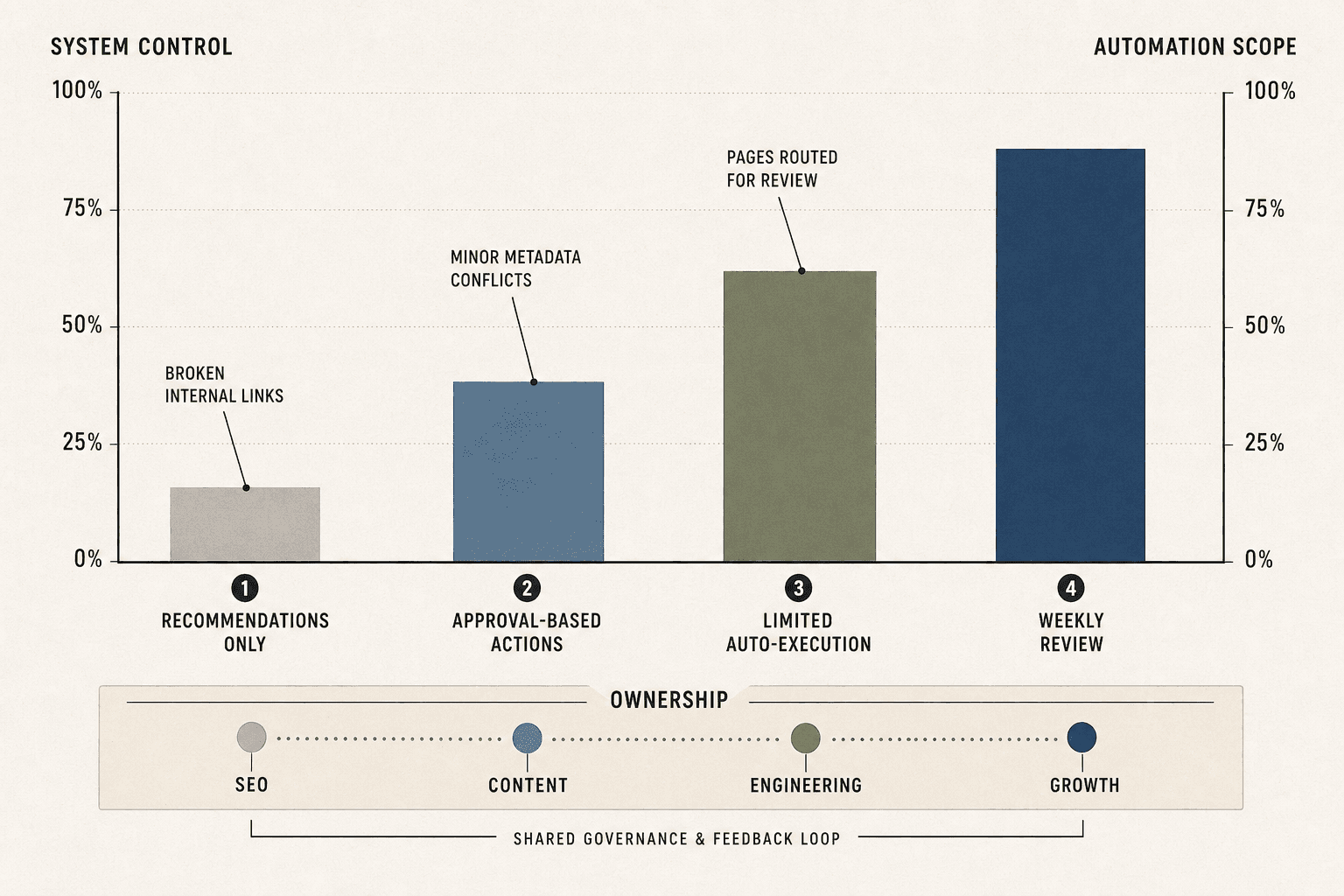
Your next move is phased deployment. Start with recommendations only so you can verify judgment. Then move to approval-based actions for higher-impact changes. After that, allow limited auto-execution on low-risk fixes, such as broken internal links, minor metadata conflicts, or routing obvious pages to review. That sequence keeps trust high and mistakes contained.
Ownership matters just as much as automation. Your SEO lead should own rules and priorities. Content should handle updates and refreshes. Engineering should cover templates, schema, and technical exceptions. Growth should tie outputs back to business goals. If nobody owns the loop, it becomes another dashboard people ignore.
You also need a weekly review rhythm. Use Mygomseo reporting to spot wins, flag exceptions, and pull pages that need manual review. That habit turns your system from a noisy monitor into a feedback engine that improves over time. You are not trying to automate everything. You are building a process that gets sharper, safer, and faster with each cycle.
That is the real payoff: a practical system you can scale without losing control.
If you want a simple place to start, Try It Free to export and share projects and design simple connections.