AI Overview Tracking: How to Know When Google's AI Mentions Your Brand (And When It Doesn't)

Ai overview tracking answers a blunt question: did Google cite you, or skip you? If you are not monitoring AI answers, you are missing wins and losses that rank trackers never show. That gap matters now because AI search changes visibility fast. According to 5 Best AI Marketing Tools for Growth Teams (2026) - Maestra.io, combined SEO and AI visibility tools can start at $199, so you need a clear process before you pay for more software. This guide shows you how to set up monitoring, spot inclusion triggers, and improve citation chances step by step. You will learn what to check, what to log, and what signals matter. By the end, your team will have a repeatable workflow you can verify every week.
Prerequisites for AI Overview Tracking
What tools and accounts you need
Prepare five basics before you track anything in Google.
- Open Google Search Console and confirm access to your site.
- Export a keyword list with queries and landing pages.
- Create a spreadsheet or dashboard for weekly checks.
- Use a browser in clean mode, like Incognito.
- Add one ai overview checker for faster spot checks if needed.
This answers a common question: what is ai overview tracking? It is the process of logging when Google shows an AI answer, whether your brand mention appears, and which source URLs get cited.
You should now have one place to record every check.
What data you should collect before you start
Collect the fields you will review every week. Include query, target page, device type, location, AI Overview shown, brand mention, citation URL, and notes. For example, track “best payroll software for startups” on mobile in Chicago, then log whether your page appears in the ai reply.
Use Search Console to find priority terms. Focus on queries with impressions, weak positions, and clear buyer intent. If you want outside context on mention monitoring, How to track brand mentions in AI search and Mention Monitoring and AI Tools for Successful SEO Promotion show common fields teams track.
You should now see a working sheet built for google ai overview tracking.
How to define success metrics
Set three simple metrics before launch.
- Count AI Overview presence rate.
- Count brand mention rate.
- Count citation rate by page.
At this point, your sheet should map 20 to 50 priority queries to target pages. Verify that each row includes device, location, and ai visibility fields before proceeding.
Step 1 Set Up Google AI Overview Tracking
1. Build your query set
Group your target queries by intent first. Use three buckets: informational, comparison, and transactional. For example, “how to reduce churn” fits informational. “best CRM for startups” fits comparison. “CRM pricing for small business” fits transactional.
Then narrow the list to the terms most likely to trigger AI answers. Start with question-based searches, problem-based searches, and “best” queries. These often surface AI search summaries more than branded home page terms. If you want to track how your brand performs, include both branded and non-branded searches in the same sheet.
Add columns for query, intent, device, location, AI Overview appears, cited domains, and brand mention. This makes google ai overview tracking easier to repeat each week. You should now have a query set that reflects real search behavior, not guesses.
Verify that every query has one clear intent label before proceeding.
2. Create a clean checking process
Open an incognito browser before every check. Stay logged out of Google if possible. This reduces noise from search history, account activity, and past clicks. Use the same browser, same device type, and same process every time.
Check each query one by one. Record whether an AI Overview appears at all. Then capture the cited domains inside the answer. Also note whether your brand appears in the written response, the source list, or nowhere. For example, your page may not rank first, but your site may still earn a citation.
If you need a visual walkthrough of how these results look in practice, check out this tutorial from Surfer Academy:
Run checks weekly for most teams. Switch to twice per week if you publish often or compete in a fast-moving niche. You can also monitor by location and device, but keep those variables separate. Check mobile and desktop in different rows. Log city or country in its own column. At this point, your process should feel boring. That is good. Boring means repeatable.
Verify that you use the same process for every query before moving on.
3. Log baseline results
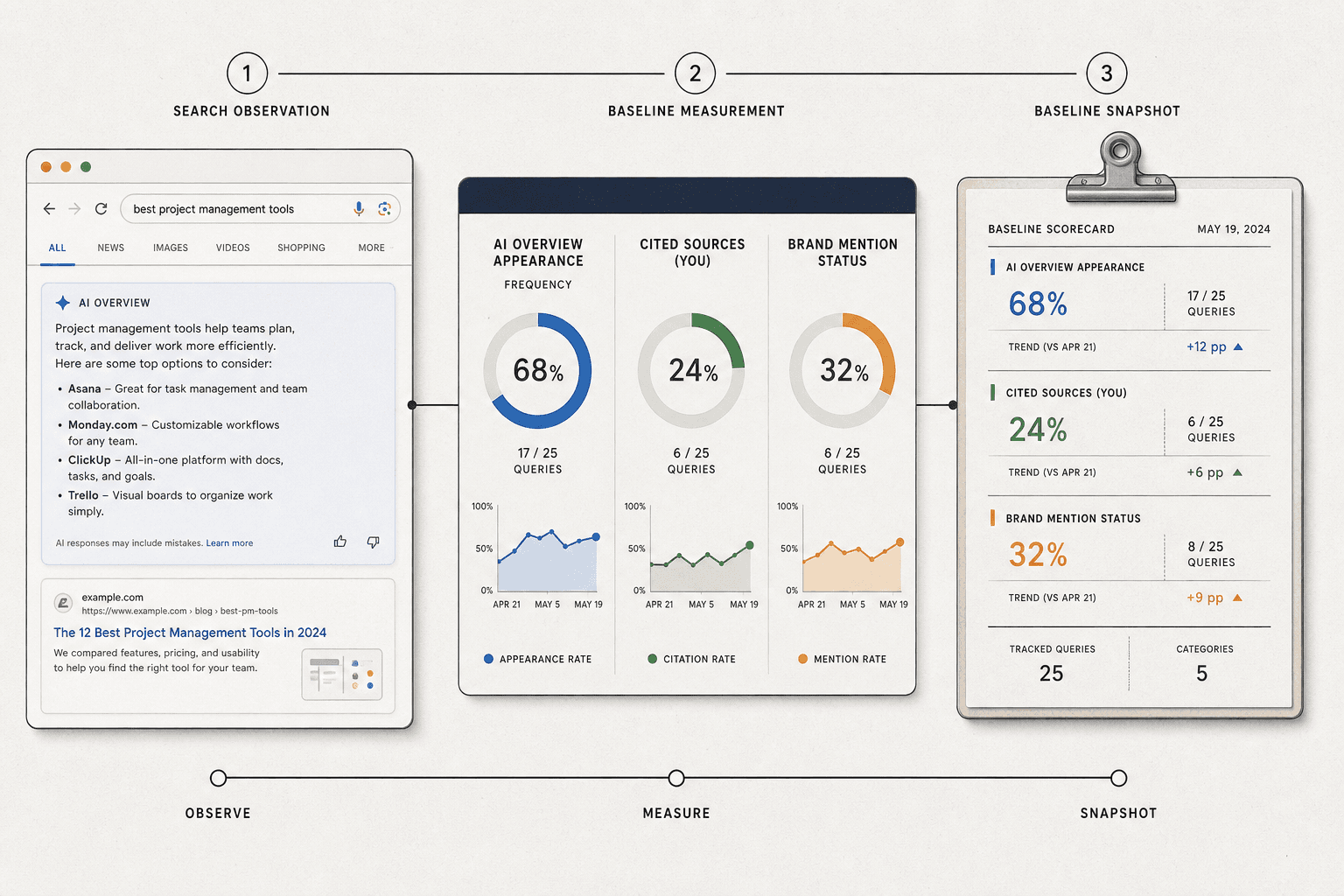
Calculate three numbers after your first pass. First, find your appearance rate. Divide queries with an AI Overview by total queries checked. Second, find your citation rate. Divide queries where your site is cited by total queries checked. Third, list the pages and domains that win mentions most often.
For example, if 12 out of 30 queries show an overview, your appearance rate is 40%. If your brand shows on 3 of those 30 queries, your citation rate is 10%. Research from Mention Monitoring and AI Tools for Successful SEO Promotion shows 92% of consumers trust earned media more than many other formats. That makes citation tracking worth your time.
You should now see your first baseline for ai overview tracking. Verify that your sheet shows which queries trigger AI Overviews, which competitors earn citations most often, and whether your brand shows at all.
Step 2 Find AI Overview Inclusion Triggers
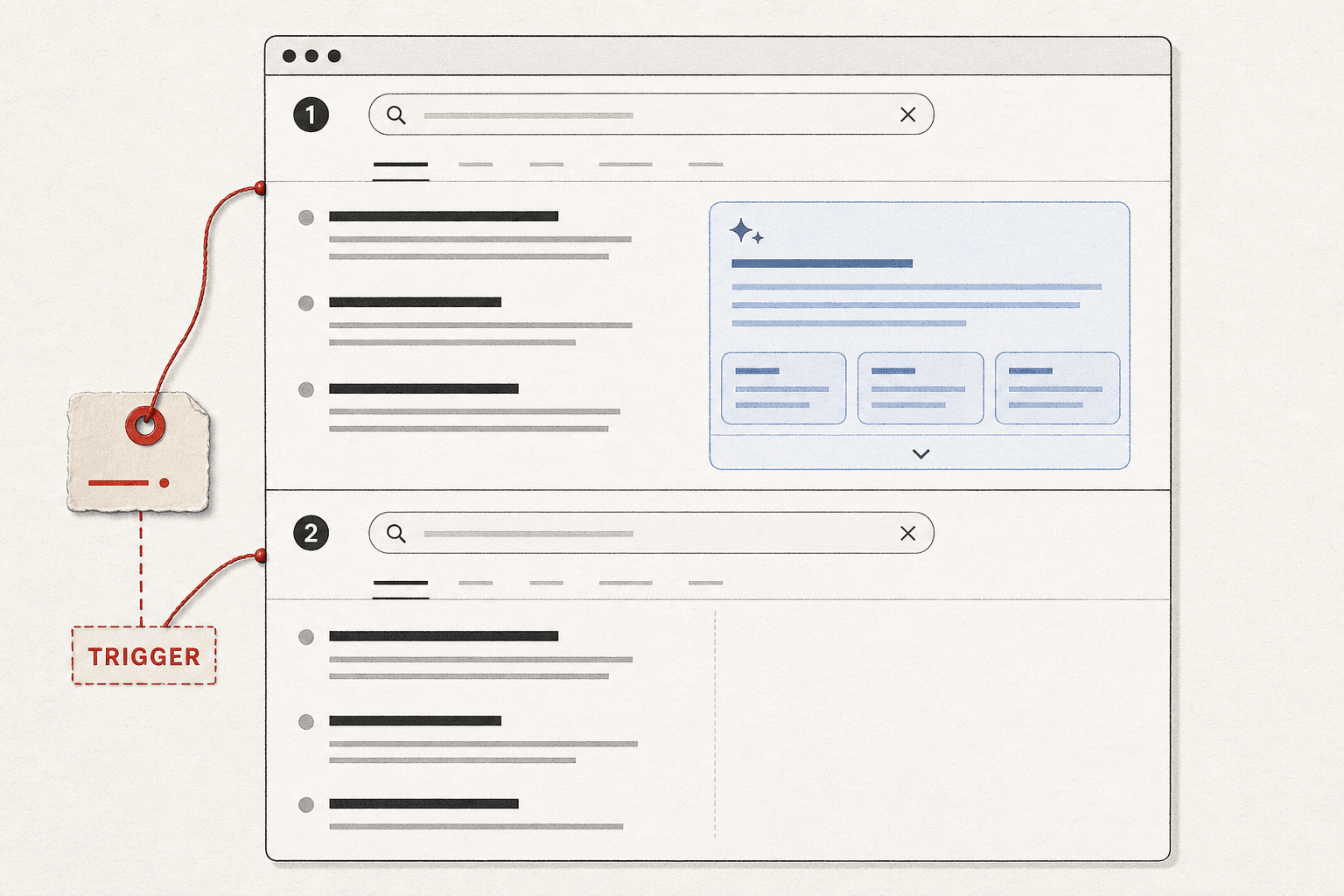
Review query patterns that trigger AI Overviews
Start by comparing close variants of the same topic.
- Search one broad query, one specific query, and one comparison query.
- Tag each query by intent: informational, navigational, commercial, or local.
- Mark whether Google shows an AI Overview for each version.
- Note the wording that appears most often in winning queries.
For example, compare “what is customer data enrichment,” “customer data enrichment tools,” and “HubSpot vs Segment.” You may find that informational and comparison queries trigger AI search features more often than brand-homepage queries. Queries that ask for definitions, steps, pros and cons, or direct comparisons often give Google clearer material to summarize.
Analyze pages and domains Google cites
Next, inspect the pages Google pulls into the answer.
- Open each cited result.
- Check whether the page answers the query in the first screen.
- Look for structured headings, short definition blocks, comparison sections, and recent examples.
- Record whether the page mentions recognizable entities, products, or brand names.
A cited page usually removes ambiguity fast. It says what the topic is, who it applies to, and how options differ. Research from CXL shows 79% of cited snippets came from content ranked in the top 10 results. That does not guarantee inclusion, but it does show source clarity still matters.
For a visual walkthrough of this process, check out this tutorial from Ahrefs Tutorials:
Also check the domain type. If Google cites vendor blogs, publishers, and official docs for the same query, note that mix. If your brand shows only on branded searches, your content may lack the neutral, direct format needed for broader inclusion. Adobe also explains that tracking brand mention patterns in AI search helps you spot where your visibility breaks down across queries and answer types (Adobe).
Turn patterns into hypotheses you can test
Now convert your notes into testable rules.
- Write one trigger per line.
- Tie each trigger to an example query and cited page.
- Turn each pattern into a simple hypothesis.
- Choose one page to update first.
For example, write: “Informational queries with concise definitions trigger more often.” Or: “Pages with comparison tables earn citations for versus terms.” Another useful hypothesis is: “Pages that name known tools or brands win more citations because Google can anchor the answer to clear entities.”
You should now have a short list of likely triggers: informational intent, concise definitions, comparison formatting, fresh facts, and strong source clarity. At this point, your ai overview tracking should reveal repeatable patterns across pages earning a citation or brand mention. Verify that at least three winning pages share the same traits before you proceed.
Conclusion
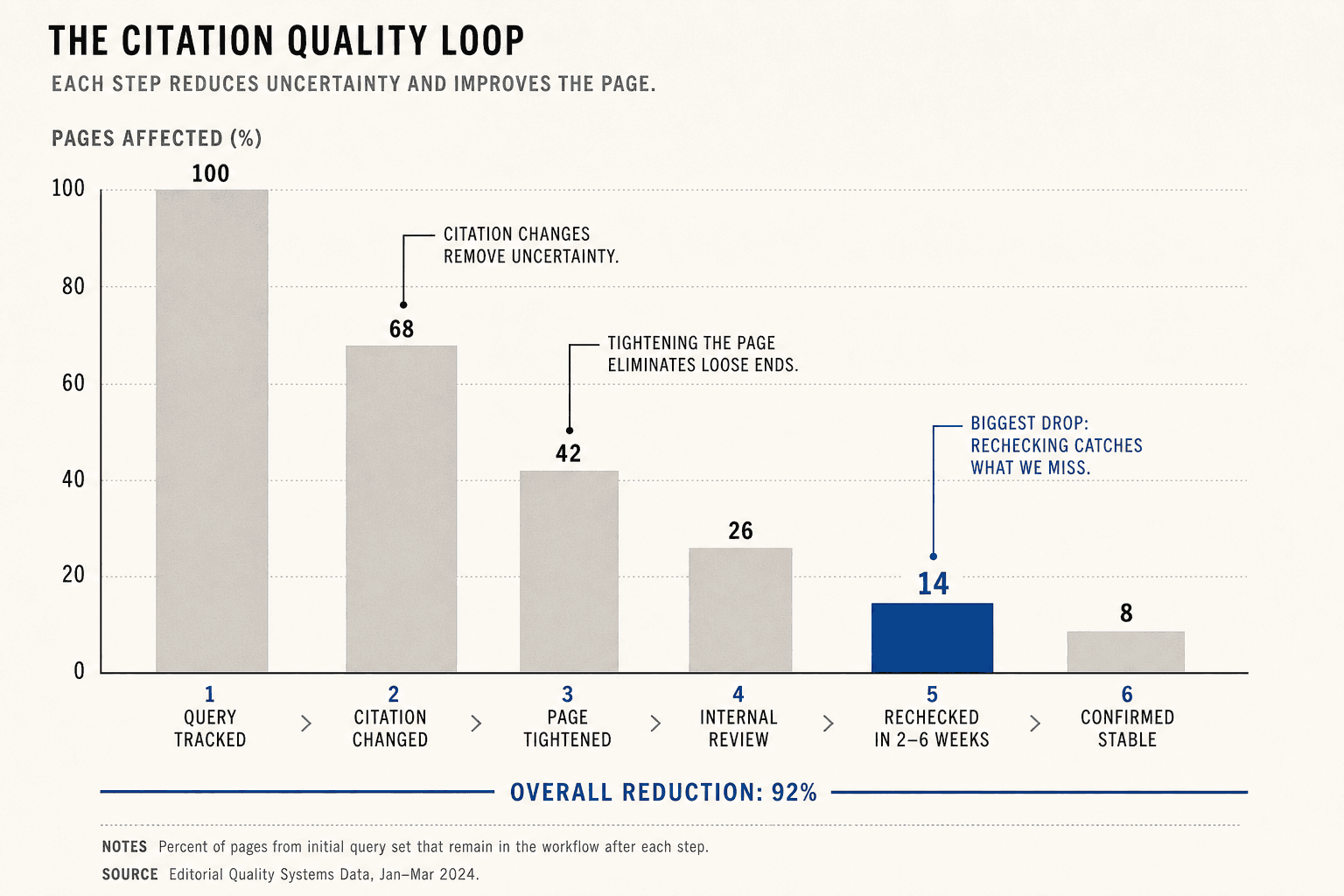
That is the real shift. AI visibility does not improve from broad content updates or vague SEO tasks. It improves when you make specific pages easier to quote, easier to trust, and easier to map to one search intent. In Step 3, you tighten the page so Google has less work to do. You place a clear answer near the top. You use question-led headings that match real queries. You sharpen definitions, add original facts when you have them, and remove sections that pull the page in three directions at once. That is how you increase the odds of a brand mention without forcing it.
You also make your tracking cleaner. When a page has one job, your team can judge results faster. You can look at a query, review the AI reply, and see whether the citation changed because of structure, clarity, or source strength. That matters. If you cannot tell why a page earned visibility, you cannot repeat it. If you can spot the pattern, you can scale it across other pages, templates, and topic clusters.
The payoff is focus. Instead of rewriting your whole site, you can update a small set of high-opportunity pages first. Start with pages already earning impressions. Pick the queries that already show AI search features. Then build answer blocks, simplify headings, and make attribution obvious but controlled. Your goal is not to sound robotic. Your goal is to become the easiest reliable source to cite.
Keep the timeline realistic. After you publish, recheck the same tracked queries over the next 2 to 6 weeks. Watch whether the AI overview checker shows new citations, lost citations, or no movement at all. Compare device, query wording, and page format. Then decide what to scale next. Double down on formats that earn mentions. Rewrite pages that still miss the mark. Drop tests that create noise.
If there is one takeaway, it is this: treat google ai overview tracking like an operating system, not a one-time audit. Track the query. Inspect the answer. Improve the page. Recheck the result. That loop helps you move from guesswork to proof. It also gives your team a repeatable process for track ai overviews, verify ai visibility, and grow the pages most likely to win the citation.
AI search will keep changing, but clear answers, clean intent, and visible source signals will keep mattering. Want a simple place to organize and share your workflow? Try It Free to export and share projects and design simple connections.