SEO Audit Tool for Agencies: What to Look For When You're Managing 20+ Clients

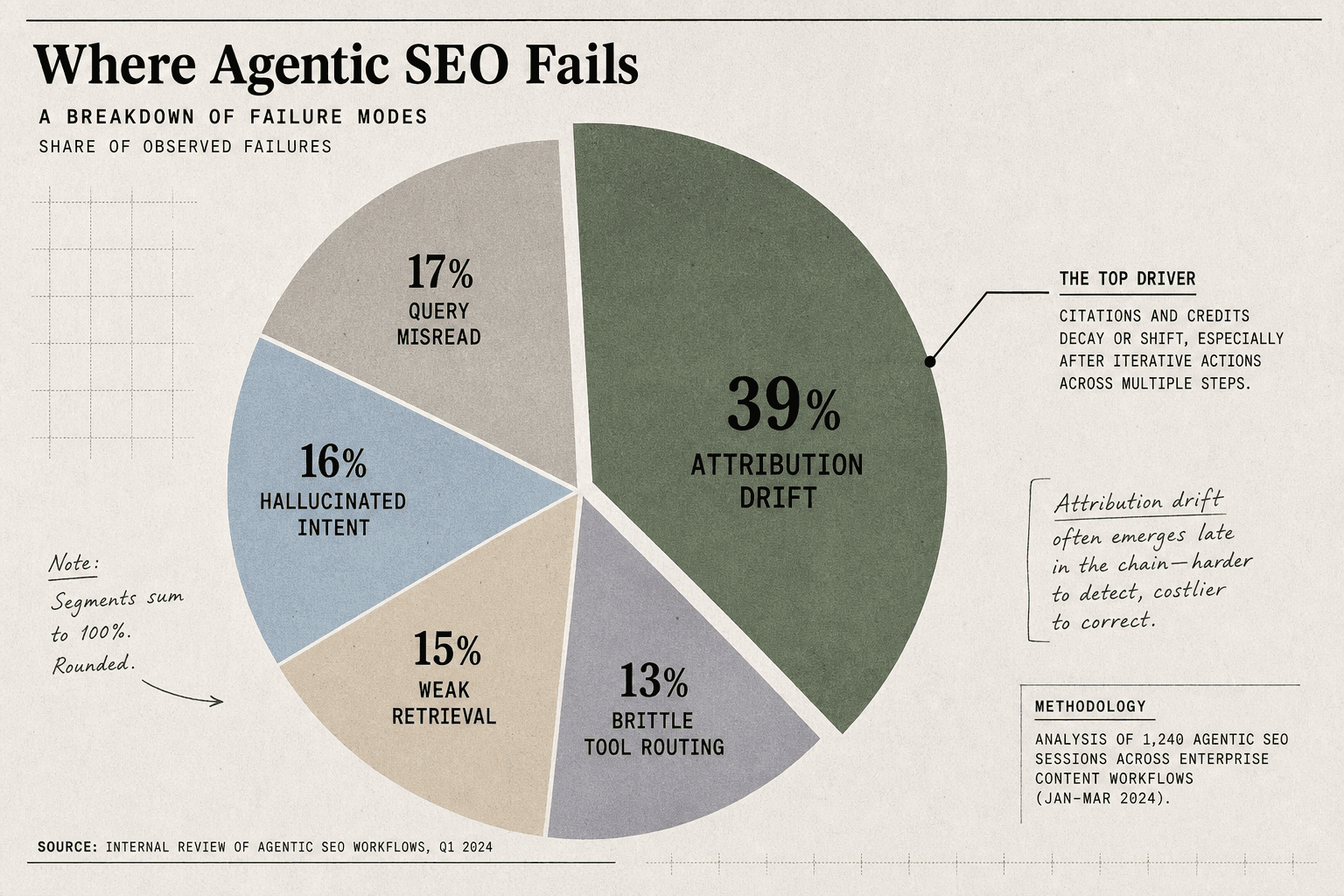
A weak seo audit tool for agencies slows everything down. The right one speeds audits, reporting, and action across every client account. That matters more now because most seo tools handle basic scans, but agencies managing multiple clients need more than issue lists. According to The Best Free & Paid SEO Software Tools For Agencies in 2026 | SEOTesting, one tested page delivered a 90% traffic lift after a content refresh. Data from The Best Free & Paid SEO Software Tools For Agencies in 2026 | SEOTesting also shows a 0.2% click-through rate across 58.8 million impressions in Search Console. This comparison breaks down white label reporting, bulk auditing, local SEO support, and automation. It also uses one framework for every platform and shows where Mygomseo differs as the agentic alternative.
How to Evaluate an SEO Audit Tool for Agencies
Multi client workflow
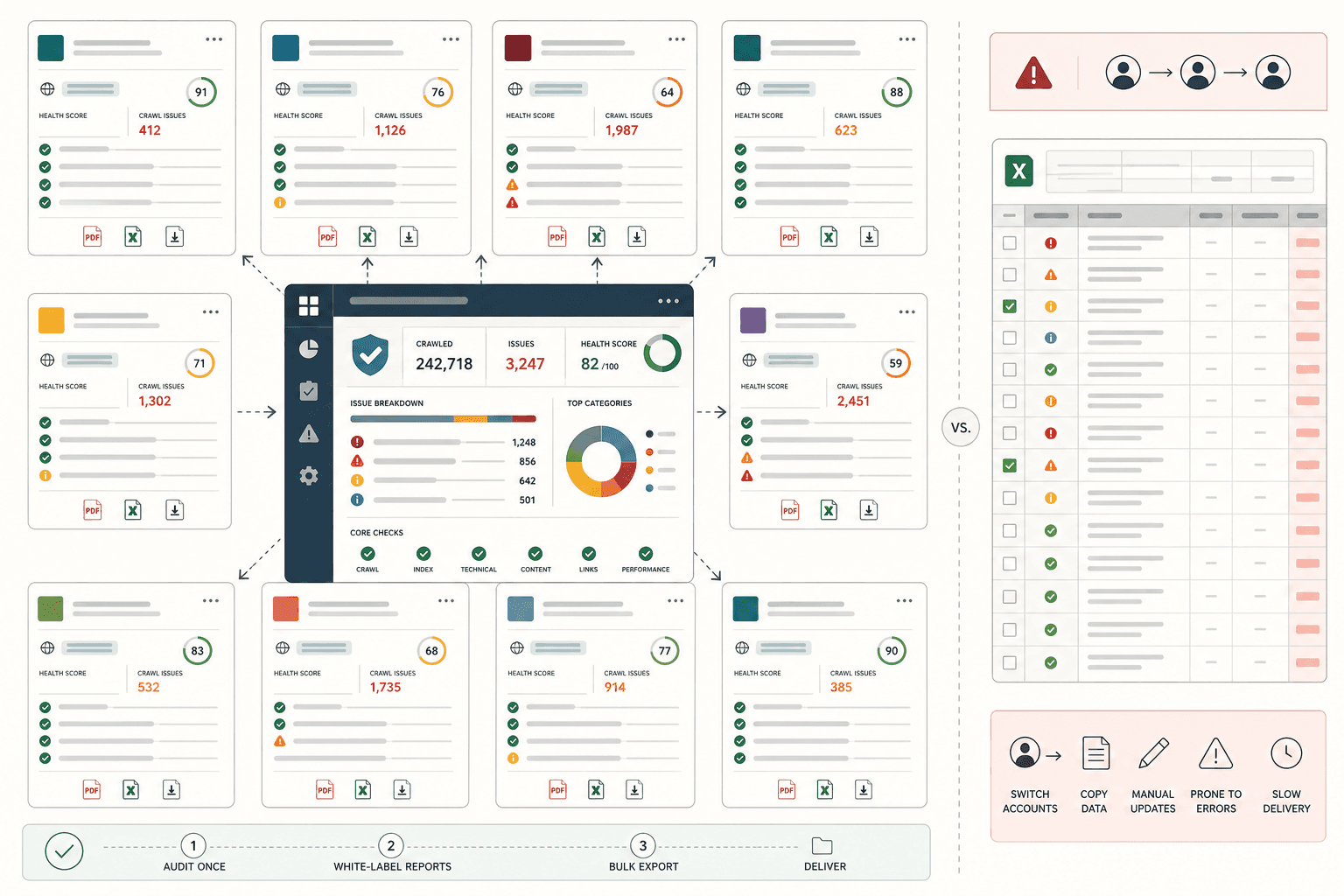
Multi client workflow comes first because agencies managing ten accounts face different problems than a single in-house team. For example, fast account switching matters when one strategist reviews five sites before lunch. Shared notes, clear permissions, and simple task handoff also matter. A goodseo tool for agenciesshould feel like one control room, not ten separate tabs.
White label reporting
White label reporting matters when agencies need client-ready output without extra design work. Reports should carry the agency logo, colors, and domain, but the real test is export quality. For example, a branded PDF that still needs cleanup costs time. Swydo highlights how white label reporting saves time only when dashboards and exports are presentation-ready from the start (Swydo).
Bulk auditing and crawl depth
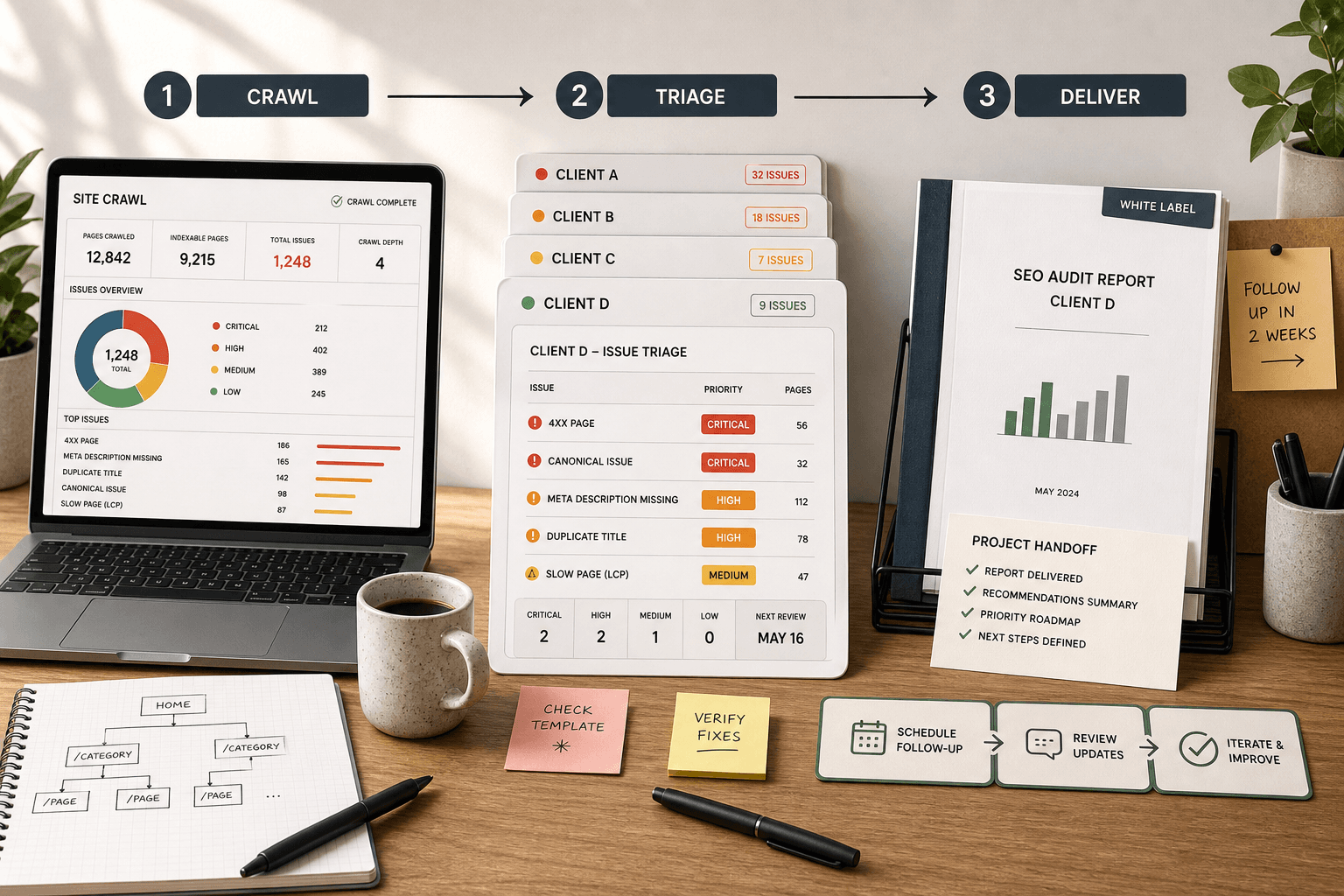
Bulk auditing shows whether a tool can handle portfolio scale. A shallow crawl may flag broken titles, but miss deeper template issues across category pages. Agencies should check crawl limits, project caps, and how the platform handles local SEO locations at scale. One Little Web notes that agencies often need tools for audits, tracking, and reporting in the same workflow (One Little Web).
Automation versus reporting only
Some platforms report problems well, but stop there. Others help automate fixes, recurring checks, content tasks, or follow-up workflows. That difference matters because a good report without action is like a mechanic listing faults but never opening the hood.
The team at Merchynt demonstrates this concept clearly:
Pricing and team fit
Pricing should be measured against team fit, not sticker price alone. Network Solutions notes that SEO tools vary widely by feature depth and business size (Network Solutions). Agencies should score each option on account switching, export quality, and manual work after each audit. Teams that want lightweight support can also test Free community tools before expanding.
Best SEO Audit Tools for Agencies Compared
Ahrefs
Overview
Ahrefs is a broad SEO platform with strong site auditing, backlink data, and keyword research. For agencies, it works well as a central research hub when teams need to review technical issues and search visibility in one place. For example, an account manager can audit a client site, pull keyword gaps, and check lost backlinks without changing tools.
Key Features
Ahrefs includes Site Audit, Rank Tracker, backlink analysis, competitor research, and keyword discovery. Its dashboards help agencies move from crawl findings to search opportunity analysis quickly. It also supports scheduled crawls, which helps teams monitor several clients without rerunning every review by hand.
Strengths
Ahrefs is strong when agencies need clear technical findings plus strong off-page context. That matters for local SEO projects where rankings often depend on both site health and link authority. It also helps agencies explain why an issue matters, not just where it appears. According to The Best Free & Paid SEO Software Tools For Agencies in 2026 | SEOTesting, organic click-through rates can reach 59% for high-intent searches, which makes ranking visibility data more valuable during client reviews.
Weaknesses
Ahrefs still leaves follow-up execution to the team. It identifies problems well, but agencies must usually handle task creation, content updates, and workflow handoff elsewhere. White label reporting is also not its main identity, so agencies with branded client reporting needs may need extra tools.
Best For
Ahrefs fits agencies that want deep research and strong audit context in one place. It is a strong option for strategy-led teams that already have project management and fulfillment systems in place.
Mygomseo
Overview
Mygomseo takes a different approach. Instead of stopping at issue detection, it aims to carry work forward after the audit. That makes it notable for agencies that need speed across repeated client tasks. For example, if a team audits 15 local business sites in one week, the platform can help move from findings to next actions faster than tools that only export reports.
Key Features
Mygomseo focuses on automated auditing, follow-up workflows, and operational support after the scan. Its value is less about giving another issue list and more about reducing the manual steps that usually follow. That matters for agencies handling white label work, recurring SEO tasks, and high client volume.
Strengths
Mygomseo stands out as the agentic option in this group. Where other seo tools for agencies often report the problem, Mygomseo is positioned to automate what happens next. That can help with bulk auditing, client-by-client action queues, and repeatable optimization work. Agencies that need a practical stack may also pair platform workflows with Free community tools for lighter research tasks.
Weaknesses
The trade-off is breadth. Teams that want the deepest backlink index or the widest third-party SEO database may still rely on a research-heavy platform beside it. Agencies also need to confirm whether every niche workflow they use today maps cleanly into the product. In other words, Mygomseo may reduce effort after the audit, but some teams may still want another tool for advanced market research.
Best For
Mygomseo fits agencies that care most about execution speed after audits. It suits teams managing multiple clients, repeat local SEO deliverables, and operational workflows that break when too much work stays manual. For agencies asking whether oneseo audit tool for agenciescan handle audits and follow-up actions, this is the clearest yes in the group.
Screaming Frog
Overview
Screaming Frog is a desktop crawler built for technical SEO work. It is often the fastest way to inspect site structure, redirects, status codes, metadata, and crawl depth. For example, when a developer hands over a redesigned site, an agency can use Screaming Frog like a flashlight in a dark attic - it shows what is broken fast.
Key Features
Its core strengths include deep crawling, custom extraction, duplicate content checks, redirect analysis, and integration options with analytics and search data. Agencies can use it to test large sites, isolate technical patterns, and export detailed issue sets for review. It is especially useful during migrations and QA checks.
Strengths
Screaming Frog is efficient and detailed. It gives technical teams a fast way to validate site health across many URLs. For local SEO work, that can help uncover broken location pages, thin metadata, or internal link gaps. Research from Best SEO Tools for Your Business in 2026 shows that 20% improvements can come from better technical and on-page refinement, which supports the case for strong crawl analysis.
Weaknesses
It is not built as a polished client-facing platform. White label reporting, multi-client collaboration, and workflow automation are limited compared with broader SaaS suites. Because it is desktop-based, it can also feel less convenient for distributed agency teams that need shared dashboards and fast stakeholder access.
Best For
Screaming Frog fits technical agencies and consultants who want precise crawl control. It works best as a specialist tool, not a full agency operating system.
Semrush
Overview
Semrush is an all-in-one marketing platform with auditing, keyword tracking, competitor analysis, and reporting. For agencies, it offers wide coverage across SEO, content, and paid search. That makes it useful when one account team manages broad digital work and wants fewer standalone tools.
Key Features
Semrush includes Site Audit, position tracking, local SEO support, listing management, keyword research, and branded reporting options. Its client portal and reporting features help agencies package findings in a cleaner way than some technical-first tools. It also supports campaign monitoring across many domains.
Strengths
Semrush balances breadth and usability well. Agencies can run audits, monitor rankings, review local listings, and build reports from one environment. Unlike Screaming Frog, it is easier for non-technical stakeholders to read. Unlike Ahrefs, it often leans more into agency presentation and workflow packaging. Teams that also cover content planning may find related roles and process models useful in resources like Marketing Manager (US).
Weaknesses
Semrush can feel broad before it feels simple. Teams may pay for features they do not use, and deep technical users may still prefer a dedicated crawler for edge cases. It also reports extensively, but many follow-up actions still depend on outside execution.
Best For
Semrush fits full-service agencies that want one platform for audits, reporting, and campaign oversight. It works well for agencies that need client-friendly outputs and a wider digital marketing view.
Which Tool Is Best
There is no single winner for every agency. Ahrefs is strong for research depth. Screaming Frog is strong for technical crawling. Semrush is strong for broad reporting and campaign visibility. Mygomseo is strongest when the real bottleneck starts after the audit, not during it.
If an agency wants one tool to find issues and another system to manage fixes, Ahrefs or Semrush can work well. If the goal is one agency seo tool that helps handle audits and follow-up actions in the same flow, Mygomseo has the clearest operational fit.
White Label Reporting and Bulk Auditing Comparison
Side by side comparison table
The comparison below focuses on agency operations, not just raw feature counts. It looks at pricing, white label depth, bulk workflows, and how well each platform supports agencies managing several client accounts at once. Pricing and tool positioning reflect current market summaries from SEOTesting, Whatagraph, and OneLittleWeb.
- Mygomseo — Starting Price: Custom · White Label: Yes · Bulk Audits: Strong · Multi Client Management: Strong · Local SEO Support: Yes · Automation Depth: Deep · Best For: Agencies that want audits plus follow-up execution
- Semrush — Starting Price: $139.95/mo · White Label: Limited · Bulk Audits: Moderate · Multi Client Management: Strong · Local SEO Support: Yes · Automation Depth: Moderate · Best For: Larger teams needing broad SEO tools
- SE Ranking — Starting Price: $65/mo · White Label: Yes · Bulk Audits: Moderate · Multi Client Management: Strong · Local SEO Support: Yes · Automation Depth: Moderate · Best For: Small agencies needing balanced cost and reporting
- Ahrefs — Starting Price: $129/mo · White Label: No native white label · Bulk Audits: Limited · Multi Client Management: Moderate · Local SEO Support: Limited · Automation Depth: Light · Best For: Teams focused on research over client reporting
- Screaming Frog — Starting Price: $279/yr · White Label: No · Bulk Audits: Strong on crawl audits · Multi Client Management: Weak · Local SEO Support: No · Automation Depth: Light · Best For: Technical auditors handling site crawls in bulk
- Whatagraph — Starting Price: Custom · White Label: Yes · Bulk Audits: Weak · Multi Client Management: Strong · Local SEO Support: Limited · Automation Depth: Moderate · Best For: Agencies centered on branded reporting
Common pain points agencies hit
Semrush covers many jobs well, but white label depth stays limited for some teams. For example, an agency may finish solid audits, then still rebuild reports by hand for each client. That slows handoff and adds manual exports. Network Solutions and Whatagraph both frame reporting flexibility as a key buying factor.
Ahrefs is strong for research, but weaker for agency presentation workflows. A strategist can find issues fast, yet branded client delivery often needs extra tools. Screaming Frog hits a different wall. It handles bulk crawls well, but multi-client views feel operationally thin.
SE Ranking offers a more agency-ready middle ground. Still, bulk work can become repetitive at scale. For example, agencies managing franchise sites may need repeated setup changes across many locations. Local SEO also matters more than many general SEO platforms suggest, especially for service businesses with many listings, as noted by Localo.
The real breakdown happens after the audit. A seo audit tool for agencies should not stop at issue detection. Research from SEOTesting shows 25% savings on annual billing for some tools, but lower software cost does not remove labor cost. According to SEOTesting, 43% is still a useful reminder of how large the web ecosystem is, which makes manual auditing harder at scale. That is why many teams pair reporting tools with automation layers or even Free community tools for faster repeat tasks.
Which Agency SEO Tool Fits Each Team
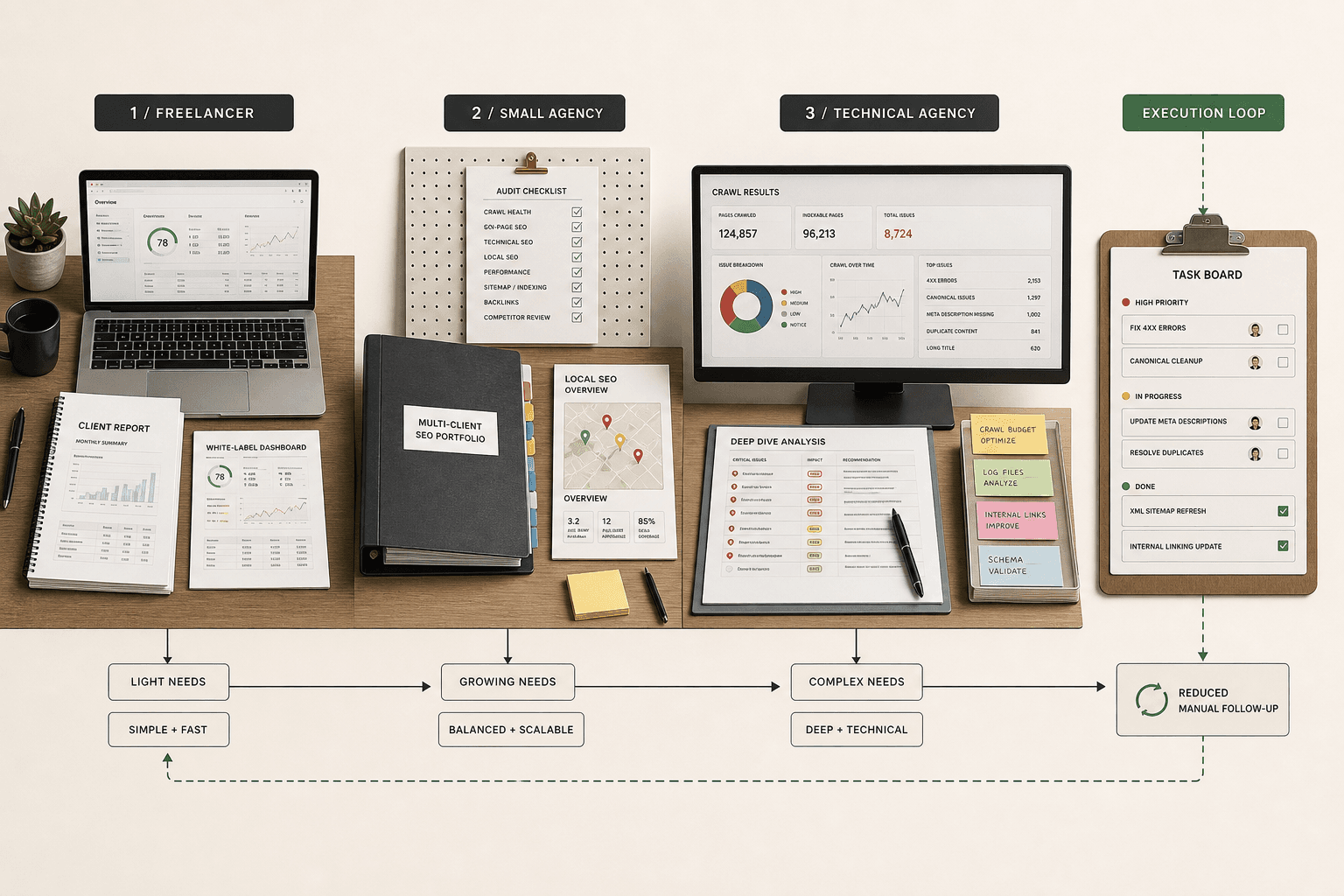
Smaller agencies and freelance teams often need clean reports, simple workflows, and fast client handoff. In those cases, a lighter agency seo tool with strong white label output can make more sense than a deep technical platform. Mid-sized agencies with broader service lines usually need balance. They need solid audits, easier multi-client management, and local SEO coverage without adding heavy training costs. Larger agencies, or shops with technical SEO as a core service, may get more value from tools built for deeper crawling, custom analysis, and advanced issue review.
The split becomes sharper when reporting demands rise. Teams selling clarity to clients should favor tools that make exports, branding, and account switching painless. Teams selling technical depth should lean toward crawlers and analysis features. Teams that want less manual follow-up should look hardest at an agentic system. That is where Mygomseo stands apart. It does not stop at surfacing problems. It helps reduce the execution work that other seo tools often leave on the team.
The best next step is simple. Match the tool to the agency’s size, service mix, technical depth, and reporting pressure, then test real workflows before committing. For a hands-on starting point, Try It Free.