AI SEO Agent Deep Dive: What It Actually Does Inside Your Site (Not Just What It Reports)

Most teams treat an ai seo agent like a better prompt box. That mistake kills search growth. They get drafts, summaries, and keyword lists, but not execution across pages, links, schema, and refresh cycles. According to Printful, 1% can change outcomes fast when margins are tight. We built practical AI SEO automation at Mygomseo for lean teams that need shipped work, not polished demos. In this piece, we will show how agentic loops run on a real site, what the agent decides alone, and when humans step in. Data from Printful shows 2%, but the bigger story is leverage. The real win is a system that keeps moving after the first output.
Why Most Agentic SEO Claims Fall Apart
The current state of AI SEO automation
Most AI SEO automation still behaves like a faster content assembly line. We see polished AI wrappers everywhere, yet most stop at drafts, briefs, and surface suggestions. The market calls that progress. We call it partial automation.
The real workflow is still split across disconnected seo tools. Keyword research sits in one dashboard. Content lives in another. Internal links end up in a spreadsheet. Publishing waits in a CMS queue. Yotpo’s review of leading ai seo tools reflects that fragmented stack, with separate products handling separate jobs rather than one system owning outcomes (Best AI SEO Tools 2026: Master Generative Search).
I remember the Tuesday night I hit 47 open browser tabs. I was hunting for why our highest-converting page had dropped 40% in two weeks. Tab 12 held Search Console. Tab 19 showed our CMS. Tab 31 was the link map in Sheets. Tab 44 was our page speed dashboard. By 11 p.m., I had the diagnosis. By midnight, I'd drafted the fix. By 2 a.m., I was still waiting for our CMS queue. We lost three more days of traffic. That's when I knew partial automation wasn't enough. That is not agentic seo. That is manual coordination wearing an AI badge.
Why prompt chains are not autonomous systems
A prompt chain can generate steps. It cannot own a goal. That distinction matters.
Agentic SEO means the system can observe site data, decide what to do next, act inside defined guardrails, verify the result, and adapt. If it cannot close that loop, it is not an ai seo agent. It is a scripted assistant.
Many teams confuse chained prompts with autonomy because the output looks smart. But smart output is not operational judgment. A real system should spot a drop in clicks, trace the affected pages, update internal links or metadata, check the change, and escalate only when risk rises. Most so-called ai seo tools never reach that bar.
Where traditional seo tools still break the workflow
Traditional seo tools still break at handoff points. They surface insight, then force humans to move data, rewrite tasks, and push changes elsewhere. That gap creates delay, inconsistency, and lost learning.
Printful's overview shows pricing across AI SEO products ranges from $50 to $500 per month, yet cost does not solve orchestration (20 Top AI SEO tools (2026): Supercharge your Printful store | Printful). According to Printful, even the broader AI tooling landscape remains scattered (20 Top AI SEO tools (2026): Supercharge your Printful store | Printful). So, are AI SEO tools actually autonomous? Mostly, no. They assist execution. They rarely manage the whole site loop.
How an AI SEO Agent Works Inside a Real Site
The observe decide act verify loop
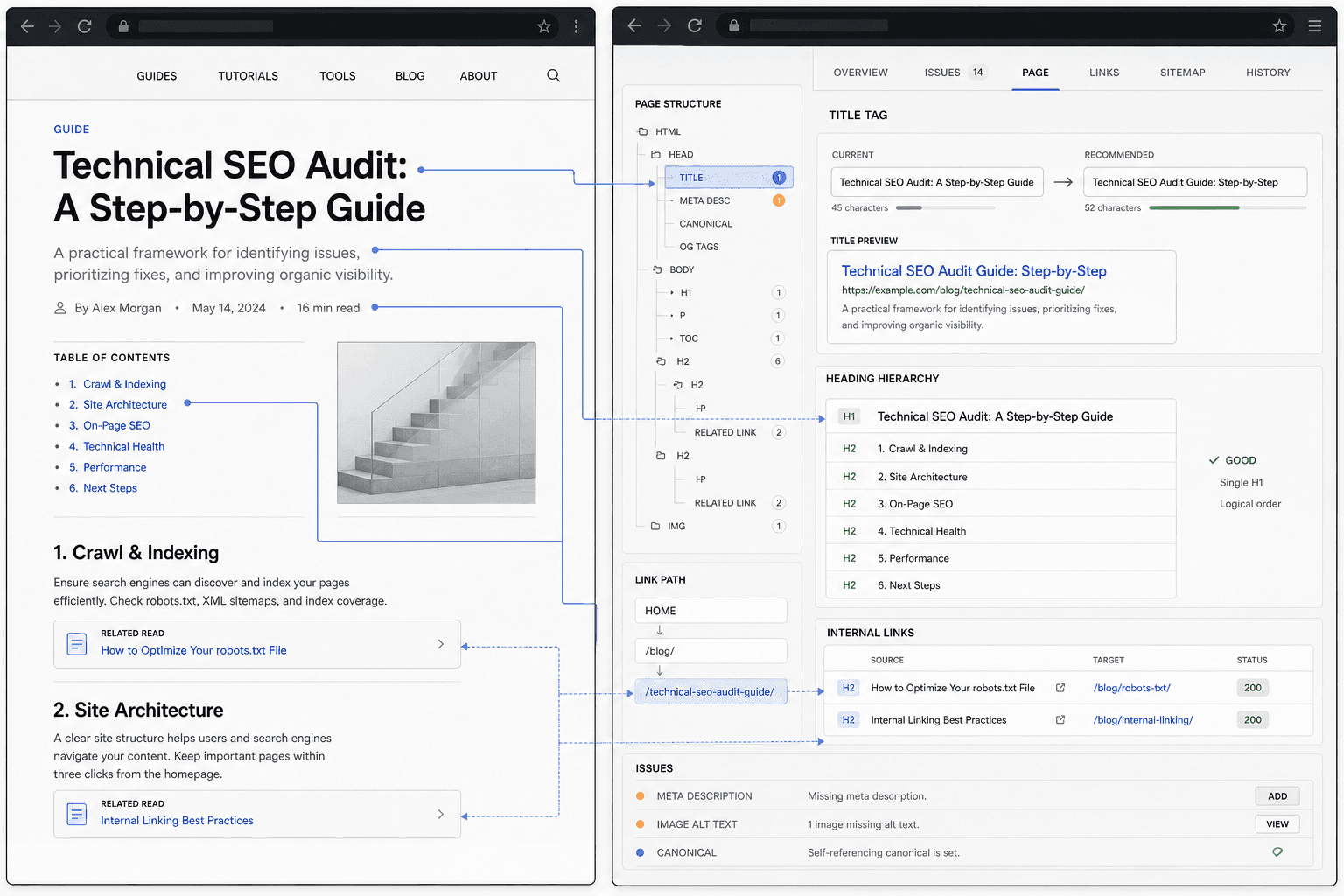
Anai seo agentdoes not begin with a blank page. It begins with evidence. It watches rankings, crawl errors, stale pages, weak internal links, unpublished drafts, and traffic shifts across the site. That is how an autonomous seo agent works in practice. It behaves more like an operator than a copywriter.
We learned this the hard way. In one early workflow review, we had 47 browser tabs open. We were checking Search Console, the CMS, link maps, and page speed by hand. The problem was not ideas. The problem was deciding the next best move fast enough.
Once the system has context, it scores options. It asks simple questions with hard business value. Which page can recover faster? Which query needs a support article? Which template needs schema fixes? Which linking gap blocks ai visibility across the cluster?
Inputs the agent monitors every day
A real loop needs live inputs, not static prompts. We want the system to monitor keyword movement, crawl health, content freshness, internal link coverage, publish status, click data, and on-page engagement signals. That is the observation layer behind useful ai seo automation.
Then the agent ranks tasks by expected impact, confidence, and effort. A title update may be high confidence and low effort. A new support page may carry bigger upside, but less certainty. That triage matters because most sites do not suffer from a lack of tasks. They suffer from a lack of order.
This also answers a common question: how does an autonomous SEO agent actually work? It works by narrowing choices before it writes anything. It decides whether to refresh, expand, link, structure, or wait.
For a visual walkthrough of this process, check out this tutorial from Jake AI Marketing:
Outputs the agent can execute safely
Can anai seo agentmake changes on a live website? Yes, but only inside guardrails. We let the agent handle reversible actions first. That includes draft updates, title tests, internal link additions, content briefs, publishing queues, and social distribution triggers tied to approved rules.
The line is simple. Low-risk changes can run automatically. Brand-sensitive, legal, or structural changes should escalate to humans. That is the difference between reckless automation and reliable execution on a real site.
Verification closes the loop. The agent checks whether edits went live, whether pages were indexed, and whether users clicked and engaged from ai search. According to Printful, teams often wait12 weeksto see ranking movement. Research from Yotpo shows37%of consumers want direct, curated answers. Those signals tell the agent whether to continue, retry, or escalate.
What We Let the Autonomous SEO Agent Decide
Decisions we automate with high confidence
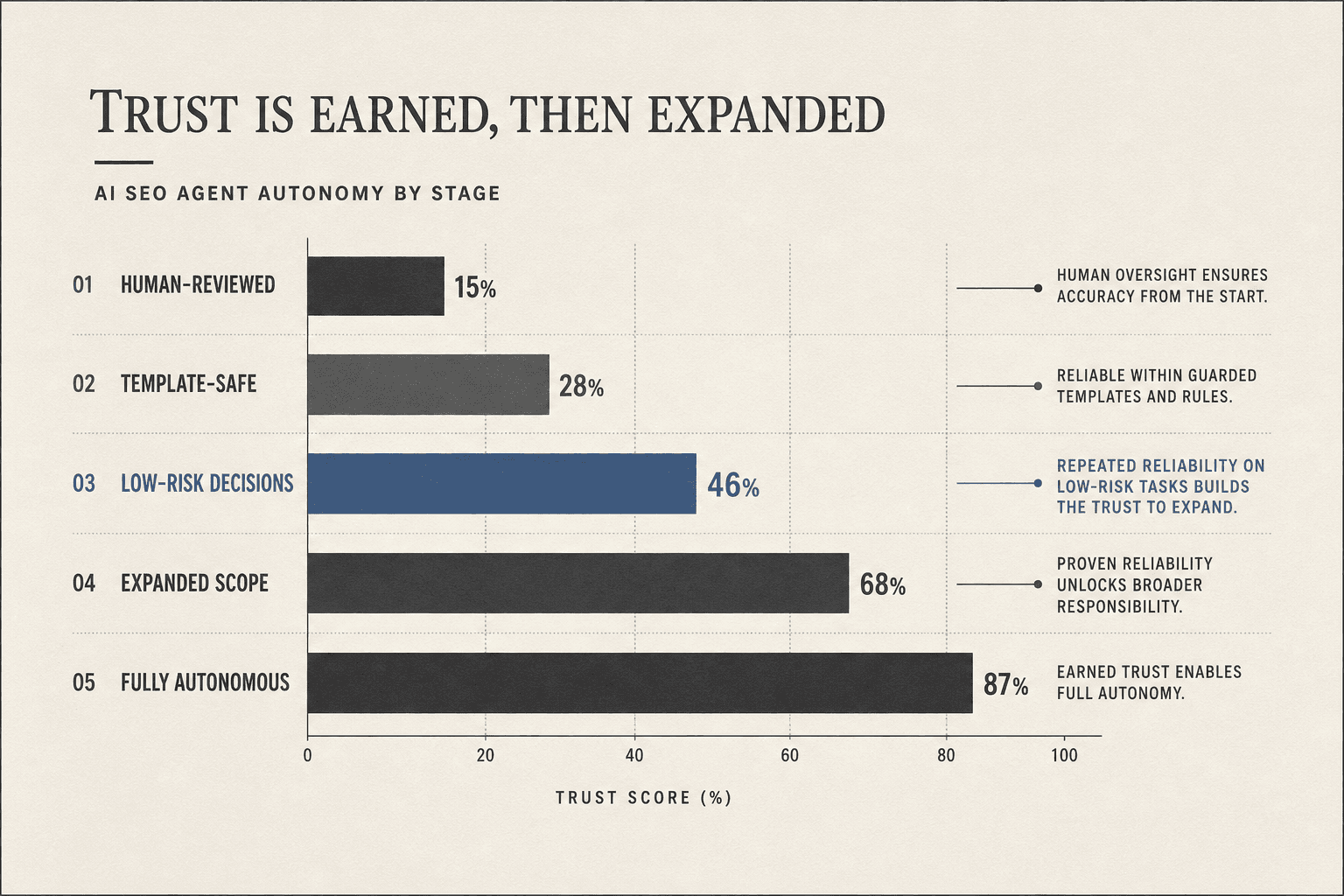
We automate the work that follows stable patterns. Topic clustering fits here. Cannibalization detection fits too. So do internal link suggestions, stale fact checks, and content brief creation. These are structured choices with clear inputs, clear logic, and low downside when the system gets one call wrong.
That matters because most SEO drag comes from slow execution, not lack of ideas. Research from Best AI SEO Tools 2026: Master Generative Search shows shoppers now start discovery on AI platforms at meaningful scale, which raises the cost of stale pages and weak site structure. In that environment, theautonomous seo agentshould handle the repeatable groundwork fast and consistently.
We treat the next layer as semi-autonomous. The agent can update titles and meta descriptions, choose anchor text, insert FAQs, recommend schema, and queue CMS drafts. But we still keep approval gates around those actions. The machine does the prep. A human still owns the final yes.
Decisions we escalate to humans
We escalate any decision that can reshape brand meaning or business risk. That includes changing core messaging, merging important pages, deleting content, making strong claims, or publishing changes on high-value pages without review. Those calls need context beyond rankings.
Some teams argue the best ai seo systems should publish everything automatically. We think that is backwards. Speed is useful. Unchecked confidence is expensive. Data indicates richer search features can lift engagement by more than 10%, but that does not mean every change deserves instant publication.
Human review matters most when tradeoffs get fuzzy. A page can be underperforming and still carry sales value. Two posts can overlap and still serve different buyer intents. An FAQ can win clicks and still weaken positioning. The agent sees patterns. People see stakes.
Real workflow examples from our implementation story
One moment changed how we built our approval logic. We watched the system flag a decaying page at 6:12 a.m. It compared the page against fresher competitors, drafted a refresh brief, suggested internal links from related posts, rewrote metadata, and then stopped cold at one sentence. That sentence changed the page promise. The agent sent only that part to us for review.
That was the right split. The system handled the mechanics. We handled the message. According to Best AI SEO Tools 2026: Master Generative Search, teams are under pressure to defer waste and focus resources harder, and that is exactly why selective escalation matters.
We use the same model for expansion. When ranking and indexing shifts reveal a topic gap, the agent builds a cluster plan, maps parent and child pages, and schedules production by likely impact. It moves first on the pages most likely to gain traction, then asks us to review only the strategic bets.
Why AI Search Rewards Teams That Build This Now
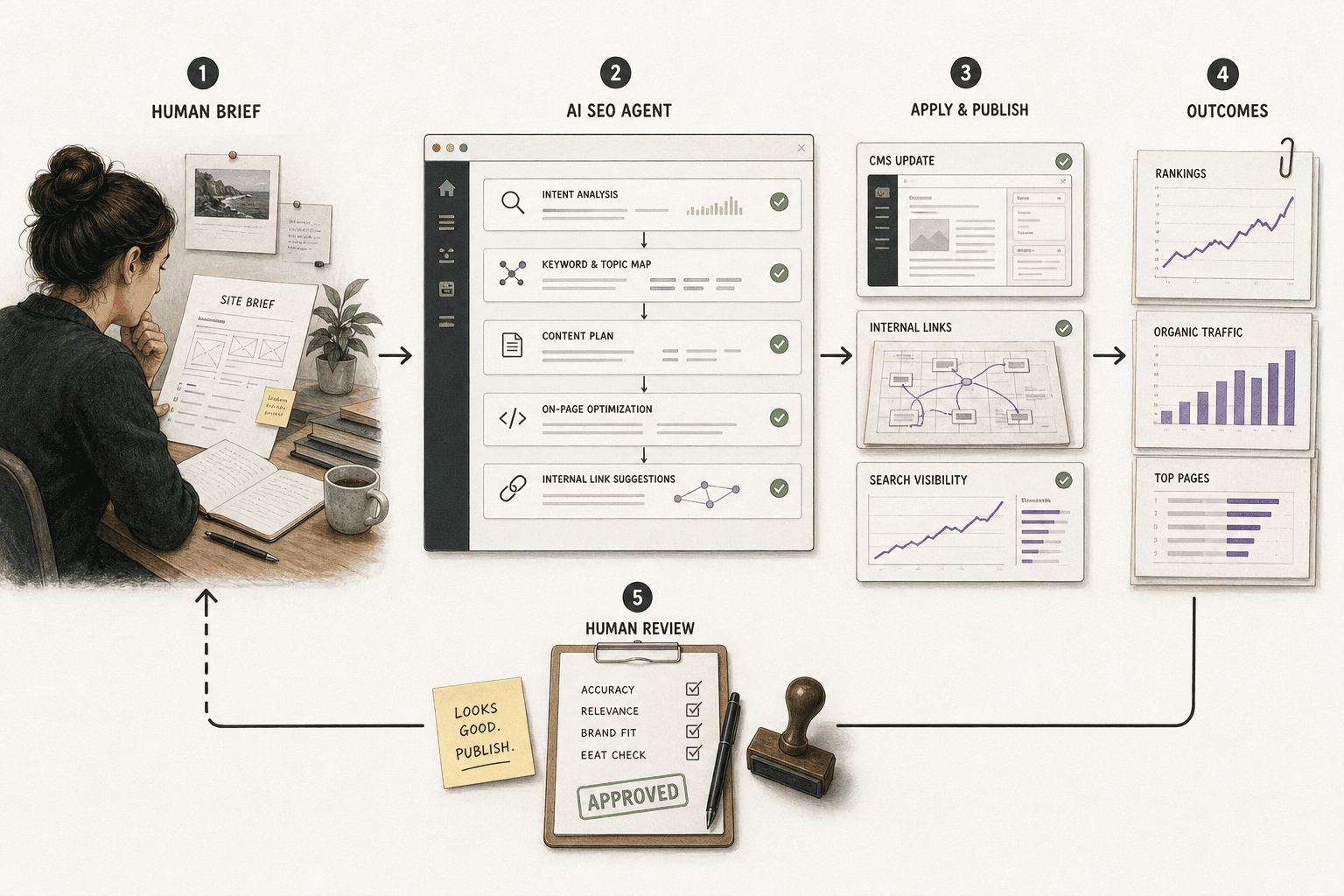
Our view is simpler. The future is not full automation. It is supervised autonomy. The teams that win will not hand the keys to a bot. They will build a system where an ai seo agent moves fast inside clear guardrails, then hands judgment calls to humans at the right checkpoints. That model respects brand risk without accepting operational drag.
We have seen what this changes in practice. Teams publish updates faster. They cover more of the topic map. They tighten internal links without relying on spreadsheets. They clean up slow review chains and reduce CMS chaos. Most important, they build stronger ai visibility across classic search, AI Overviews, and emerging answer surfaces. That is the real prize. Not more content. More control.
This is why the timing matters. Right now, ai seo agent is still an early-mover opening. That will not last. The market is moving from fascination with writing features to demand for operating systems. Buyers will stop asking which ai seo tools can draft a post. They will ask which autonomous seo agent can observe a site, decide what matters, act safely, and improve over time. That shift will hit faster than most teams expect.
Some will argue that this only works for large teams with process maturity. We think that misses the point. Smaller teams need this model more. They feel every delay harder. They cannot afford broken handoffs between seo tools, content, publishing, and reporting. Supervised loops give lean teams leverage without forcing them to trade away judgment.
The compounding advantage is the story leaders should pay attention to. A better refresh cycle helps rankings. Better coverage creates new entry points. Stronger linking spreads authority. Cleaner operations reduce waste. Each loop makes the next loop stronger. That is how agentic seo stops being a tactic and becomes infrastructure.
So stop treating SEO like a backlog of disconnected tasks. Build an operating loop. Set the rules. Start with one workflow on one site. Measure the lift. Then let the agent earn more authority as the evidence gets stronger. If you are ready to move from AI outputs to real ai seo automation, Try It Free.