Free SEO Checker vs Full Website Audit: What You Actually Need First
A seo audit tool can save hours, but the wrong one can hide serious problems. For startup teams, that makes the choice less about features and more about fit. Early-stage companies often need fast answers, yet a shallow website audit can miss deeper technical SEO issues. SEO consultant Phil Kurth notes that critical issues can remain hidden for months, while research from CognitiveSEO shows that indexing problems affect a significant portion of websites. This comparison breaks down what startups should look for in an SEO audit tool: speed, depth, cost, and clear next steps. It stays practical, neutral, and focused on lean teams.
SEO Audit Tool Evaluation Criteria
How the comparison works
This comparison uses one baseline for both options. That keeps the review fair and easy to scan. Each seo audit tool is judged on crawl depth, issue accuracy, ease of use, reporting clarity, team fit, and pricing flexibility. In simple terms, the test asks whether the tool finds the right problems, explains them clearly, and fits a lean team’s workflow.
A useful website audit should surface broken pages, index issues, and weak metadata fast. A deeper technical seo audit should go further. It should check crawl traps, rendering problems, internal link gaps, and duplicate content patterns. For example, a fast scan is like a smoke alarm. A deeper diagnostic is closer to an electrician tracing the wiring.
What startup teams should prioritize
Early teams need to split must-haves from nice-to-haves. Critical features usually include accurate issue detection, clear priority labels, simple reports, and flexible pricing - while white-label exports, custom dashboards, and advanced segmentation across large sites remain optional for most startups.
The right choice also changes by stage. Pre-launch teams need a clean site audit before pages go live. Low-traffic growth teams need routine checks on indexing and basic on-page errors. Content scaling teams need stronger templates, internal linking checks, and repeatable reporting. Technical cleanup teams need deeper crawling and root-cause analysis.
A site audit should usually run monthly for stable sites. It should run weekly during migrations, redesigns, or heavy publishing periods. Is a free SEO audit tool enough? Sometimes, yes. It can work for a small brochure site or an early landing page set. But once issues stack across templates, JavaScript, or content hubs, free tools often miss context or depth.
When speed matters more than depth
Speed matters when the team needs a quick decision. For example, a founder preparing a launch may only need core errors, index status, and page speed flags. In that case, faster output beats long diagnostic reports.
Depth matters when the cost of missing an issue rises. Professional audits typically range from $500 to $7,500 depending on scope and site complexity, according to SEO consultant Phil Kurth. Without a thorough seo audit tool, critical issues can remain hidden for months. That gap makes prioritization critical, especially when choosing between free and professional options.
Quick Scan SEO Audit Tool Option
Overview
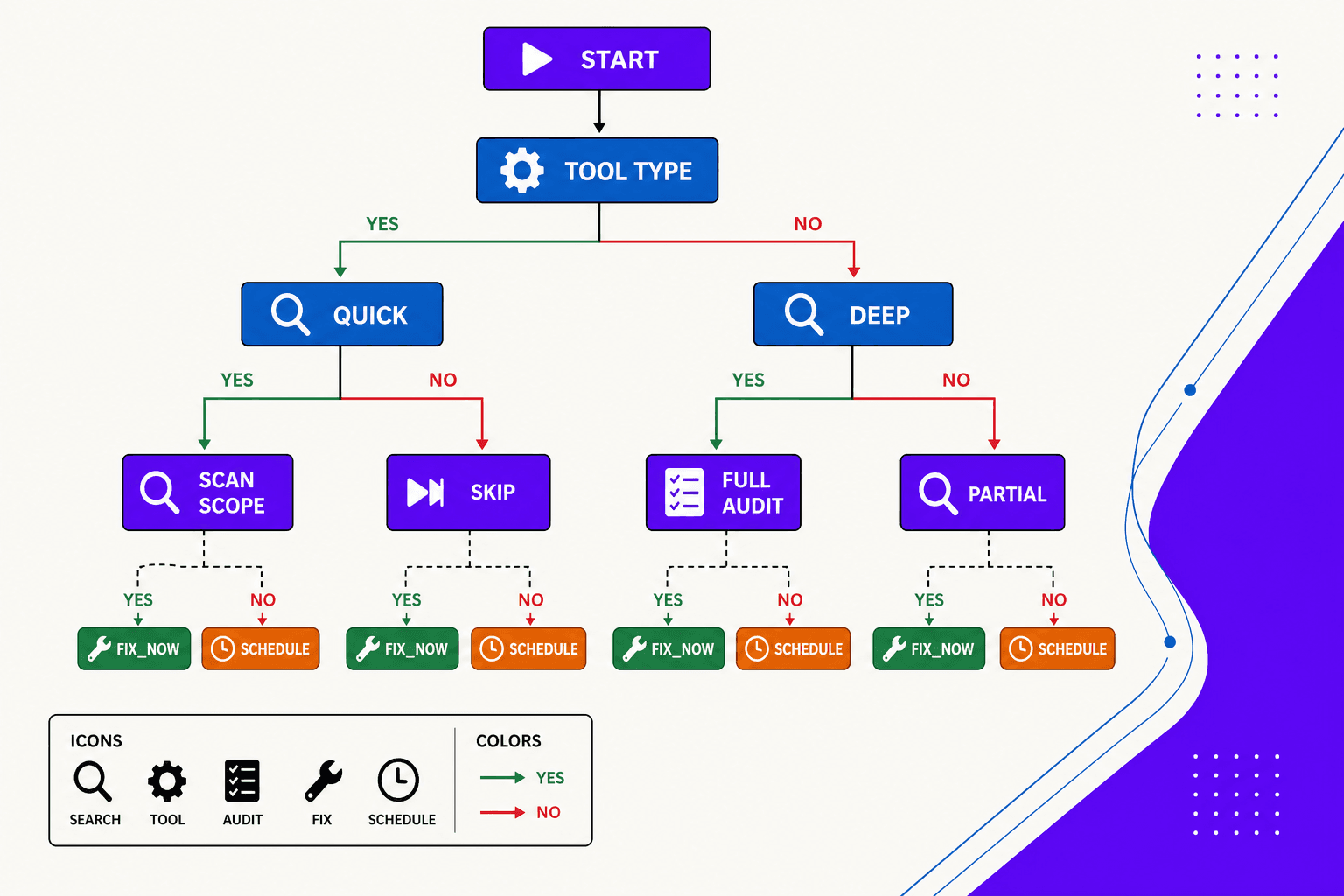
A quick scan seo audit tool gives teams fast visibility. It highlights common on-page and technical issues without heavy setup. That makes it useful for founders and lean marketers who need an early website audit, not a full investigation.
This option works like a dashboard warning light. It points to obvious problems fast, but it does not open the engine. For example, a startup preparing a launch can run a scan, spot missing titles, broken links, and blocked pages, then fix those basics before traffic starts.
Is a free SEO audit tool enough? Sometimes, yes. It is often enough for small sites, early validation, and simple pre-launch checks, but it is rarely enough for a deep technical seo audit of a growing site (Why Free SEO Audits & Tools Can Actually Cost You More, SEO Audit Services vs Free Tools: What You Get | Digital Future Tech).
Key Features
Most quick scan tools cover the basics well. A standard site audit usually includes basic crawling, broken link checks, metadata reviews, indexability flags, page speed signals, and simple issue scoring.
What is included in a basic website audit? In most cases, teams get page titles, meta descriptions, status codes, redirect checks, image alt gaps, duplicate content warnings, and mobile or speed signals (SEO and Website Audit: What You Need to Check, Free SEO Audit Tools vs Professional Audit: What You Get | Phil Kurth). The output is usually simple, ranked, and easy to scan.
SEO consultant Phil Kurth notes that critical issues can remain hidden for months when teams rely on surface checks alone. Louis Pretorius frames the free versus paid seo audit tool decision through more than 20 years of consulting experience, highlighting how scope and depth vary significantly between options.
Strengths
The main strength is speed. Most tools are cheap or free, easy to use, and built for non-specialists. That makes them a practical first pass for teams without an SEO lead.
They also help teams triage. Instead of guessing, a founder gets a short list of visible fixes. For example, a five-page SaaS site can clean up missing metadata and broken internal links in one afternoon.
Weaknesses
The trade-off is depth. Quick scans often miss crawl budget waste, JavaScript rendering issues, log-level behavior, and messy internal linking patterns. Those problems matter more once a site grows.
Unlike deeper diagnostics, these tools rarely explain cause and effect. They flag symptoms, not system behavior. A clean report can still hide pages that search engines struggle to render, discover, or prioritize.
Best For
Quick scan tools fit small sites, launch prep, and early-stage validation. They work best when a team needs a lightweight site audit before paying for advanced analysis.
They are less suited to complex platforms or content-heavy sites. Once traffic grows, templates multiply, or indexing becomes unstable, a deeper technical seo audit usually becomes the safer next step.
Deep Technical SEO Audit Tool Option
Overview
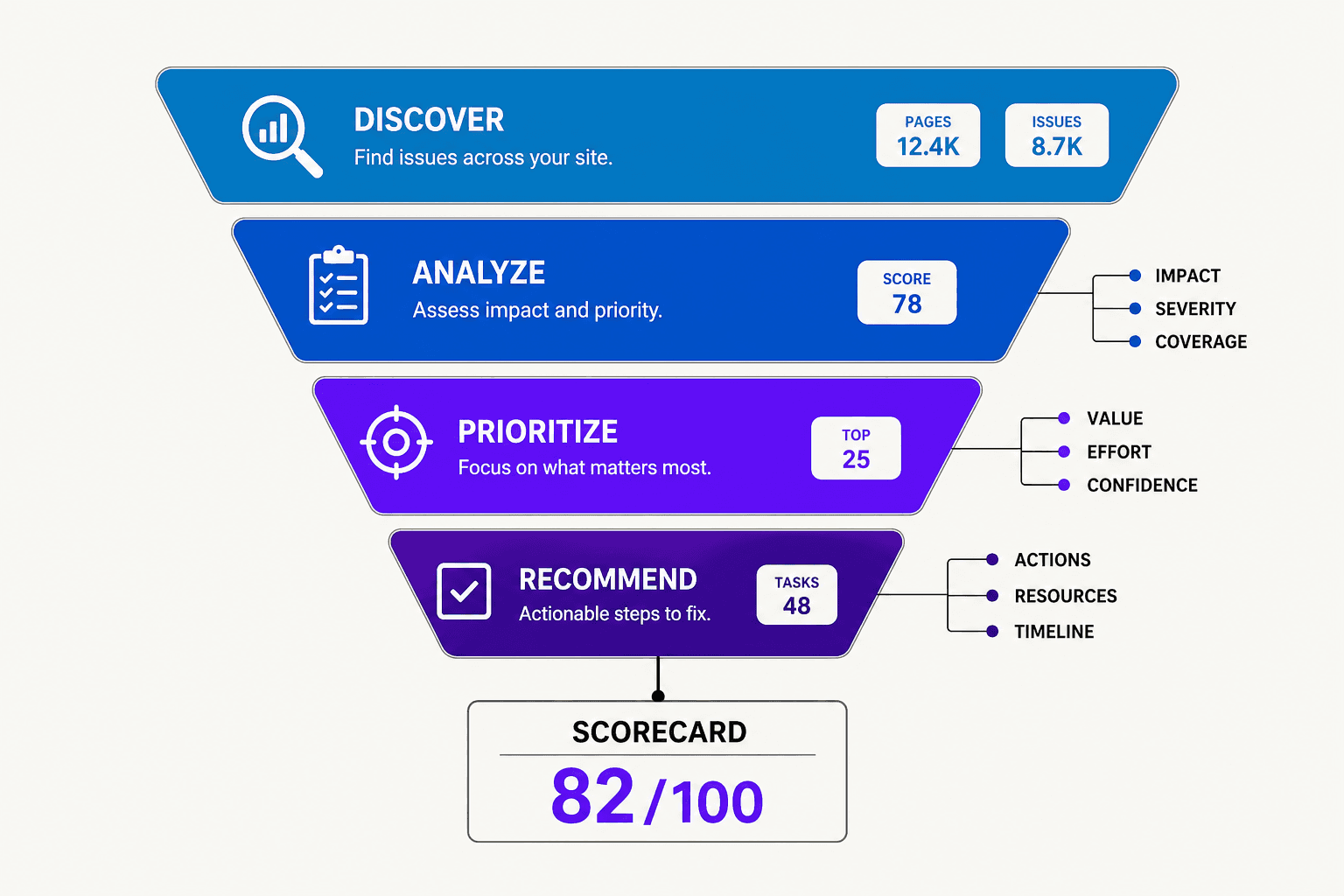
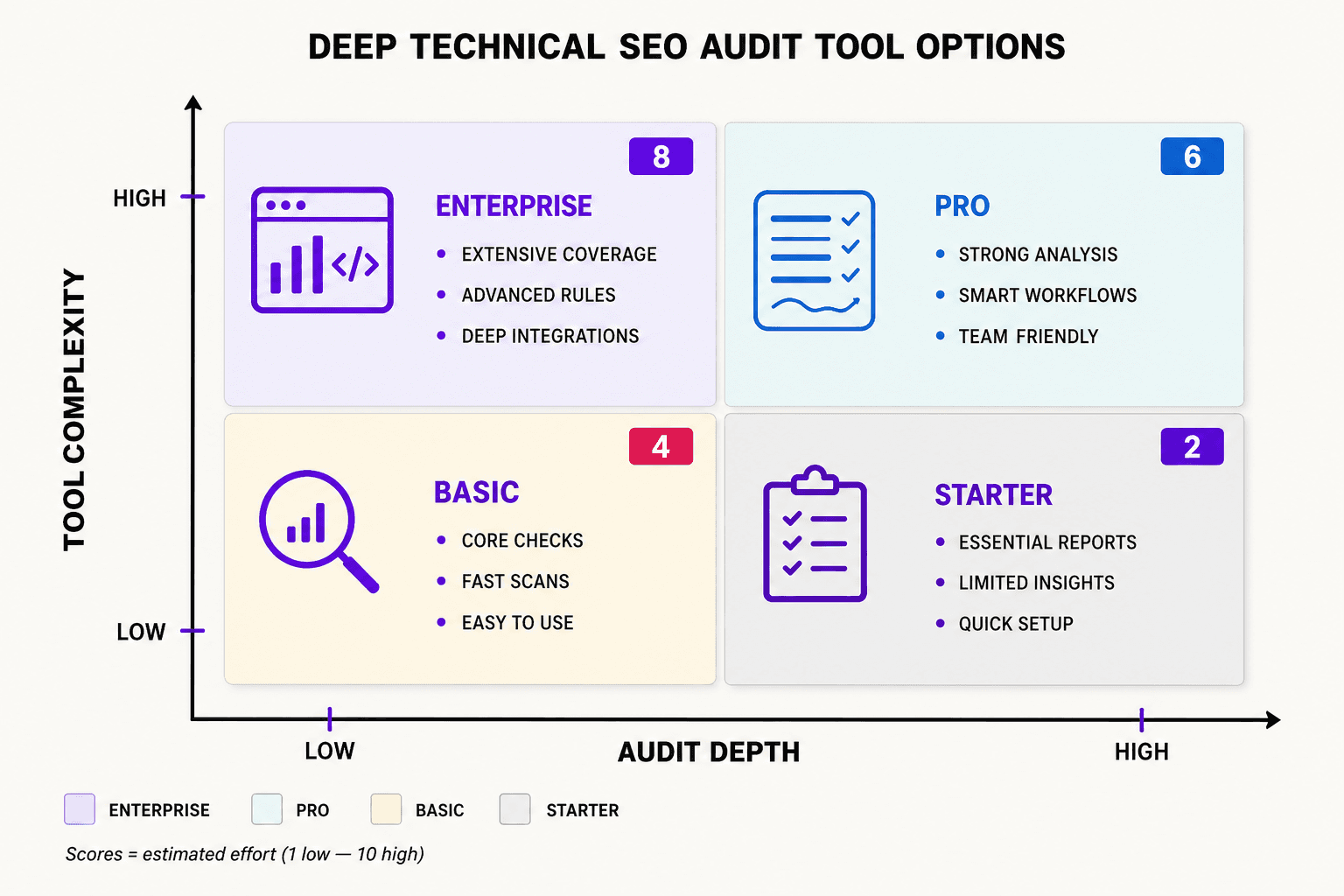
A deep diagnostic platform is not a quick scan. This type of seo audit tool looks under the floorboards. It checks how a site crawls, renders, indexes, and connects at scale. For example, a startup may see traffic drop after a redesign, even when titles and meta tags look fine.
That is the core difference between a website audit and a technical seo audit. A website audit usually checks broad, visible issues across pages. A technical seo audit goes deeper and tests structural signals, crawl paths, rendering behavior, and index control. In short, one finds surface friction, while the other finds system failures.
Key Features
A deeper platform usually includes advanced crawl settings and segmented views. Teams can review folders, templates, subdomains, or page types in isolation. That matters when one template creates errors across thousands of URLs.
It also supports canonical reviews, hreflang validation, JavaScript rendering checks, and internal link mapping. Some tools add log analysis support, which shows how search bots actually move through a site. A strong seo audit tool also ranks issues by likely impact, so teams can separate real blockers from background noise.
Strengths
The biggest advantage is depth. These platforms produce a fuller site audit and expose risks that basic scans often miss. For example, they can reveal orphan pages, wasted crawl paths, duplicate template blocks, or pages that render poorly for bots.
That makes them useful during growth spurts and messy transitions. They support redesigns, migrations, and technical debt cleanup with more precision than a lightweight website audit. According to Phil Kurth, deeper audits uncover issues free tools often miss. CognitiveSEO makes a similar point, arguing that shallow reports can hide costly problems.
Weaknesses
The trade-off is complexity. These tools take longer to learn and often flood teams with alerts. For a founder who only needs a simple site audit, that can feel like using a medical scanner for a paper cut.
They also demand context. A long error list does not always mean a real ranking threat. Louis Pretorius explains that paid tools offer more depth, but that depth can exceed the needs of smaller teams.
Best For
A deep technical option fits scaling sites, larger content libraries, and teams carrying hidden technical debt. It also fits companies planning migrations or recovering from a redesign. That is usually when a technical SEO audit becomes necessary.
For example, if index coverage shifts after template changes, a basic website audit may miss the root cause. Data from Digital Future Tech shows conversion rates of 0.9% for sites using free tools versus 3.2% for those using professional audits, which suggests that better diagnosis can affect more than rankings.
SEO Audit Tool Comparison Table and Best Fit
| Criteria | Quick scan | Deep diagnostics |
| --- | --- | --- |
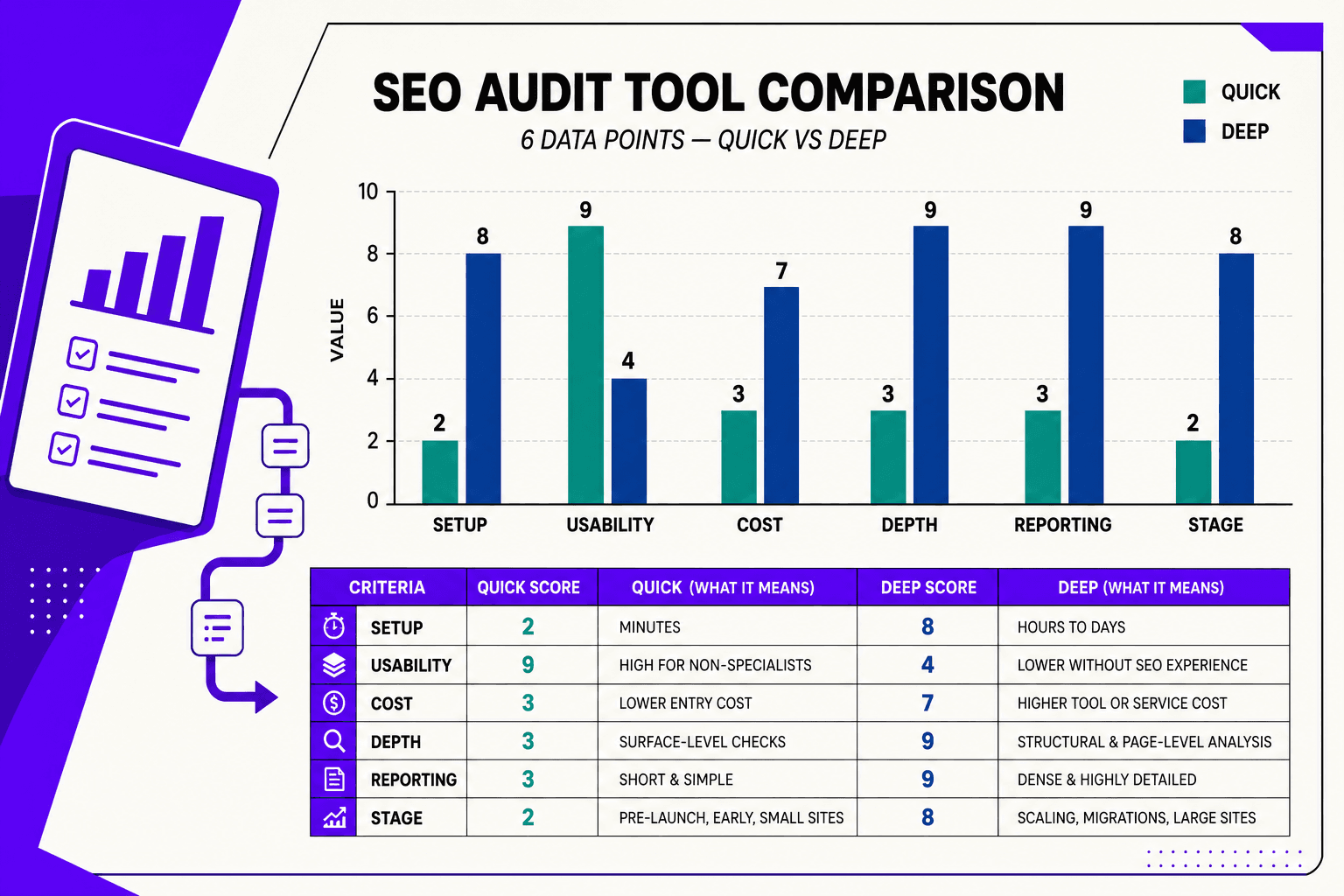
| Setup time | Minutes | Hours to days |
| Audit depth | Surface-level checks | Structural and page-level analysis |
| Ease of use | High for non-specialists | Lower without SEO experience |
| Cost | Lower entry cost | Higher tool or service cost |
| Reporting detail | Short and simple | Dense and highly detailed |
| Ideal company stage | Pre-launch, early traction, small sites | Scaling stage, migrations, larger sites, recurring issues |
That table shows the real trade-off. Speed and simplicity help early teams move. Depth and precision help growing teams avoid expensive mistakes. Neither approach is wrong. The better seo audit tool choice depends on what the company needs to decide now.
Quick scans solve one problem well. They create fast visibility. That matters when a founder or small marketing team needs a basic website audit without waiting on a specialist. But they also create a common trap. Clean scores can look reassuring, even when deeper technical seo audit issues still sit underneath. Shallow recommendations also limit next steps. A team may know something is off, but not why it happens or how to fix it.
Deep tools solve a different problem. They uncover hidden issues across templates, internal links, rendering, and indexing. That makes them stronger for a serious site audit on a growing website. Still, the friction is real. The learning curve is steeper. Reports are longer. Without an SEO owner, the output can turn into a backlog no one acts on. More data does not always mean more clarity.
The practical takeaway is simple.
- Choose a quick scan when speed matters most, the site is small, or the goal is triage.
- Choose deeper diagnostics when the site is growing, technical complexity is rising, or problems keep coming back.
- Reassess the tool choice as the company stage changes, because the right fit rarely stays fixed for long.
The best seo audit tool is not the one with the most features. It is the one that matches the startup’s limits, team skills, and current risk level.
As startups grow, the smartest teams treat audit depth as a timing decision, not a status symbol.
Want to learn more? Learn More to explore how this choice fits the next stage.