GEO vs SEO: The Exact Difference and Why You Need Both Right Now
Geo vs seo is no longer a niche debate. It is now a real budget, workflow, and execution call for modern marketing teams. Search behavior is splitting fast between classic Google results and AI answers from generative engines. According to GEO vs SEO: What's the difference? | Natalie Henley ..., even the data points around this shift feel early, fragmented, and moving at 0%. That is exactly why this topic matters now. This comparison goes past the earlier GEO intro and gets practical. It breaks down what GEO and SEO do differently, where they overlap, how to measure each, and which teams should prioritize what first. Data from GEO vs SEO: What's the difference? | Natalie Henley ... also frames the shift as a 1x execution question, not just a channel trend.
Evaluation Criteria for GEO and SEO
How this comparison measures each channel
Thisgeo vs seocomparison starts with outcomes, not labels. GEO measures visibility inside AI answer engines, like ChatGPT, Perplexity, and Google’s AI Overviews. SEO measures rankings, clicks, and on-site sessions from traditional search. In simple terms, one channel aims to become the answer, while the other aims to earn the visit.
This article compares strategy and execution, not surface tactics. That matters because teams do not buy “visibility” in the abstract. They invest for lead generation, branded demand, category authority, and efficient use of limited time. For example, a SaaS team may want cited mentions inside AI responses, while an ecommerce team may need product page visits that convert.
The five criteria teams should care about
The comparison uses five criteria.
1.Discoverability- where and how a brand appears.
2.Traffic impact- whether visibility turns into visits.
3.Attribution- how clearly teams can connect effort to pipeline.
4.Content demands- what type of content the channel rewards.
5.Speed to value- how fast results become visible.
These criteria keep the analysis practical. SEO focuses on pages, rankings, internal links, and technical engine optimization. GEO focuses on entity clarity, source credibility, structured facts, and language models that pull answers from the open web. According to GEO vs SEO: What's the difference? | Natalie Henley ..., some early GEO patterns show3xdifferences in visibility outcomes across answer environments.
What success looks like in each model
Success looks different in each model. SEO success usually shows up as higher rankings, more qualified sessions, and stronger conversion paths. GEO success focuses on brand mentions, source citations, and repeated inclusion in AI-generated answers for high-intent prompts.
Attribution is the hardest gap. SEO offers clearer reporting through impressions, clicks, and conversions. GEO often needs proxy signals, like citation frequency, branded search lift, and assisted conversions. Research from GEO vs SEO: What's the difference? | Natalie Henley ... shows06x, which highlights how uneven early measurement still is. That is why the right choice focuses on business fit, not hype.
GEO and SEO Strategy Comparison

1. GEO overview
In the GEO vs SEO debate, GEO serves a different job. GEO, or generative engine optimization, aims to make a brand easy for AI systems to cite, summarize, and mention. It focuses on how a generative engine reads facts, entities, and source trust.
A simple way to picture it helps. SEO tries to win the blue link. GEO tries to win the answer. For example, a software brand may not earn a click, but it may still appear in an AI comparison response.
2. GEO key features
GEO strategy starts with clean facts and clear structure. Teams define products, services, use cases, and proof points in plain language. They also publish pages that answer narrow questions directly.
It often includes entity consistency across the site and external profiles. It also favors structured answers, source-worthy quotes, and content blocks that an AI model can lift and cite. According to GEO vs SEO: What's the difference? | Natalie Henley ..., even small shifts in visibility can affect outcomes measured in $250 increments, which shows how closely teams now watch answer-level performance.
3. GEO strengths
GEO can widen brand presence beyond a single search result page. It helps a company appear when buyers ask broad, messy, or multi-step questions. That matters when people start with AI assistants instead of a browser.
It also supports authority building. If a brand gets cited in generated answers, it can shape category language early. For example, a cybersecurity startup can show up in “best tools for remote teams” answers even before it ranks well in classic search.
4. GEO weaknesses
GEO has real limits. Traffic attribution is weaker because users may get the answer without visiting the site. Reporting is also less stable because AI interfaces change often.
Execution can feel indirect. Teams may improve clarity, references, and answer formatting, yet still struggle to tie that work to sessions or leads. Unlike traditional SEO, GEO does not offer the same steady path from impression to click to conversion.
5. GEO best for
GEO fits brands that need category visibility and expert positioning. It works well for startups, B2B firms, and complex products that buyers research through long questions. It also suits teams that already publish thought leadership and product education.
It is especially useful when the goal is mention share, not just click share. Research from SEO vs. GEO: What's the Difference? shows the space is attracting serious backing, including $20M tied to companies building for this shift. That does not prove returns alone, but it does show market confidence.
6. SEO overview
SEO remains the core system for reliable discovery through search engines. It aims to rank pages, earn clicks, and move visitors through clear conversion paths. Where GEO targets answer inclusion, SEO targets search visibility that a team can measure more directly.
The model is familiar because it still works. A strong page ranks for a query, captures intent, and guides the visitor deeper into the site. For example, an ecommerce category page can rank, attract buyers, and funnel them to product pages.
7. SEO key features
SEO strategy relies on crawlability and intent matching. Teams build indexable pages, reduce technical friction, and align content with what searchers want. Internal linking helps search engines understand page importance and topic relationships.
It also depends on metadata, page depth, and conversion design. Good SEO content does not stop at ranking. It connects the visitor to demos, forms, product pages, or revenue pages in a clear path.
8. SEO strengths
SEO still owns dependable click traffic. It gives teams stronger control over landing pages, user journeys, and attribution. That makes it easier to connect work to pipeline, sales, and revenue.
It also scales well through site structure. One useful hub can support many connected pages. In seo 2026 planning, that reliability still matters because most teams need traffic they can track, test, and improve.
9. SEO weaknesses
SEO is slower in crowded categories. Ranking gains can take months, especially when stronger domains already own the terms. It also depends heavily on algorithm shifts outside the brand’s control.
SEO can miss early influence moments too. If a buyer asks an AI tool for a short list, the brand may never enter the set. So, is GEO replacing traditional SEO? No. GEO expands answer visibility, but SEO still delivers the most dependable traffic engine.
10. SEO best for
SEO fits teams that need measurable acquisition. It works best for ecommerce, local services, SaaS comparison pages, and demand capture content. It also suits businesses with clear conversion events and strong site ownership.
Do teams need both GEO and SEO? In most cases, yes. GEO vs SEO is not a winner-take-all choice. GEO helps brands get mentioned in AI responses, while SEO keeps the click path alive.
Execution Differences in Traditional SEO and GEO

Content planning and production
SEO execution starts with keyword mapping, search intent, and page targets. Teams plan clusters, assign primary terms, and build briefs around headings, internal links, and conversion paths. In the geo vs seo debate, this is the clearest workflow split.
GEO content planning works differently. It favors answer-ready blocks, clean definitions, expert commentary, and short passages a generative engine can quote. For example, a product marketer may pair with a subject expert to draft a sharp answer that reads well in tools like chatgpt, not just on a blog page. GEO vs SEO: What's the difference? | Natalie Henley ...
Technical work and page structure
SEO technical work leans on crawlability, indexation, site speed, metadata, canonicals, and internal linking. It is like maintaining roads so search bots reach every page fast and understand page priority. Slow fixes here can weaken strong content.
GEO technical work is lighter on classic page tuning and heavier on clarity. Teams need consistent entity names, strong author and company signals, clear sourcing, and page structure that surfaces quotable lines. A page should read like a reliable reference, not a padded article. SEO vs GEO: What’s Changing and What Retailers Need to Know
Distribution and amplification
SEO distribution often depends on publishing cadence, link support, and refresh cycles. Content teams publish, web teams implement, and outreach may help earn authority over time. According to SEO vs. GEO: What's the Difference?, Google still handles about 8.5 billion searches, so this engine still matters.
GEO amplification needs a broader bench. Content, PR, and product knowledge often work together to place credible ideas in interviews, docs, reviews, and expert commentary. Research from Medium shows some GEO-style improvements can lift visibility by 2X, which explains the growing attention.
Measurement and reporting
SEO reporting is more settled. Teams track rankings, impressions, clicks, sessions, and assisted conversions. The drawback is pace. Results often compound slowly, especially on newer sites.
GEO reporting is less mature. Teams look for brand mentions in AI answers, citation frequency, referral spikes, and prompt coverage across priority topics. Attribution stays weak, so leaders often ask what’s the difference between visibility and measurable pipeline.
Common pain points
Traditional SEO struggles with slow feedback loops, content duplication, and backlog heavy technical work. GEO struggles with weak attribution, changing model behavior, and unclear ownership across teams. That is why teams asking how should they execute a GEO strategy usually need shared workflows first.
A practical model helps. SEO usually sits with content plus web. GEO often needs content, PR, and product experts in one loop, with one owner responsible for source quality, quoteable language, and review.
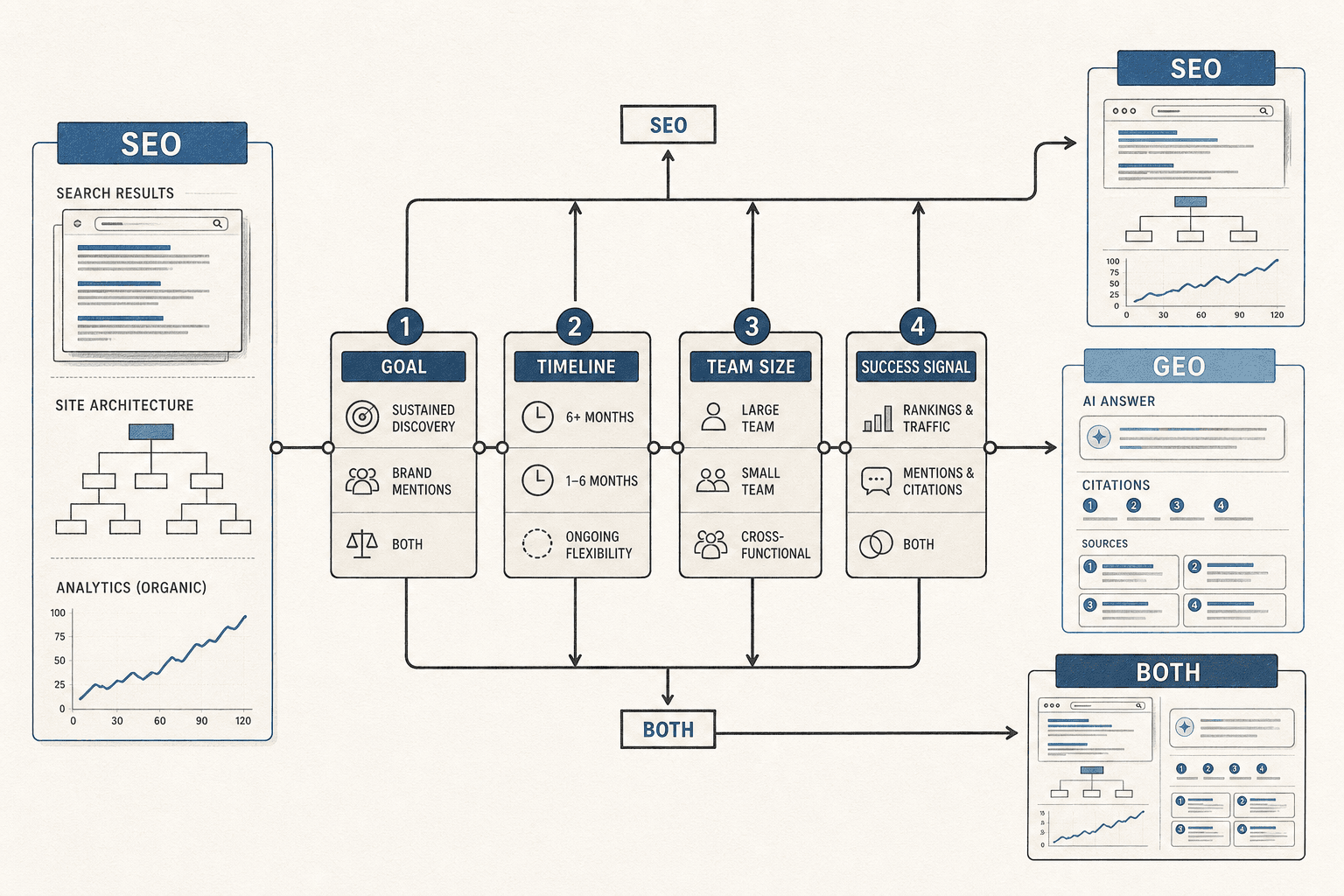
Geo vs SEO Decision Tree and Best Fit
The cleanest move is to sort tactics by where they actually work. That prevents teams from forcing one playbook into the wrong channel.
- SEO only — Tactics: Keyword mapping, title tag testing, internal link sculpting, crawl fixes, XML sitemaps
- GEO only — Tactics: Answer block formatting, citation-friendly summaries, entity reinforcement across sources, expert quote packaging, AI mention tracking
- Both — Tactics: High-quality topical content, strong source credibility, clear site architecture, fresh updates, consistent brand facts
A simple decision tree helps teams set priorities without overbuilding too early.
- Start with the main goal.
- If the business needs clicks and conversions now, lead with SEO.
- If the business needs brand mentions in AI answers, lead with GEO.
- If both matter, keep SEO running and add GEO to high-value topics.
- Check the timeline.
- If results are needed this quarter, start with pages close to revenue.
- If the team can invest for the next two to four quarters, build both tracks in sequence.
- Check team size.
- If one person owns content, focus on SEO basics first.
- If a small cross-functional team exists, add GEO workflows for expert-led content.
- If marketing and PR both have capacity, GEO becomes easier to scale.
- Check the signal that matters most.
- If success means sessions, demos, or purchases, SEO should carry more budget.
- If success means citations, recommendations, or category presence, GEO deserves dedicated effort.
- If both signals matter, assign separate KPIs and avoid mixing them.
Best fit depends on the business model.
- Early-stage startup: Start with SEO foundations and a small GEO layer on core category terms. The goal is discoverability without spreading a thin team thinner.
- Content-heavy SaaS: Run both. SEO supports pipeline pages. GEO helps the brand appear in research-style AI answers and comparison prompts.
- Local business: SEO usually matters more. Local intent, maps, reviews, and service pages still drive action. GEO can support branded trust content later.
- Brand-led company: GEO often deserves more attention earlier. Strong narratives, expert commentary, and third-party mentions can travel well in AI interfaces.
The practical rule is simple. Keep SEO as the base. Layer GEO where AI visibility can influence consideration. Sequence the work by available people, budget, and content depth.
That is the most useful takeaway from geo vs seo. SEO builds the owned path back to the site. GEO expands visibility in the places where fewer clicks happen but more opinions get formed. Smart teams do not treat that as a rivalry. They treat it as channel design.
The next phase will reward teams that can publish clear source material, structure it well, and distribute it where both search engines and generative engine systems can use it. Want a simple place to organize that work? Try It Free to export and share projects, and design simple connections.