How to Audit Your Content for AI Citability (The GEO Checklist)
AI citability is no longer a nice-to-have. It is a growth lever. If your page is easy for AI systems to parse, trust, and quote, you can win visibility before a searcher ever clicks. That matters now because AI search habits are rising fast, and answer engines reward clear structure over vague brand fluff. According to GEO Content Audit: 10-Point Checklist to Make Pages AI-Citable - Rankio, pages can begin earning AI citations within 3 weeks. So what is AI citability? It is your content's ability to be understood, trusted, and cited in AI-generated answers. In this guide, you will run a practical 15-point audit. You will check structured data, authority signals, answer-first formatting, and citation triggers. Then you will verify what improved.
Prerequisites for Your Geo Content Audit
What you need before you start
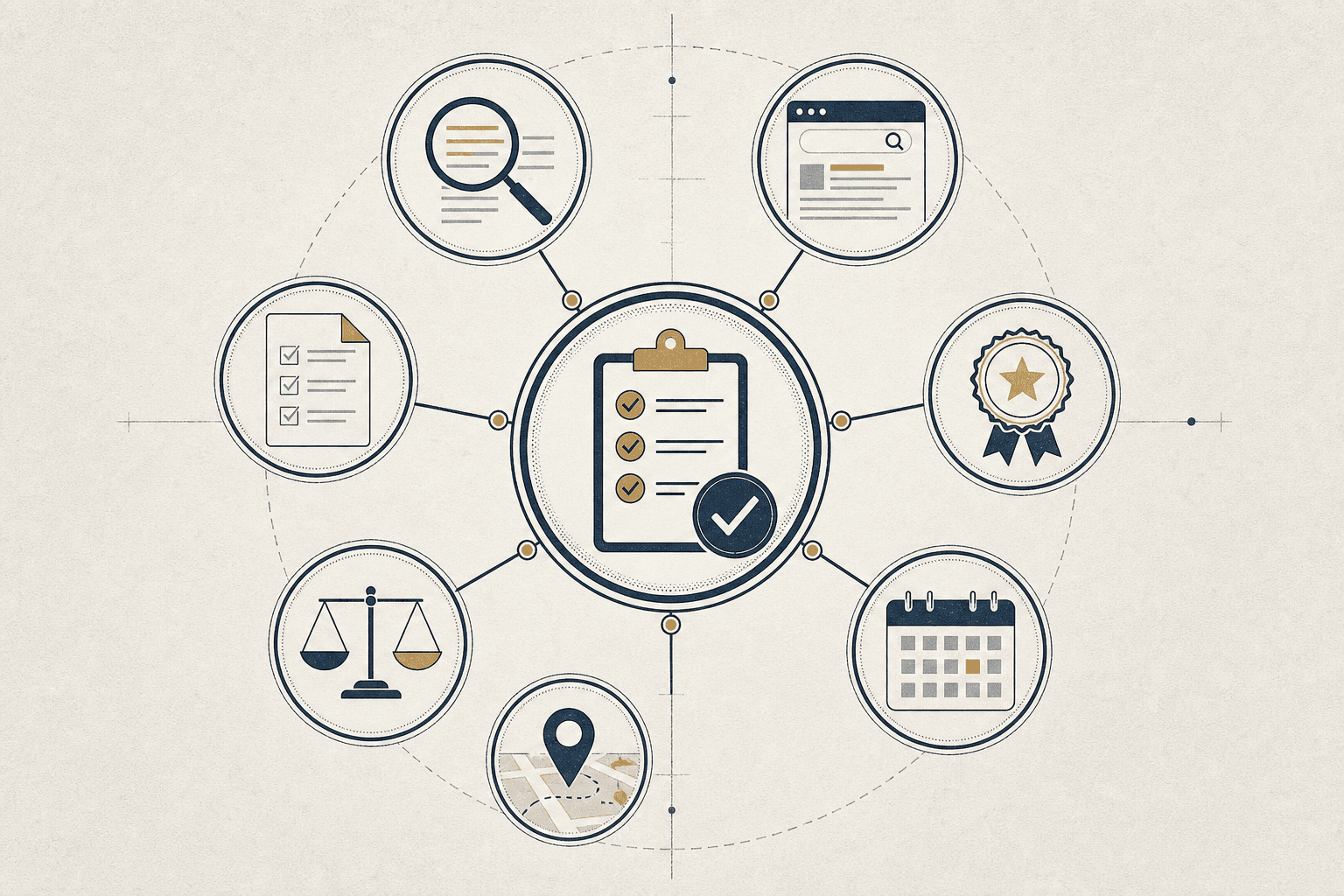
Gather five basics before you touch a page. Open Google Search Console, GA4, your CMS, a schema validator, and accounts for ChatGPT and Perplexity. This is your minimum stack for measuring ai citability in a practical way. Just as you would prepare your development environment before debugging, gather your audit tools before touching content.
Use one sheet for the full geo content audit. Add columns for URL, topic target, page type, schema status, traffic trend, and AI citation status. In your CMS, confirm each page is live and indexable. In your schema validator, check whether structured data appears and passes basic validation.
For a visual walkthrough of the technical audit side, check out this tutorial from Amit Tiwari:
Pick pages and prompts to audit
Select 5 to 10 important pages first. Pick revenue pages, core service pages, key blog posts, and one comparison or FAQ page. For example, audit your pricing page, top product page, and one high-intent guide. This gives you a useful checklist for small teams.
Next, write a short prompt set you can reuse. Ask ChatGPT and Perplexity the same questions each time. For example: “Best payroll software for startups” or “How do you run a content workflow audit?” Then check whether your page gets cited, referenced, or ignored.
Define your baseline and success metrics
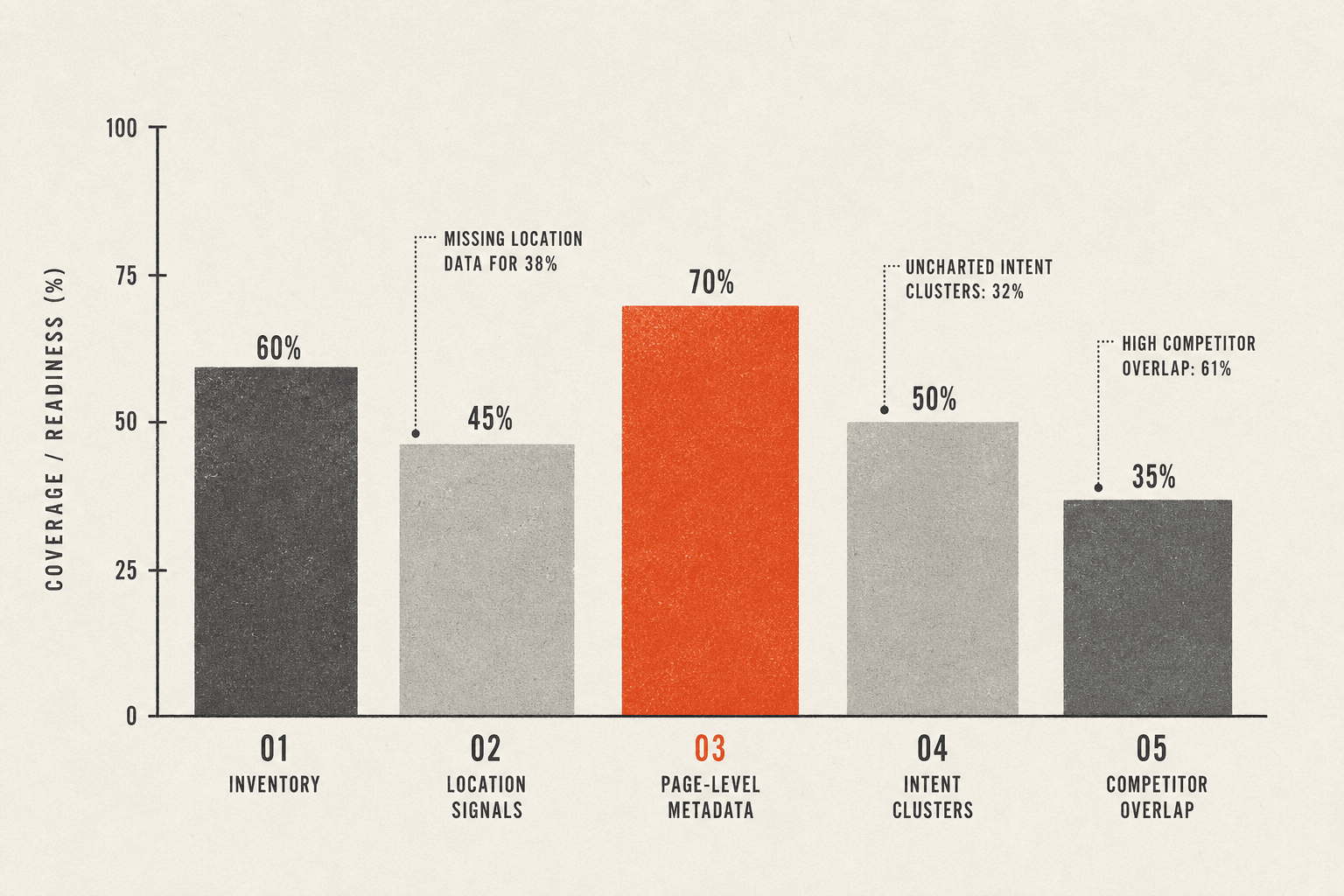
Score each page before making changes. Use a simple audit checklist: schema valid or not, indexed or not, cited in AI answers or not, and organic traffic trend up, flat, or down. Research from Onely shows 1.5% as an early benchmark worth tracking.
You should now have one sheet with clean starting scores. At this point, your page list and prompt list should be locked. Verify that every target URL has a baseline row before proceeding.
Step 1 Benchmark AI Visibility and Citation Patterns
1. Run prompt tests in ChatGPT and Perplexity
Run 5 to 10 prompts tied to your target pages. Mix commercial and informational intent. For example, ask “best payroll software for startups” if you sell payroll tools. Then ask “how to automate payroll compliance” if you have an educational guide.
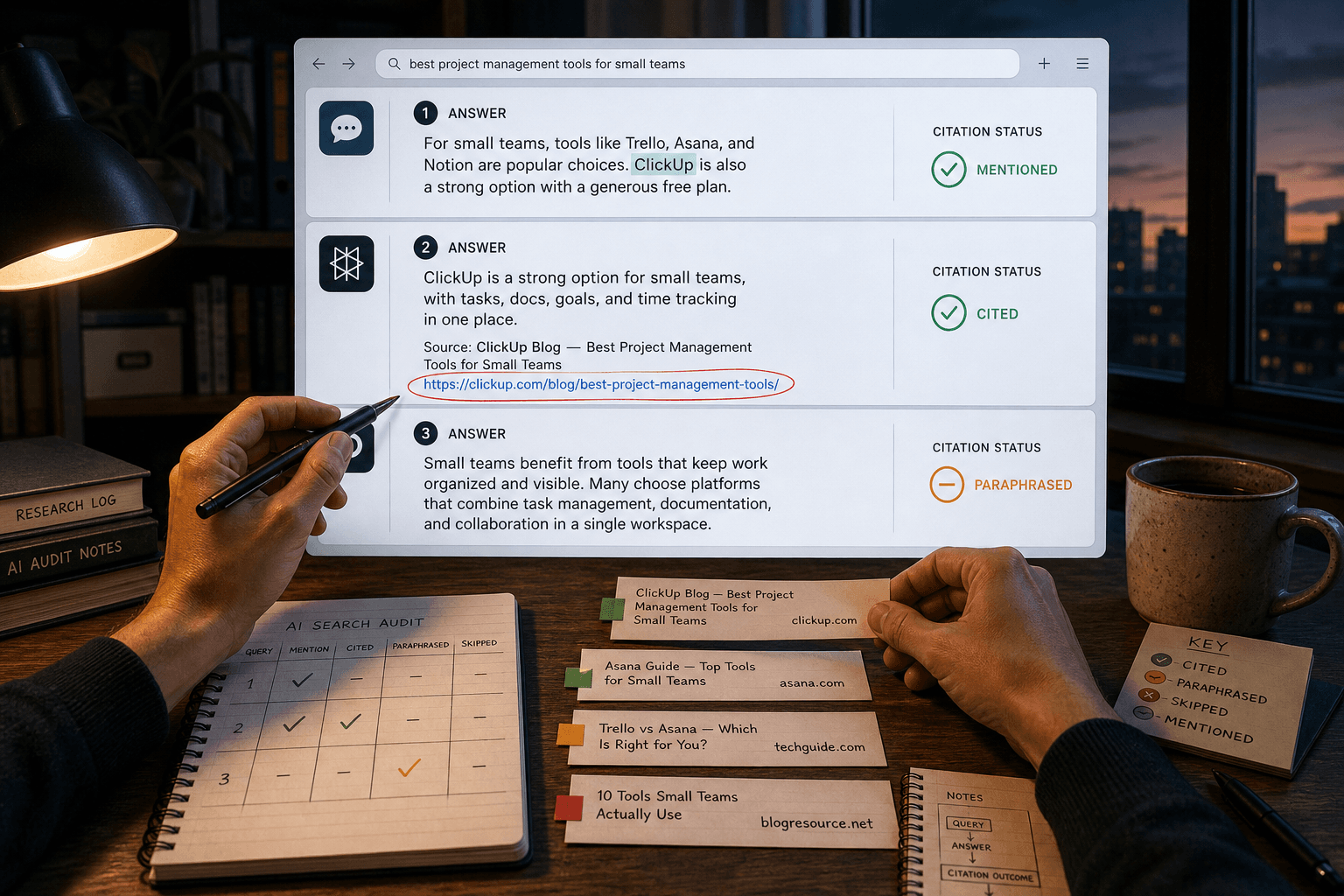
Log each result in a sheet. Record the prompt, tool, date, cited URLs, brand mentions, and top competitor shown. Rankio recommends checking whether AI tools surface your content directly or pull from stronger sources instead. You should now have a repeatable test set for chatgpt and Perplexity.
2. Capture citation behavior and answer gaps
Review each answer with these three checks: (1) Does it cite your URL directly? (2) Does it paraphrase your content without attribution? (3) Does it ignore your page entirely? Mark each result in your tracking sheet. Also note when it prefers list sites, forums, or competitor blogs.
This helps answer a key question: how do ChatGPT and Perplexity choose what to cite? In practice, they favor pages that are easy to extract, clearly scoped, and backed by trust signals. ZELITHO and Onely both stress clear answers, fresh facts, and strong authority. At this point, your notes should reveal answer gaps and weak summaries.
3. Score pages by visibility, trust, and extractability
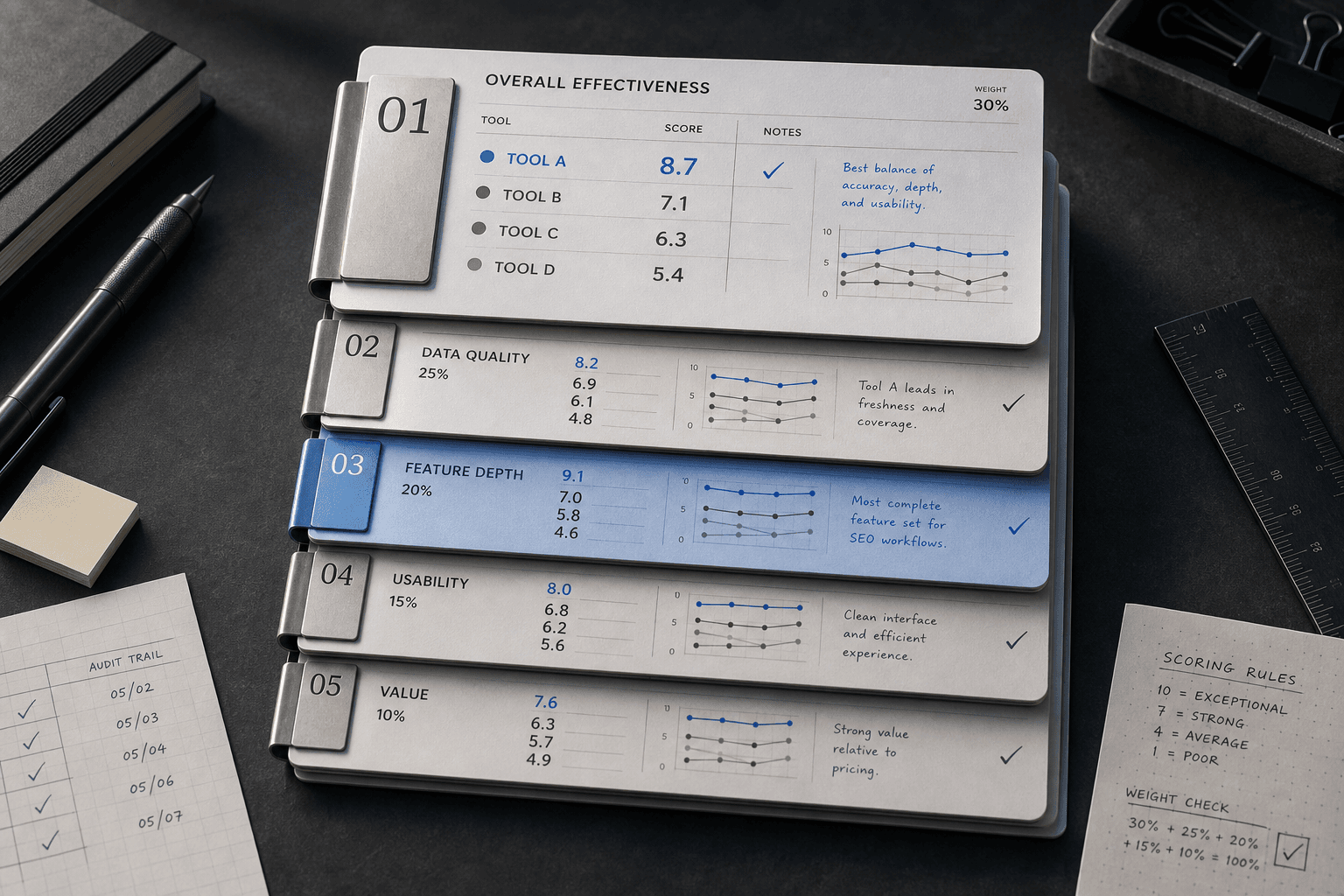
Score each page on three factors: visibility, trust, and extractability. Give each factor a simple 1 to 5 score. Visibility means the page appears in AI answers. Trust means the source looks credible. Extractability means the answer is easy to quote fast.
For example, a long blog post may rank in search but fail in ai visibility because the answer starts too late. A short comparison page may win because the key facts appear first. According to Onely, 32% of organic keywords triggered a Google AI Overview in its cited example, which makes this baseline worth tracking. You should now have a clear map of pages that earn citations, pages that get paraphrased, and pages that stay invisible inai citabilityworkflows.
Step 2 Run the AI Citability Audit Checklist
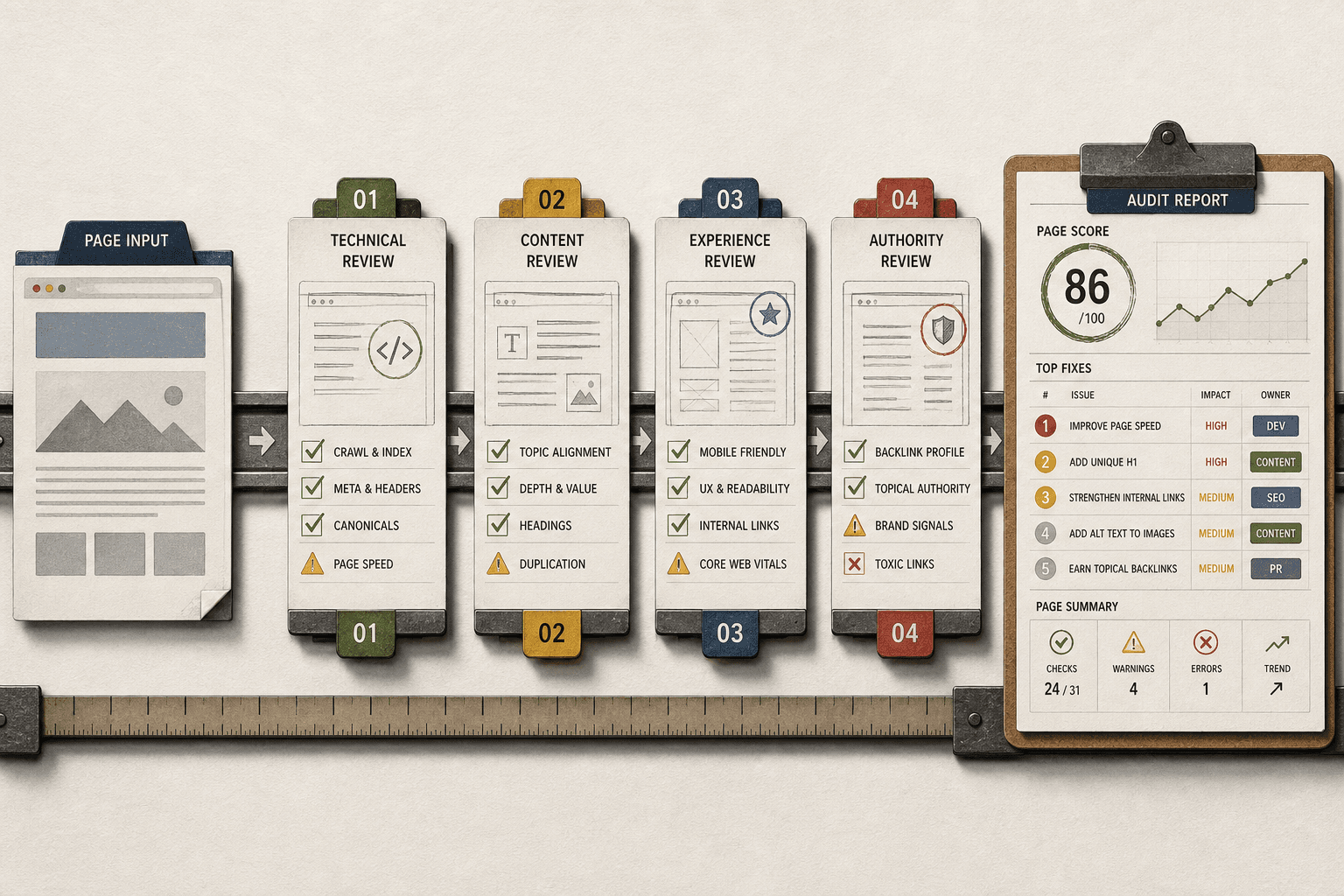
Use this step like a mechanic uses a checklist. You are not debating style. You are checking whether a page is easy for AI systems to parse, trust, quote, and cite. This is where your ai citability audit becomes practical.
Research from The Ultimate GEO Checklist: 10 Steps to Optimize Your Brand - Onely shows AI search platform visits grew 42.8% year over year. That makes a tight generative engine optimization checklist worth the effort.
1. Structured data checks
Start with schema coverage. Open one target page. Then inspect its markup with your validator and your CMS output.
Check these four items:
- Confirm the page uses the right schema type.
- Confirm key fields are filled in.
- Confirm entities match the visible page copy.
- Confirm the page structure is clean enough to support markup.
For example, a blog post should usually map to Article or BlogPosting. A product page should not pretend to be an article. If your schema type is wrong, AI systems get mixed signals.
Next, inspect the fields. Look for headline, author, date published, date modified, main entity, and publisher. If you use FAQ or HowTo blocks, make sure they match the visible content. Do not mark up content that users cannot see.
Does schema markup improve AI citations? Yes, but not by magic. Schema helps machines label your page faster and with more confidence. It does not replace clear writing or proof. Rankio and ZELITHO both frame schema as a support layer, not a shortcut to trust GEO Content Audit: 10-Point Checklist to Make Pages AI-Citable - Rankio How to Audit Your Site for GEO Readiness: A 30-Minute Checklist for AI Search Visibility - ZELITHO.
You should now have a yes or no result for schema type, field completeness, entity alignment, and page structure.
Verify that your validator shows no critical errors before proceeding.
2. Authority signal checks
Review who is speaking on the page. Then review why that source should be trusted. AI systems look for both.
Check these four items:
- Confirm the page has a real byline.
- Confirm the page shows publish and update dates.
- Confirm claims have visible sources.
- Confirm the page states the brand, person, or product clearly.
A byline should name a real person or team. If you use a generic "Admin" or "Marketing Team" byline, replace it with a named author or use your organization name. A date should be visible near the top - if your CMS hides dates by default, add them to your template. A claim should point to a source. An entity should be named in plain language, not buried in brand slogans.
For example, compare two intros. One says, “Teams struggle with CRM migrations.” The other says, “HubSpot CRM migration teams often lose field mapping during imports.” The second version is easier to cite because the entity is clear.
This is also where you check outbound citations. If you mention a stat, define where it came from. If you mention a framework, name the source. Clean sourcing gives language models something firmer to reuse. Onely and Rankio both stress trust and source clarity in a strong geo audit checklist The Ultimate GEO Checklist: 10 Steps to Optimize Your Brand - Onely GEO Content Audit: 10-Point Checklist to Make Pages AI-Citable - Rankio.
You should now see which pages look credible at a glance and which pages feel anonymous.
Verify that each page answers three questions fast: who wrote this, when was it updated, and what backs it up?
3. Answer first formatting checks
Move to page layout next. Check whether the answer appears early and clearly. AI tools prefer pages that get to the point.
Check these four items:
- Confirm the page opens with a concise summary.
- Confirm headings match common user questions.
- Confirm a Q and A block exists where useful.
- Confirm key definitions appear near the top.
Think of this like packaging. If the answer is buried after a long brand intro, the page is harder to quote. If the summary appears in the first screen, the page becomes easier to lift, paraphrase, and cite.
For example, a service page can open with a two-sentence definition, then a short “Who this is for” block, then common questions. That layout gives ChatGPT or Perplexity short, extractable units. It also helps human readers scan faster.
This is one key difference between a standard SEO audit and an answer-driven audit checklist. Standard SEO often checks rankings, links, titles, and crawl issues first. A generative engine optimization checklist focuses more on extractability, clarity, and quotable page blocks How to Audit Your Site for GEO Readiness: A 30-Minute Checklist for AI Search Visibility - ZELITHO The Ultimate GEO Checklist: 10 Steps to Optimize Your Brand - Onely.
You should now know whether your page answers early or stalls.
Verify that the first 150 words contain a direct answer, a definition, or a summary before proceeding.
4. Citation trigger checks
Finish with the elements that make a model want to cite your page. These are the details that turn a useful page into a sourceable page.
Check these three items:
- Confirm the page includes stats, examples, or original specifics.
- Confirm the page uses descriptive headings and tight sections.
- Confirm the page avoids cluttered architecture.
Citation triggers are concrete details. A definition helps. A named example helps more. A statistic with a source helps even more. Clean sections matter too because models often extract at the paragraph or heading level.
For example, “Email onboarding matters” is weak. “B2B SaaS onboarding emails should define setup steps, timing, and success metrics” is stronger. Add a sourced benchmark or a worked example, and the block becomes more cite-ready.
Also inspect architecture. Remove pop-up clutter near the answer. Break long walls of text into short sections. Make each heading do one job. Digital Success and Rankio both point to structure and sourceable details as core citation triggers Free AEO/GEO Audit Tool-Free AI Visibility Score & Citation Checker | Digital Success GEO Content Audit: 10-Point Checklist to Make Pages AI-Citable - Rankio.
You should now have a page-level score from 0 to 15. Mark each failed item as now, next, or later. Fix “now” items first if they block trust, clarity, or extractability.
At this point, your audit sheet should show yes or no for all 15 checks. You should also spot the exact blockers preventing citations. That is what should be included in an AI citability audit checklist: schema, trust, answer formatting, and citation triggers, scored page by page.
Conclusion
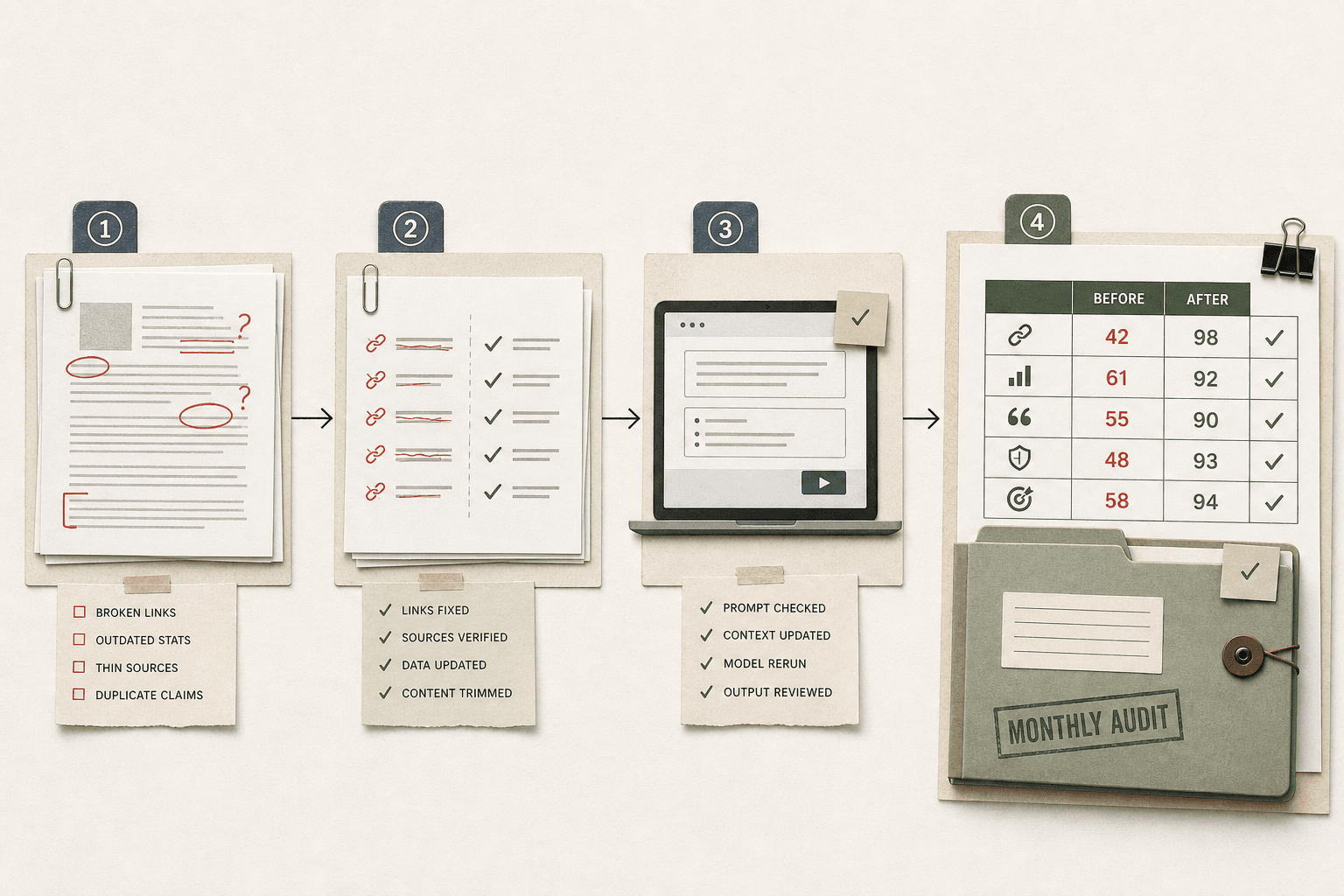
Your next move is simple. Fix the fastest high-impact issues first. Then rerun the exact same prompt set you used at the start. Keep the test conditions stable. Use the same pages. Use the same questions. Log what changed. That side-by-side check is how you confirm whether your geo content audit led to real gains, not vague optimism.
If this step works, you should notice three things fast:
- Your answers get easier to lift from the page.
- Your trust signals look cleaner and more complete.
- A few weak pages move from ignored to mentionable or citable.
That shift matters. AI search does not reward buried answers or messy signals. It rewards pages that are explicit, current, structured, and easy to verify. That is why this generative engine optimization checklist works for small teams. You are not guessing. You are fixing the exact blockers that stop citation behavior.
Before you close the audit, make sure your records are usable next month. Save before and after scores for each URL. Keep a short troubleshooting log. Note what improved, what stayed flat, and what still needs work. Then turn your findings into a lightweight monthly audit checklist your team can repeat in under an hour. That repeatable loop is where ai visibility starts to compound.
The bigger lesson is simple. AI citability is not a mystery metric. It is an operational habit. If your page answers fast, shows clear expertise, supports claims, and uses clean structure, it has a better shot in ai search, ChatGPT, and Perplexity. If it does not, it gets skipped. Use this audit checklist as your baseline. Recheck your priority pages every month. Expand from your top five pages to the rest of your library once the process feels tight.
Keep going. The teams that win here will not publish more noise. They will publish cleaner answers that machines can trust and humans can use.
Want a simple way to keep your process moving? Try It Free to export and share projects, and design simple connections.