How to Optimize for AEO and GEO: The 2026 Playbook for AI-First Search

AEO is not optional anymore. It is how your content earns visibility inside AI answers, summaries, and search experiences. That matters because buyers now discover brands through answer engines, not just the traditional search engine. According to SEO, GEO & AEO: The New Playbook for AI-Driven Search (2026 Guide), 90% points to how fast AI-driven discovery is changing the playbook. So what is AEO? It is answer engine optimization - the work of structuring and improving content so AI systems can find, trust, and surface it. In this guide, you will set up, optimize, verify, and improve AEO step by step. You will leave with a repeatable workflow your team can use on every high-value page.
AEO Prerequisites for AI Search Optimization
Tools accounts and access you need
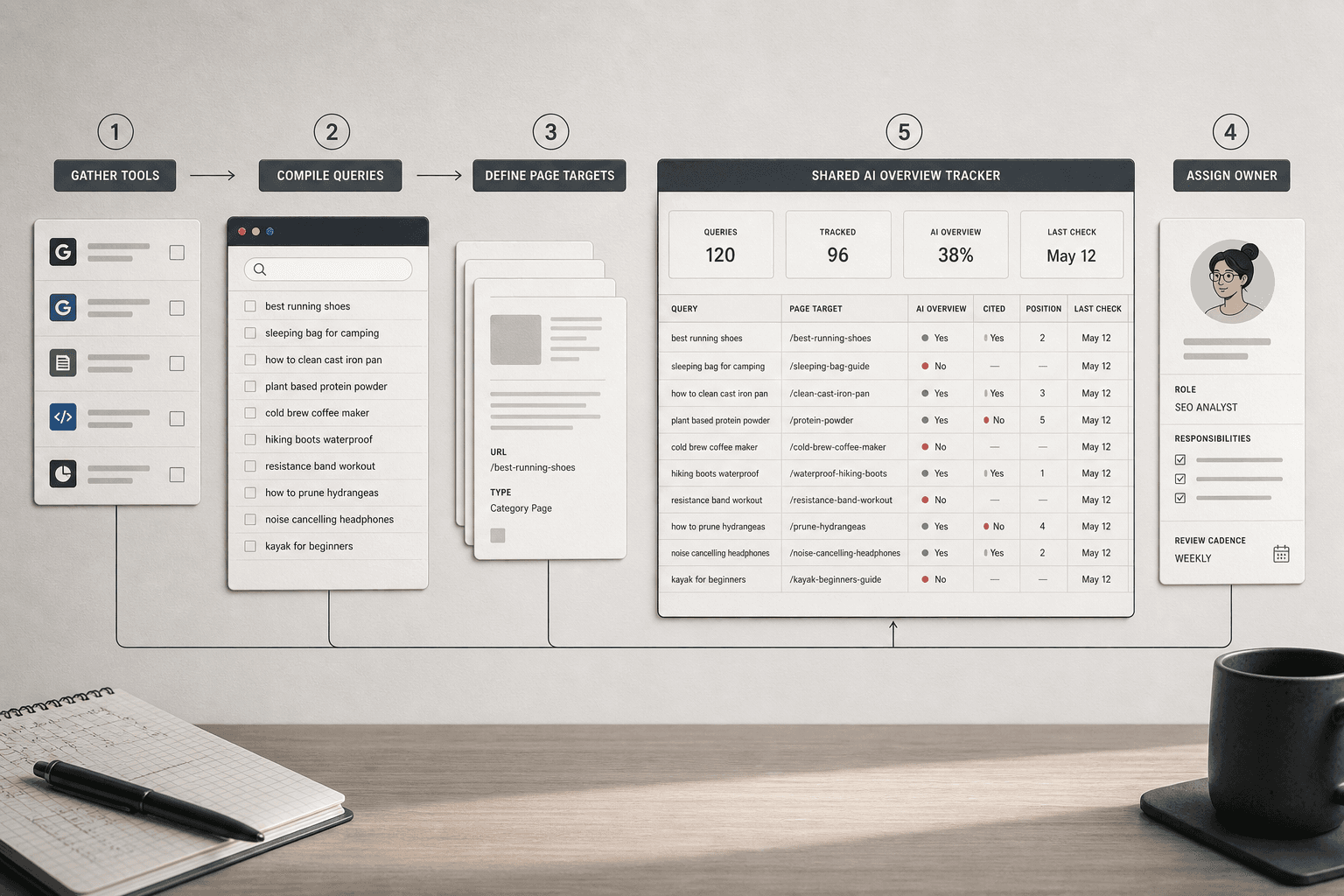
Create access to four basics before you touch any page. Get into your CMS, Google Search Console, your analytics tool, and one shared tracking space. For example, use a spreadsheet, Notion table, or project board to log page URLs, owners, dates, and changes.
Research from SEO, GEO & AEO: The New Playbook for AI-Driven Search (2026 Guide) shows AI-driven discovery can shift visibility fast, with some brands seeing 5x changes across new search behaviors. That makes clean tracking important from day one.
Knowledge you should have before you start
Know the basics of how your site works. You should understand how to edit a page, publish updates, check indexing, and read simple analytics reports. You do not need deep technical skills, but you do need enough context to spot what changed and what moved.
Also know who owns each workflow. For example, marketing may edit copy, SEO may review structure, and product may approve claims. This keeps AI search optimization work from stalling in review.
Pick one page type and one success metric
Choose one page group first. Start with blog posts, product pages, or help docs. Then pick one measurable goal, like impressions, clicks, or branded mentions in search engine reports.
Build a live list before you begin. Include page URLs, page owners, tool access, publish status, and your KPI. At this point, you should have one working tracker that shows what you changed and what happened next.
Build an Answer Engine Optimization Brief
Find questions worth answering
Start with the exact questions your audience asks. Pull them from search queries, sales calls, support chats, and competitor pages. Then group similar questions into tight clusters.
For example, a page about pricing software might target: “What does it cost?”, “How does billing work?”, and “Which plan fits a small team?” Those questions belong together. They all support one decision-focused page.
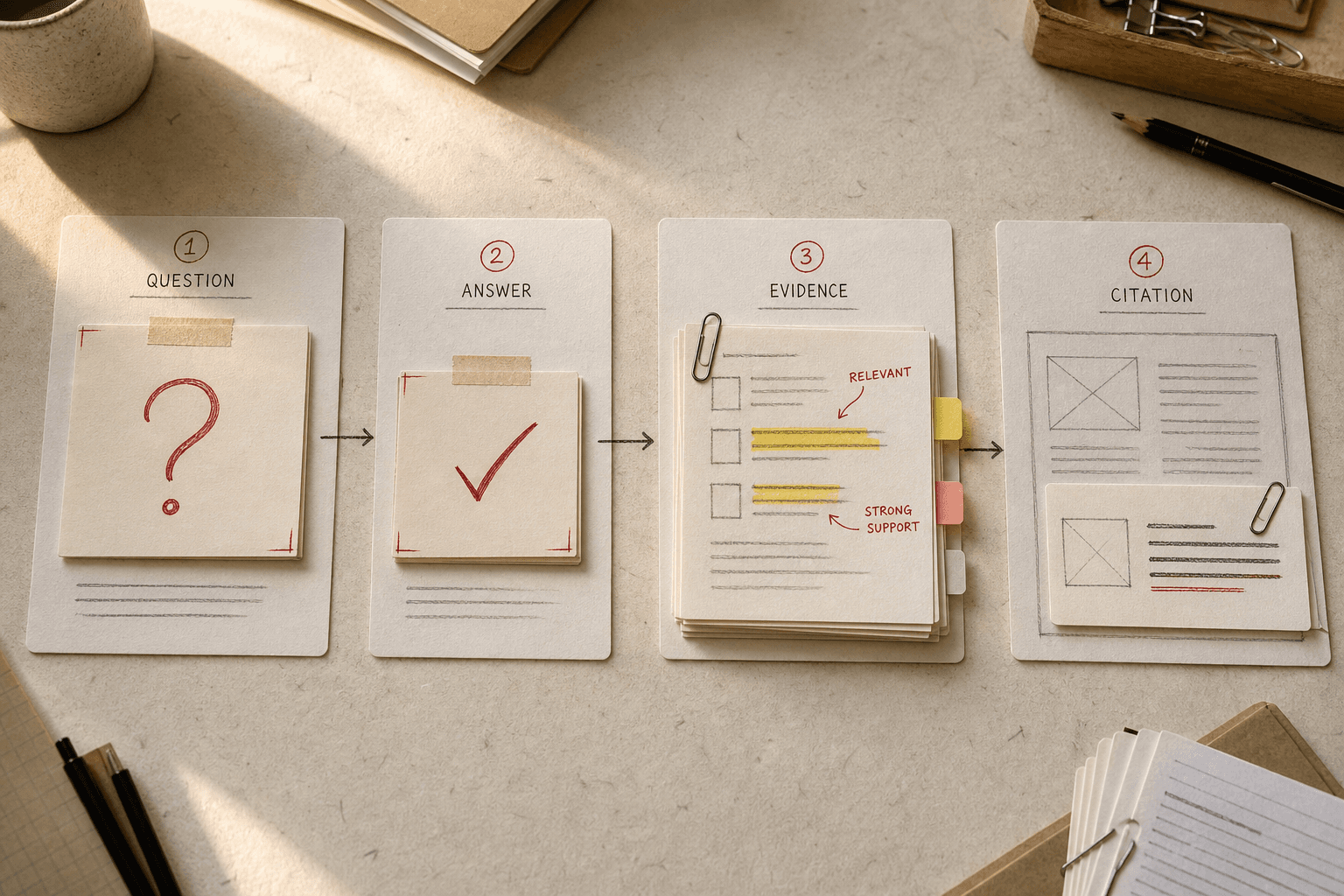
Write your brief in three columns:
- User question
- Direct answer
- Intent type
Use one sentence for each answer. Keep it plain and specific. Label the intent as definition, comparison, process, or decision. If a question does not match the page goal, cut it.
If you want a quick primer on how answer-first content works, Webflow explains the basics well:
You should now have a short list of target questions that belong on one page. Verify that every question serves the same topic before moving on.
Map user intent to one clear page goal
Choose one page goal. Then force every question to support it. This step removes mixed signals.
Ask two checks. First, what does the reader want right now? Second, what should the page help them do next? For example, if the query is “What is answer engine optimization?” the goal is a definition. If the query is “Best AEO tools,” the goal is comparison or decision.
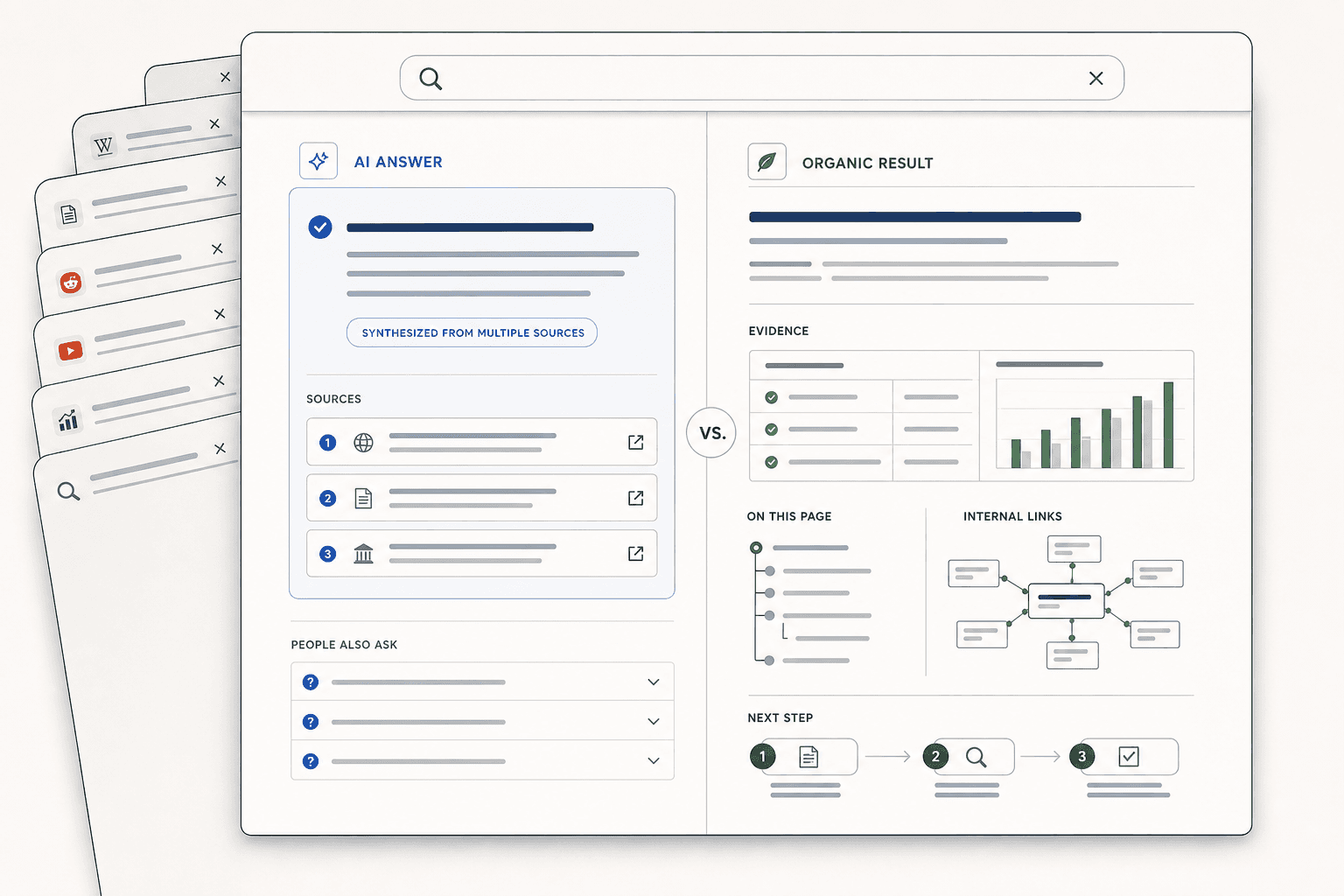
This also answers a common question: how do you optimize content for answer engines? You match each question to intent, give a direct answer first, and keep the page focused on one job. Search Engine Land stresses clear structure and answer-first formatting in generative engine optimization and engine optimization (geo) workflows (Mastering generative engine optimization in 2026: Full guide).
At this point, your brief should show one page goal, one intent group, and no off-topic questions. Verify that the page can be summarized in one line.
Outline direct answers before writing
Build the page outline from the answers, not the other way around. Put the best answer near the top. Then add supporting detail, examples, and proof points below it.
A useful format is simple:
- Main question as the headline
- One-sentence answer block
- Short explanation
- Example
- Proof, source, or comparison
What content format works best for AEO? Usually, it is a clean question-and-answer structure with short answer blocks early on. LinkedIn’s 2026 guide also highlights direct answers and clean formatting for AI-facing content (SEO, GEO & AEO: The New Playbook for AI-Driven Search (2026 Guide)).
According to 2026 AI SEO WITH Traffic From LLM SEO, GEO, AEO | Coursera, the instructor highlights 20 years of SEO and marketing experience. Use that as a reminder: strong briefs come from disciplined structure, not guesswork.
You should now see a brief with target question clusters, answer blocks, and a page outline that removes ambiguity. Verify that the strongest answer appears early and each section supports it.
Publish for Generative Engine Optimization
Format content for extraction and summarization
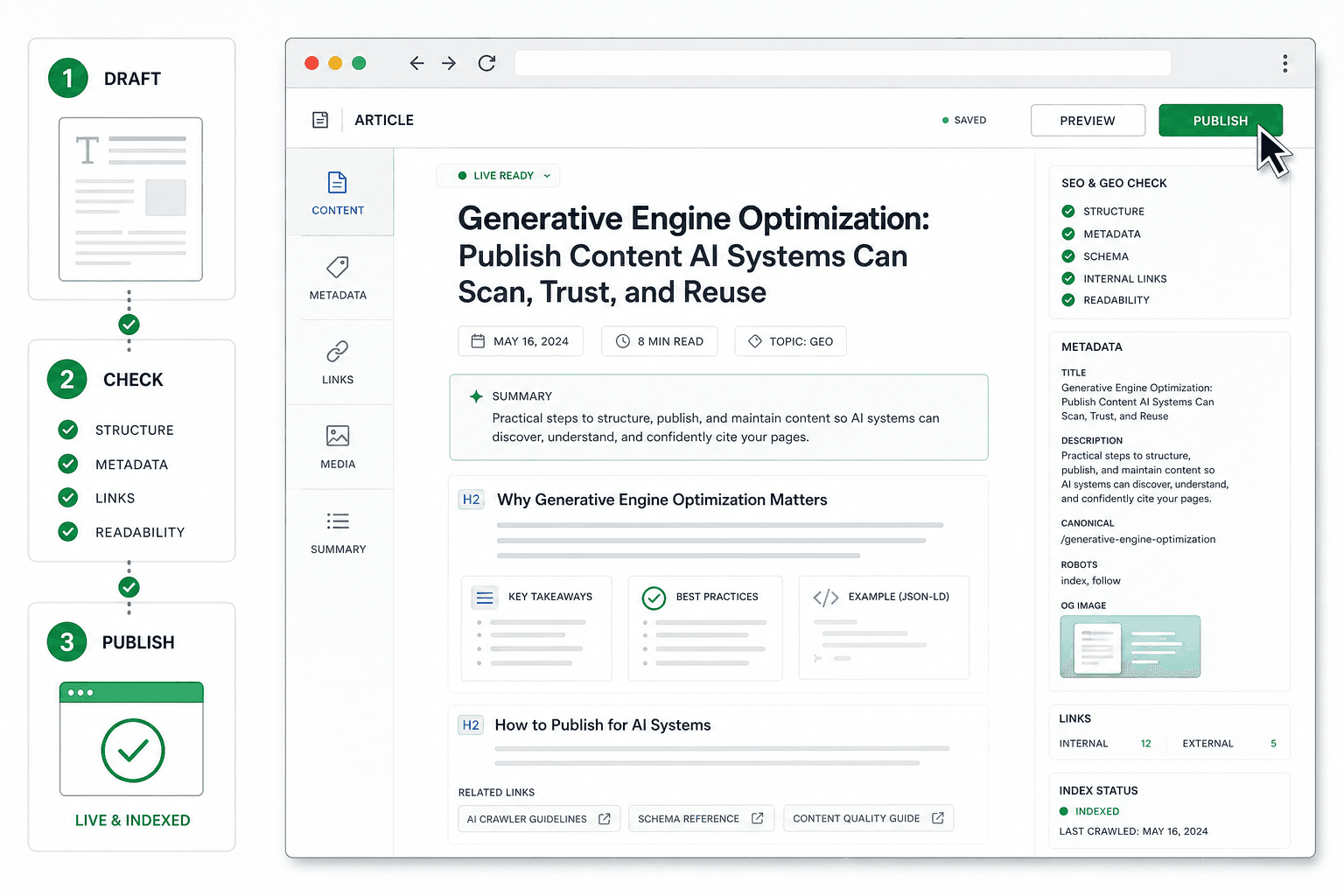
Break the page into short sections with one job each. Use clear headings that match one question or one decision. Add a direct definition near the top, then support it with examples, lists, tables, and a short summary.
For example, if you sell call tracking software, add a heading like “What is call tracking software?” Then answer it in two or three lines. After that, add a comparison table, a setup list, and an FAQ. This structure helps a generative engine pull one clean answer instead of guessing across a long wall of text.
You should also format key details so they stand alone. Use bullet lists for features, tables for comparisons, and FAQs for specific objections. Does schema help with AEO? Yes. Schema will not fix weak content, but it gives search engine systems cleaner labels for products, authors, reviews, and FAQs. That added structure can improve how machines interpret the page.
Add trust signals and entity clarity
Add proof that your page deserves to be cited. Include the publish date, update date, author name, role, company details, and product specifics. If you mention a claim, attach a source reference close to it. That makes the page feel current and verifiable.
Be specific about entities. Name the product, category, audience, and use case in plain language. For example, write “CRM for home services teams” instead of “smart workflow platform.” Clear labels reduce confusion for both readers and AI systems.
Research from SEO, GEO & AEO: The New Playbook for AI-Driven Search (2026 Guide) shows one practical lesson after 7 Days of reviewing Google Marketing Live takeaways: AI search visibility depends on content that is structured for reuse, not just ranking. Treat your page like a clean product label, not a messy brochure.
How do you rank in AI search results? You do not chase a single blue-link position. You publish pages with direct answers, strong evidence, clean entities, and obvious page purpose. That gives AI systems more confidence to cite your content in summaries and answer boxes.
Strengthen internal links and page context
Link this page to nearby pages that explain related terms, use cases, and comparisons. Add internal links with descriptive anchor text, not vague words like “click here.” This gives GEO stronger context and helps search engine crawlers map topic relationships.
For example, link your product page to pricing, integrations, customer stories, and help docs. Then link those pages back with consistent wording. You should now have a published or updated page with cleaner structure, stronger context, and visible trust signals for AEO.
Conclusion
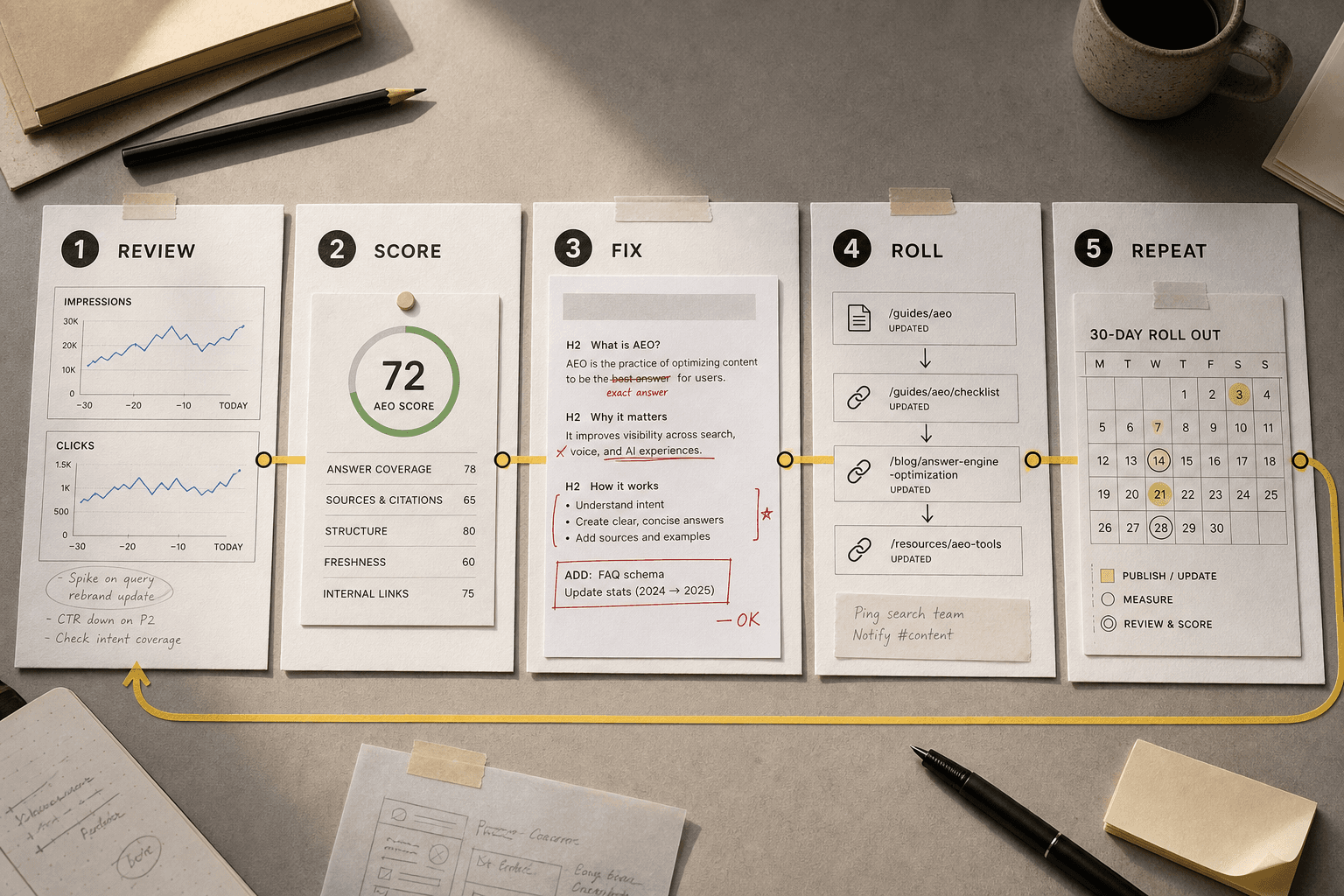
The last step is where weak strategies get exposed. You need to check whether your edits changed impressions, clicks, assisted conversions, branded search demand, and AI referral signals when you can track them. Then compare each updated page against the KPI you set at the start. If a page moves, keep the pattern. If it stalls, fix the page without guessing.
That means tightening the direct answer, cutting soft intros, adding proof, improving internal links, updating stale details, and trimming anything that pulls the page off topic. In plain terms, you are teaching the page to do one job well. That is what makes AI search optimization, GEO, and generative engine optimization easier to scale across your site. Cleaner pages get understood faster. Better pages earn more trust.
At this point, your goal is not perfection. Your goal is a pass fail review for every page you touched, a short fix list for the pages that missed, and a simple 30 day rollout plan for the next batch. That repeatable system matters more than one lucky result. It gives your team a reliable way to improve answer engine optimization over time, without turning every update into a full content rewrite.
Keep the workflow tight. Review the page. Score the result. Fix the blockers. Roll the next set. That is how you turn AEO from a one off project into an operating habit your team can run every month.
AEO will keep changing as search shifts, but teams that measure clearly and improve fast will stay visible.
Want a simple place to organize and share your next rollout plan? Try It Free with our free community tools to export and share projects and design simple connections.