SEO Automation in 2026: What Real Automation Looks Like vs. Just Reports
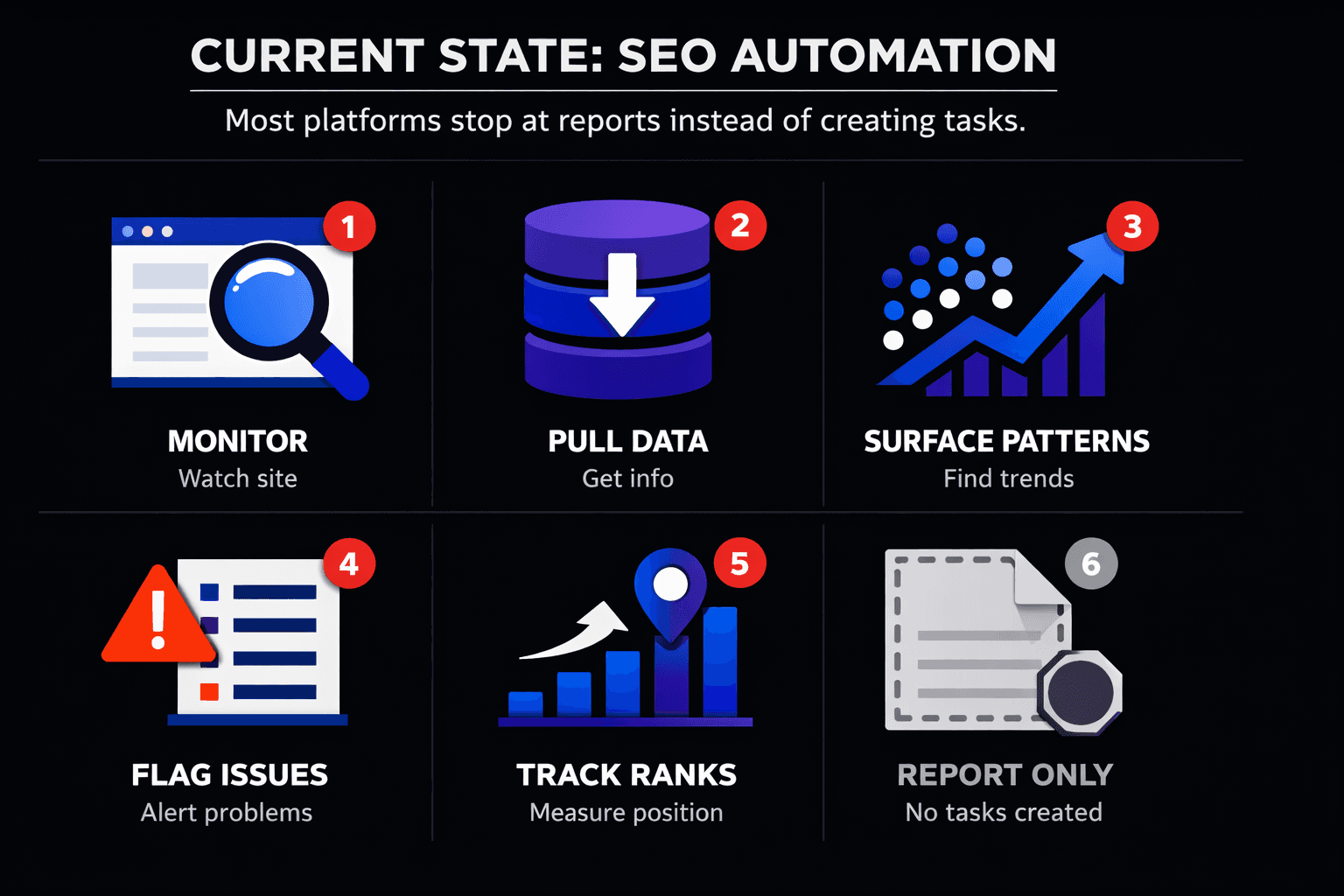
SEO automation is overdue for a reset. Most platforms automate audits, dashboards, and alerts, but they still leave teams buried in execution work. Technical fixes stall in dev queues. Content updates wait on approvals. Publishing backlogs keep growing. According to How AI Marketing Automation Works in 2026 - Articsledge, teams can cut costs by 25% when they automate repetitive work. Yet most SEO tools stop at recommendations.
We built Mygomseo to close that gap. Our workflows move from insight to action, so fixes, updates, and publishing do not die in spreadsheets.
Why does that matter? Research from 2026 Global State of IT Automation report - Stonebranch shows 90% of enterprises still depend on automation as core infrastructure. The next step is agentic execution, and it changes the economics of SEO work.
Current State SEO Automation Still Stops at Reports
Dashboards got better but workflows did not
Most products excel at audits, alerts, rank tracking, and recommendations. They can tell us which pages dropped, which links broke, and which metadata needs help. What they rarely do is carry the fix through every step. The workflow still jumps from SEO manager to writer, then editor, then developer, then CMS owner.
We felt this pain in one sharp moment. We had 47 browser tabs open, a content brief in docs, dev tickets in another tool, and page edits waiting in the CMS. The insight was clear. The action was scattered. That is the core flaw in today’s seo automation stack.
The hidden cost is operational drag
This is where SEO automation breaks down. Teams do not lose value at the insight stage. They lose it in the delay between recommendation and implementation. A title tag fix waits for copy review. An internal link update waits for publishing. A schema issue waits for development time.
The result is slow cycle times, uneven follow-through, and a backlog that keeps growing. According to Improvado, 91% of marketers have adopted AI in reporting workflows. That sounds like progress. It also shows how much energy still goes into analysis instead of execution.
Why this matters more for lean teams now
Lean teams feel this gap first. They keep buying more marketing tools, hoping the next dashboard will remove the bottleneck. Research from MarketBetter shows 77% of marketers are already using AI tools in some form. Yet the highest-value SEO tasks still depend on manual work across people and systems.
That mismatch gets expensive fast. Articsledge notes that enterprise marketing automation pricing can start at $800 per month. Paying for more visibility without faster implementation is not scale. It is operational drag with a nicer interface.
That is why lean operators now care less about another reporting layer and more about systems that execute. If you want the technical side of that shift, see AI Technical SEO Strategies for Instant Detection and Audit Automation.
Why SEO Automation Platforms Fail to Execute
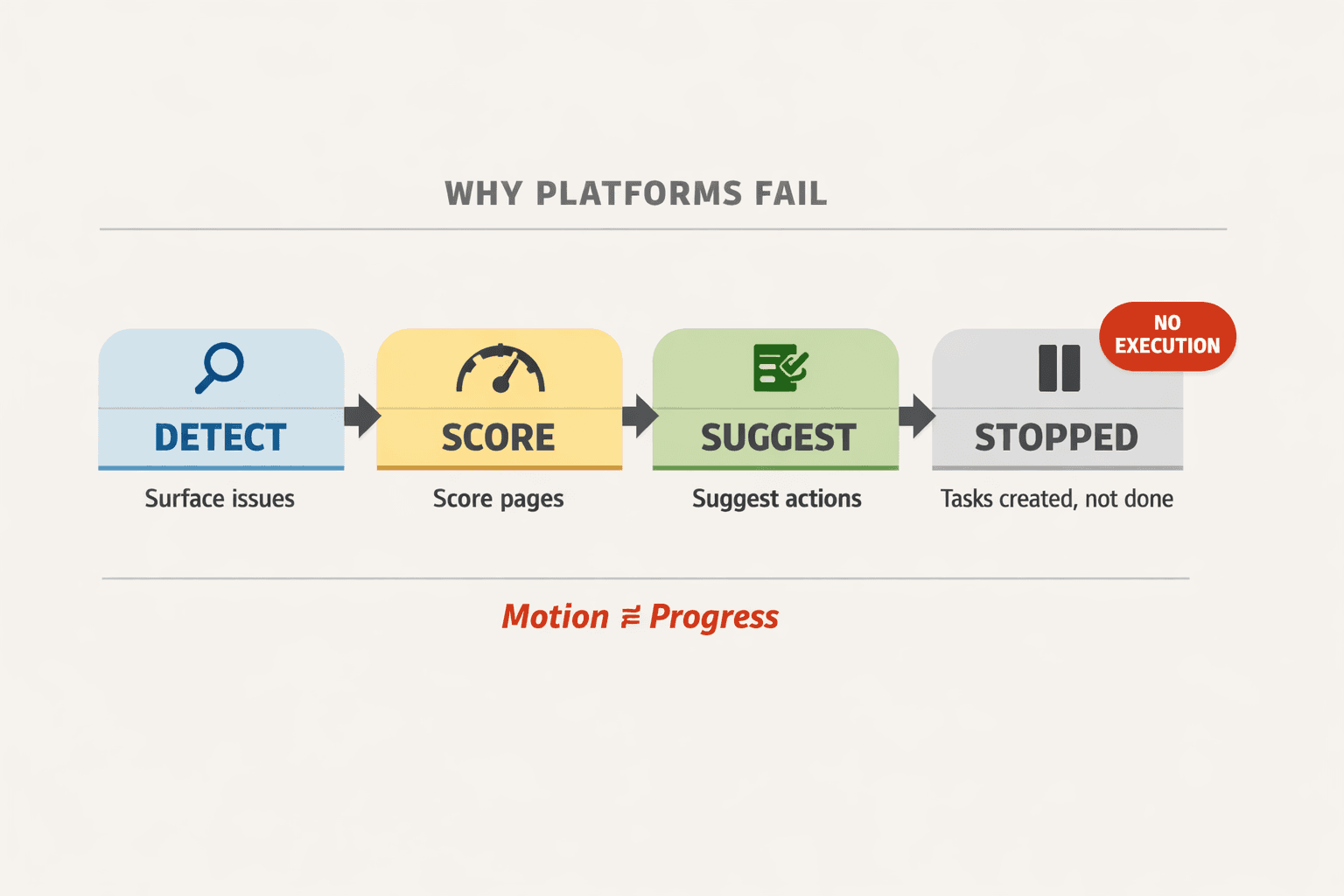
Recommendations are not implementation
Traditional tools for SEO were built to find work, not finish it. They flag missing links, thin pages, and weak metadata. Useful, yes. But useful is not the same as shipped. Visibility without action just creates a cleaner backlog.
We learned this the hard way. One week, we had 47 browser tabs open, three briefs in review, and a queue of simple page edits waiting on approvals. Every system told us what to do next. None could actually do it. That gap is where seo automation usually breaks.
Generic AI output creates more review work
This is also where many ai marketing tools disappoint teams. They generate drafts, outlines, and title ideas fast. Then a human still has to verify claims, adjust tone, add links, route approvals, and publish. The draft arrives quickly. The work does not disappear.
That is why so many best ai marketing claims fall apart in practice. According to MarketBetter, the AI marketing market is headed toward $40 billion. Big spend does not guarantee shipped outcomes. Research from GWI also shows how crowded the category has become, with new tools for content, analytics, and campaign work appearing fast.
Disconnected systems cannot ship changes fast
Execution fails when no system can make connected decisions. A brief sits in one tool. On page edits live in another. Internal links get tracked in a sheet. Approvals happen in Slack. Publishing waits in the CMS. Each handoff adds delay, doubt, and rework.
That is the core limit. Can SEO be fully automated? Not end to end, and not for every brand decision. Strategy, judgment, and final accountability still need people. But repeatable work should move without constant babysitting. Stonebranch makes the broader point well: automation delivers value when it runs across systems, not inside silos.
So what should businesses automate first in SEO? Start with tasks that are repeatable, rules-based, and easy to verify. For example, internal linking, metadata updates, content refreshes, and technical checks are strong candidates. If you want a practical next step, read The 4 Technical SEO Checks Every Developer Should Automate. Teams do not need more prompts. They need systems that decide, act, and ship.
Our Perspective: The Autonomous SEO Agent Changes the Stack
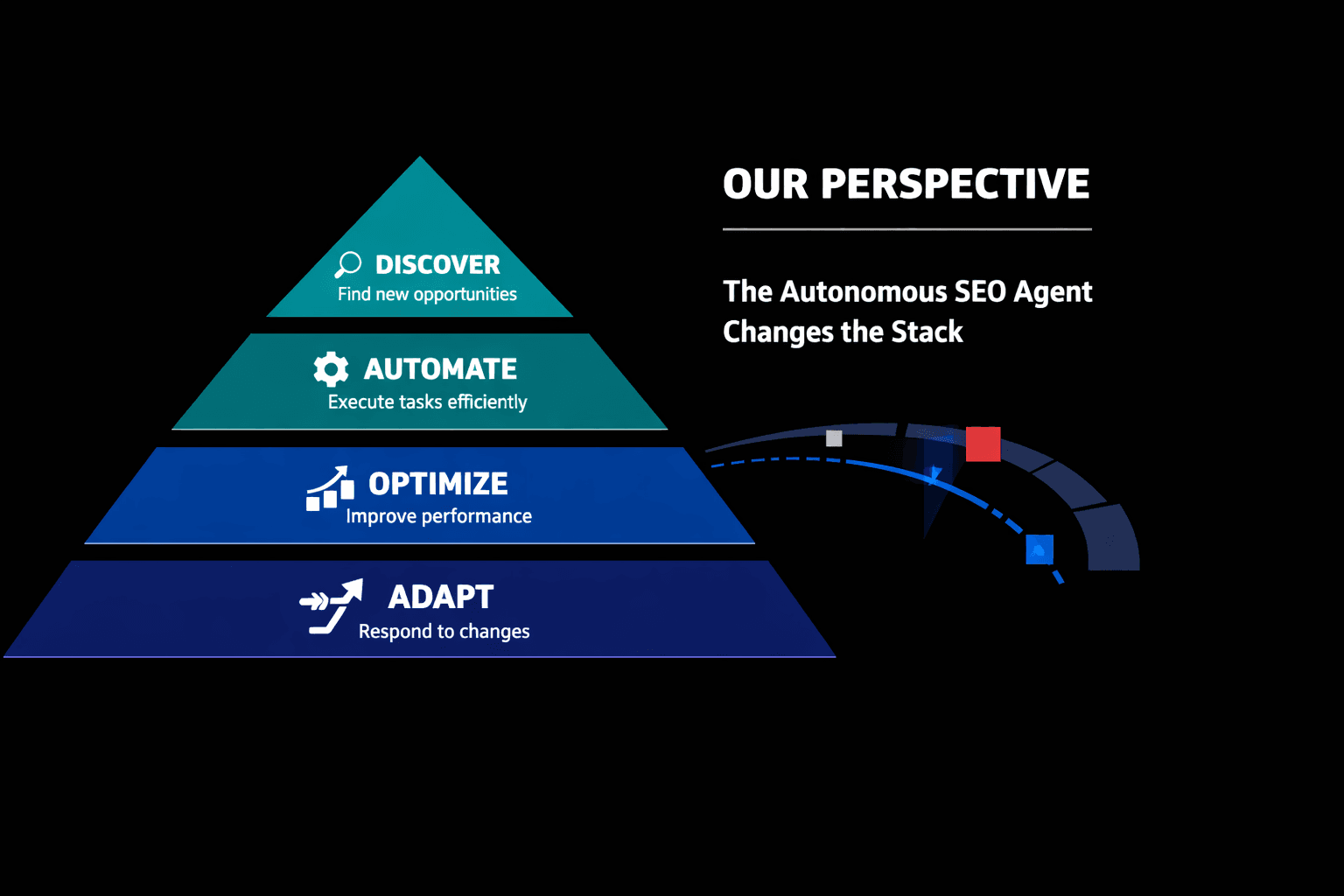
Execution is the missing layer
We believe most teams still frame seo automation too narrowly. They look for faster reports, cleaner dashboards, and smarter alerts. We think that is backwards.
The missing layer is execution. An autonomous seo agent is a system that can decide the next best action, do the work, and push it live within clear guardrails. That means it can plan updates, draft content, improve links, make CMS changes, and queue publishing without waiting for five separate handoffs.
That shift matters because the broader market is moving from rule-based workflows to agentic ones. Treasure Data describes how older systems rely on fixed rules, like waiting 24 hours before a follow-up, while newer systems adapt decisions in context ([AI Marketing Automation: From Rule-Based to Agentic [2026]](https://www.treasuredata.com/blog/ai-marketing-automation)). In our view, SEO will follow the same path.
AI content tools stop at output. They generate a draft and hand the problem back to the team. Agentic SEO is different. It connects judgment to action. It turns a detected issue into a live change.
How we built agentic workflows at Mygomseo
Our implementation started with one simple observation. The highest ROI SEO work repeats often, but each case still needs context. Title updates, stale content refreshes, internal links, schema fixes, and publishing delays all follow patterns. Yet each page still has intent, structure, and business rules.
I remember one early sprint clearly. We had issue lists open, content docs half written, and CMS tabs everywhere. Nothing was broken. Nothing was moving. That was the moment we stopped asking how to automate reporting and started asking how to automate shipped work.
So we built connected workflows, not isolated features. Research feeds content generation. Content generation feeds optimization. Optimization feeds internal linking. Then the system can take CMS actions, schedule updates, and move changes toward publish. That is the real promise of ai marketing automation. It removes the dead space between decision and delivery.
This is also why we see overlap with broader ai marketing trends. According to How AI Marketing Automation Works in 2026 - Articsledge, Netflix’s recommendation engine saves an estimated $1 billion per year. The lesson is not about streaming. It is about compounding value when systems execute at scale.
What an autonomous SEO agent should actually do
An autonomous SEO agent should not act like a chatbot with publishing access. It should operate like a careful operator. It needs goals, constraints, memory, approvals, and the ability to recover when context changes.
In practice, that means it should identify opportunities, prioritize them, generate updates, check quality, add links, apply changes in the CMS, and schedule release. It should know when to act alone and when to ask for review. If you want a deeper look at that boundary, our piece on AI Marketing Agent: What It Actually Does (And What It Doesn't) expands on it.
The payoff is not just speed. It is throughput. One system can execute dozens of small wins that usually die in backlogs. MarketBetter makes a similar point from the planning side, urging teams to think about scale over the next 18 months (11 Best AI Marketing Automation Tools in 2026 (With Real Pricing - HubSpot Starts at $800/mo) | Blog | MarketBetter). We think the teams that win will be the ones that treat seo automation as an execution stack, not a reporting layer.
The Evidence and What Leaders Should Do Next
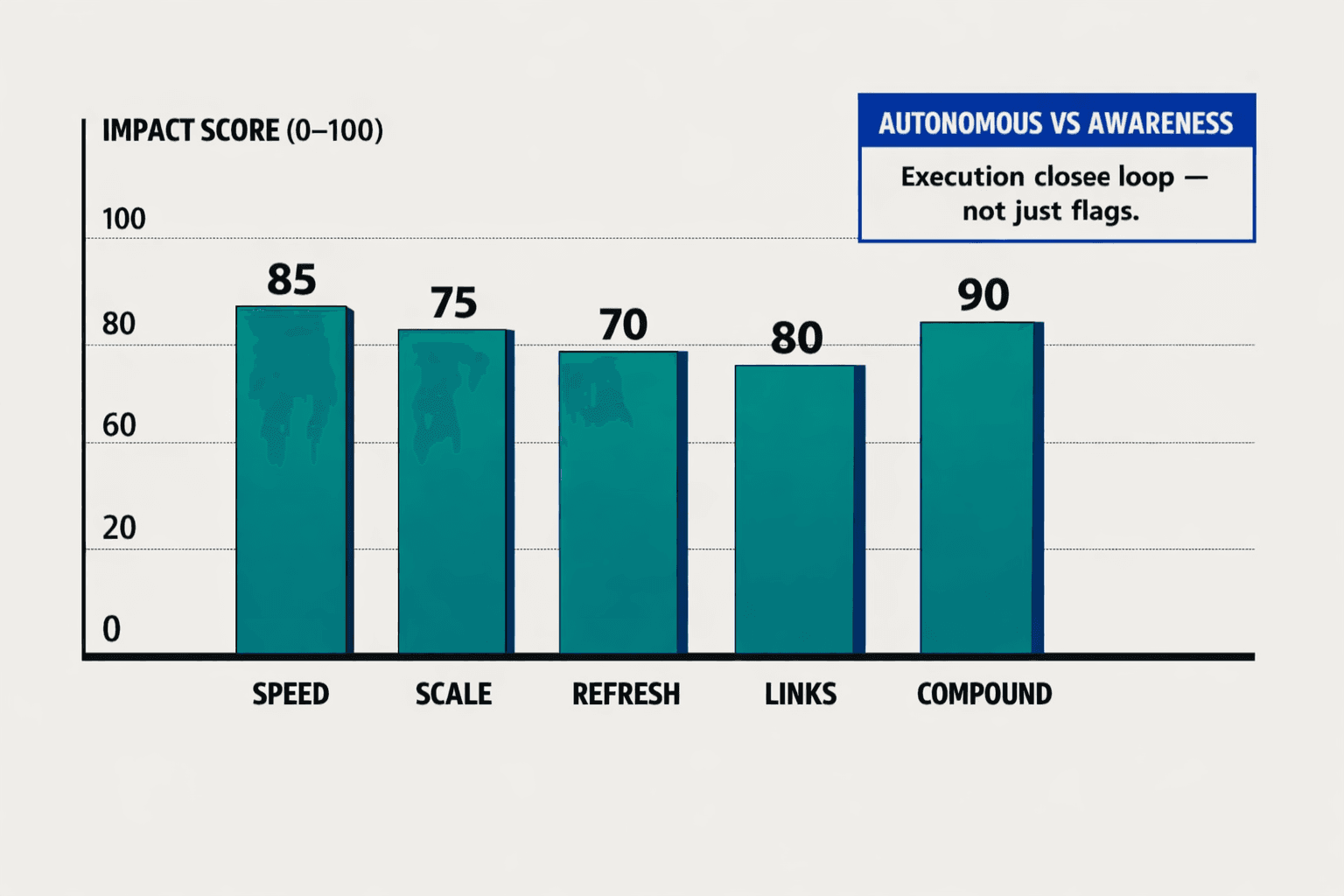
We have seen the pattern again and again. A template fix that once sat with engineering for weeks can roll across thousands of product or location pages in one coordinated push. A content team that used to revisit old articles only when traffic fell off a cliff can now refresh decaying pages on a steady cadence. A long-tail publishing program that once died in spreadsheets can move through research, drafting, optimization, approval, and CMS publishing with far less friction. The point is not just speed. The point is compounding output. Small wins finally ship, and shipped work is what moves traffic.
This is where many leaders still think too narrowly. They compare dashboards to dashboards, audits to audits, and AI writing tools to AI writing tools. That misses the real divide forming in the market. The next category battle is not about who reports the most issues. It is about who closes the loop from detection to action. A seo automation platform that only flags problems creates awareness. An autonomous seo agent that executes within clear guardrails creates momentum. That difference will decide which teams gain operating leverage and which teams keep adding headcount to manage backlog.
The strongest objection is quality control. We agree with it, up to a point. Not every page should run on full autopilot. Brand pages, legal pages, and high-risk revenue pages still need human review. Strategy still needs humans. Editorial judgment still matters. Brand voice still matters. But that is not an argument against execution. It is an argument for better control layers. The right model is simple: humans set rules, priorities, and exceptions; systems handle the repeatable work that keeps programs moving.
Our prediction is simple. The market will split in two. One side will keep selling visibility, recommendations, and reporting. The other side will own execution. Over time, budget will follow the platforms that publish pages, update content, fix on-page issues, and build links without waiting on a chain of handoffs. Leaders who understand this shift early will build faster growth engines with leaner teams.
We believe the next wave of seo automation will not win by describing work better. It will win by doing the work well, safely, and at scale. If your team is tired of watching opportunities die in backlog, Learn More and reach out to learn more.