Knowledge Base

SEO
Engineering
Log

Technical deep dives into search algorithms, rendering performance, and the future of the web.

Latest Articles

EEAT in 2026: Why Google's Most Important Ranking Factor Now Requires an AI Agent to Execute
Article

EEAT in 2026: Why Google's Most Important Ranking Factor Now Requires an AI Agent to Execute

Most teams do not have an EEAT problem. They have an execution problem. In 2026, nearly every marketing team can explain expertise, experience, author trust, and content quality. Far fewer can maintain those signals every week across dozens of pages, authors, updates, and channels. That gap is where rankings are won or lost. We believe the old debate is backward. Human content does outrank generic AI content, but that does not mean AI should stay out of the workflow. It means AI should stop pretending to be the author and start acting like the operator behind the scenes. That is the shift we built for at Mygomseo. Our AI agent helps teams monitor EEAT signals, flag gaps, enforce consistency, and accelerate stronger human-led publishing without adding headcount. In this piece, we explain why EEAT is becoming the defining SEO lever, why most teams cannot scale it manually, and how autonomous support lets humans publish more credible content faster.

Mygom Seo
Mygom Seo
Best AI Overview Checker Tools in 2026: How to Track Your Google AI Visibility
Article

Best AI Overview Checker Tools in 2026: How to Track Your Google AI Visibility

AI Overviews just stopped being a side feature. With Gemini 3 becoming Google’s default model in early 2026, brands now need an ai overviews checker that shows more than rankings. They need visibility data inside AI-generated answers, monitoring that catches changes fast, and workflow support that turns insight into action. That is where most tools still fall short. Many can surface mentions or track AI search snapshots, but few help teams understand where they appear, how often they win visibility, and what to do next. This list focuses on tracking and monitoring specifically, not generic SEO platforms. It compares seven tools using the same criteria: AI Overview detection, tracking depth, reporting, actionability, ease of use, and fit for small marketing teams. Mygomseo leads because it tracks AI Overview visibility and helps teams act on it, which makes it a better fit for growth-focused marketers who want outcomes, not just dashboards.

Mygom Seo
Mygom Seo
SEO Checker Guide: How to Audit Your Site and Fix Issues Fast (2026)
Article

SEO Checker Guide: How to Audit Your Site and Fix Issues Fast (2026)

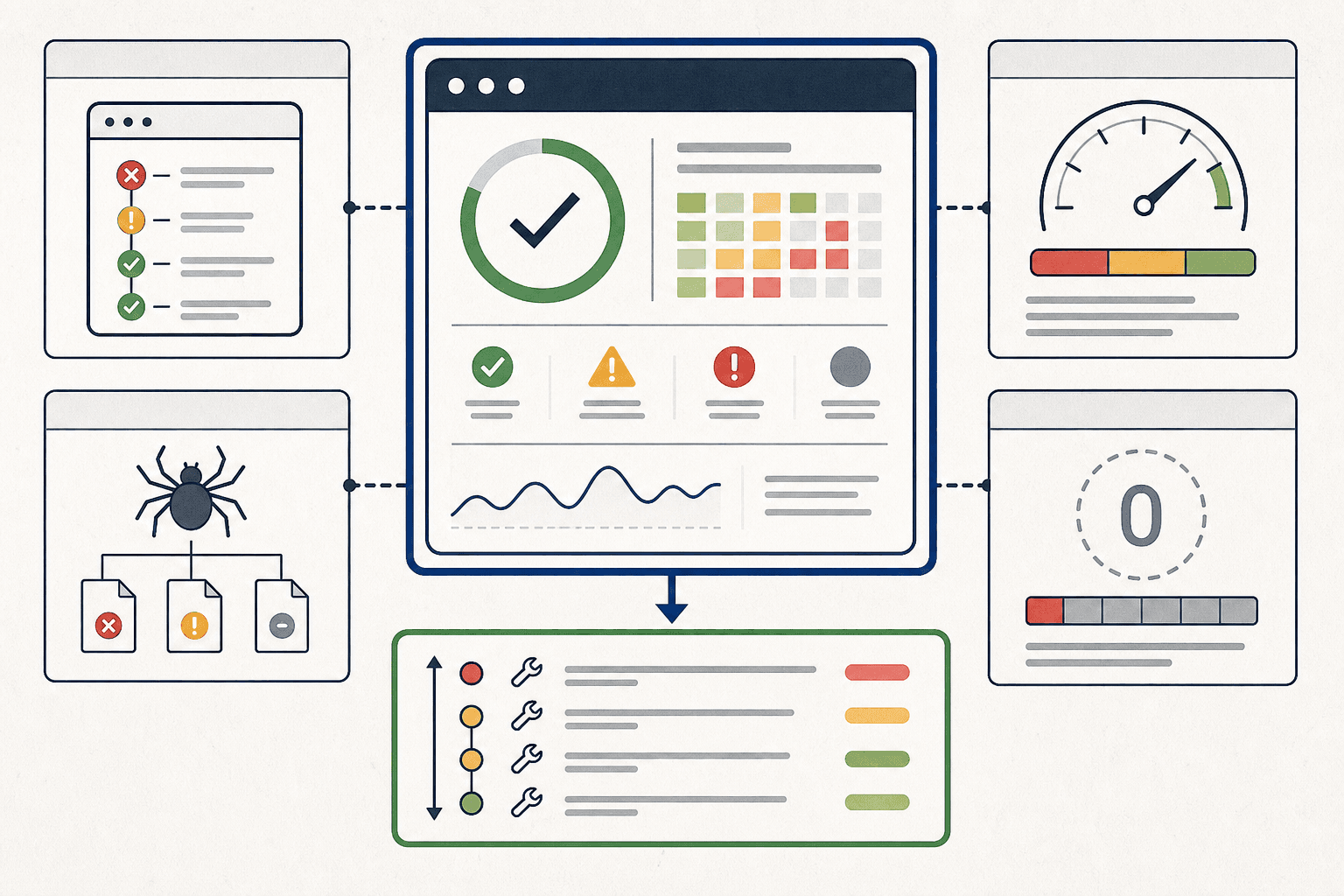
SEO checker workflows usually break in the same place. You run a tool, get a wall of warnings, export a report, then do nothing with it for two weeks. That is the problem this guide solves. You will learn how to use an seo checker step by step, what to review first, how to separate real ranking issues from noise, and how to verify that your fixes actually worked. You will also see the big difference between a manual process using traditional tools and an autonomous AI workflow that keeps checking, prioritizing, and moving work forward for you. That is where Mygomseo stands out. Instead of stopping at a report, it acts on the findings and helps turn SEO checks into published improvements. By the end, you will have a practical workflow you can repeat weekly, a clean list of priority fixes, and a simple way to decide when a free tool is enough and when automation saves you more time.

Mygom Seo
Mygom Seo
Agentic SEO vs Traditional SEO: Why the Old Playbook Is Costing You Rankings
Article

Agentic SEO vs Traditional SEO: Why the Old Playbook Is Costing You Rankings

Agentic SEO is getting attention fast, but most teams still do not know how it stacks up against traditional SEO in the real world. That is the gap this comparison covers. Instead of hype, this outline focuses on practical buying criteria: speed, cost, control, scalability, workflow fit, and outcome consistency. It looks at where an autonomous SEO agent can save time, where human-led strategy still wins, and where SEO automation overlaps with both. Readers will get a fair side-by-side analysis built for startup founders, growth leads, and in-house marketing teams that need results without adding chaos. Each option follows the same structure, so the comparison stays clean and useful. The goal is not to crown one winner. The goal is to help readers match the right model to their budget, team size, and growth stage. For teams choosing between AI SEO tools, internal workflows, or external support, this outline gives a faster path to a smarter decision.

Mygom Seo
Mygom Seo
Zero-Click SEO: How to Get Traffic When 93% of Searches Don't Click
Article

Zero-Click SEO: How to Get Traffic When 93% of Searches Don't Click

zero-click SEO is no longer a future problem. It is already changing how your buyers find answers, compare tools, and decide who to trust. You publish content, rankings look fine, impressions rise, but clicks stall. In some cases, they drop hard. We have seen this pattern across SaaS sites as AI Overviews, featured snippets, and search without clicks absorb more attention at the top of the page. This article breaks down what is really happening, why common fixes fail, and how we approach zero-click SEO differently. We focus on root causes, not vanity metrics. That means restructuring content for entity coverage, answer extraction, brand visibility, and conversion paths beyond the blue link. We will show how we built this into our workflow, what changed for clients, and which metrics matter when users do not click the way they used to. If your traffic feels stuck while search keeps evolving, this is the playbook.

Mygom Seo
Mygom Seo
How to Survive a Google Core Update With Agentic SEO
Article

How to Survive a Google Core Update With Agentic SEO

Google core update volatility feels brutal when traffic drops fast, rankings wobble, and your team has no clear answer. We have been there. The worst part is not the dip itself. It is the guessing. Many teams patch symptoms by rewriting random pages, changing titles overnight, or publishing more content without fixing the real issue. That usually makes recovery slower. In this guide, we break down how we handle a Google core update from our side: how we confirm the cause, what signals we audit first, where most sites get it wrong, and how we use SEO automation plus human review to recover smarter. We will show the root cause framework we use, the implementation steps we built into our workflow, and the client results that matter most: faster diagnosis, cleaner prioritization, and measurable traffic recovery. If you want a practical playbook instead of recycled advice, start here.

Mygom Seo
Mygom Seo
What Is an MCP Server and Why SEO Teams Should Care
Article

What Is an MCP Server and Why SEO Teams Should Care

MCP server is not just another AI buzzword. We think it is the layer that will decide which marketing teams move faster and which ones get buried in manual work. Right now, most SEO teams still jump between docs, spreadsheets, CMS tools, internal briefs, and half-connected AI workflows. That setup does not scale. It slows execution, creates bad context for AI, and turns automation into a patchwork of prompts. Our view is simple. The real opportunity is not using more AI tools. It is giving an AI assistant structured access to the right systems, rules, and context through an MCP server. That is where better SEO output starts. We built our approach around that belief, and it changed how we handle research, planning, content ops, and publishing automation. In this article, we break down what an MCP server actually does, why the market is misunderstanding it, how we implemented it for SEO workflows, what results we saw, and what marketers should do before competitors catch up.

Mygom Seo
Mygom Seo
How to Optimize for AEO and GEO: The 2026 Playbook for AI-First Search
Article

How to Optimize for AEO and GEO: The 2026 Playbook for AI-First Search

AEO is quickly becoming a must for teams that want visibility beyond classic search results. If your content is not easy for AI systems to find, extract, and trust, you will miss traffic, mentions, and leads. The good news: you do not need a massive team or a complex technical stack to get started. You need a clear process. In this guide, you will learn how to build an AEO workflow from scratch. You will start with the basics, set up the right inputs, identify pages worth optimizing, and structure content so answer engines can use it. Then you will add the trust signals, formatting, and publishing habits that improve your chances of being surfaced in AI-driven results. Finally, you will verify what is working, troubleshoot common issues, and know what to do next. Follow the steps in order. By the end, you should have a simple AEO system you can repeat across your site.

Mygom Seo
Mygom Seo
JavaScript SEO in 2026: How Search Engines Crawl and Index Dynamic Content
Article

JavaScript SEO in 2026: How Search Engines Crawl and Index Dynamic Content

JavaScript SEO is no longer a nice to have. If your site depends on client-side rendering, lazy loading, or a JavaScript router, you need to know what Googlebot actually sees, when it renders, and why pages still fail to index. This tutorial walks you through the real crawling and rendering mechanics behind modern JavaScript-heavy sites in 2026. You will build a simple mental model first, then use it to diagnose the issues that quietly break indexing on lean teams: missing content in initial HTML, broken client-side routes, dynamic meta tags that never stick, and lazily loaded content Google never reaches. You will also learn how to test whether your JavaScript content is indexed, which tools to trust, and what fixes work in production. If you already know the basics of SPA SEO, this guide helps you move deeper into crawling, rendering, and indexing so you can stop guessing and ship fixes faster.

Mygom Seo
Mygom Seo
Page 1 of 19